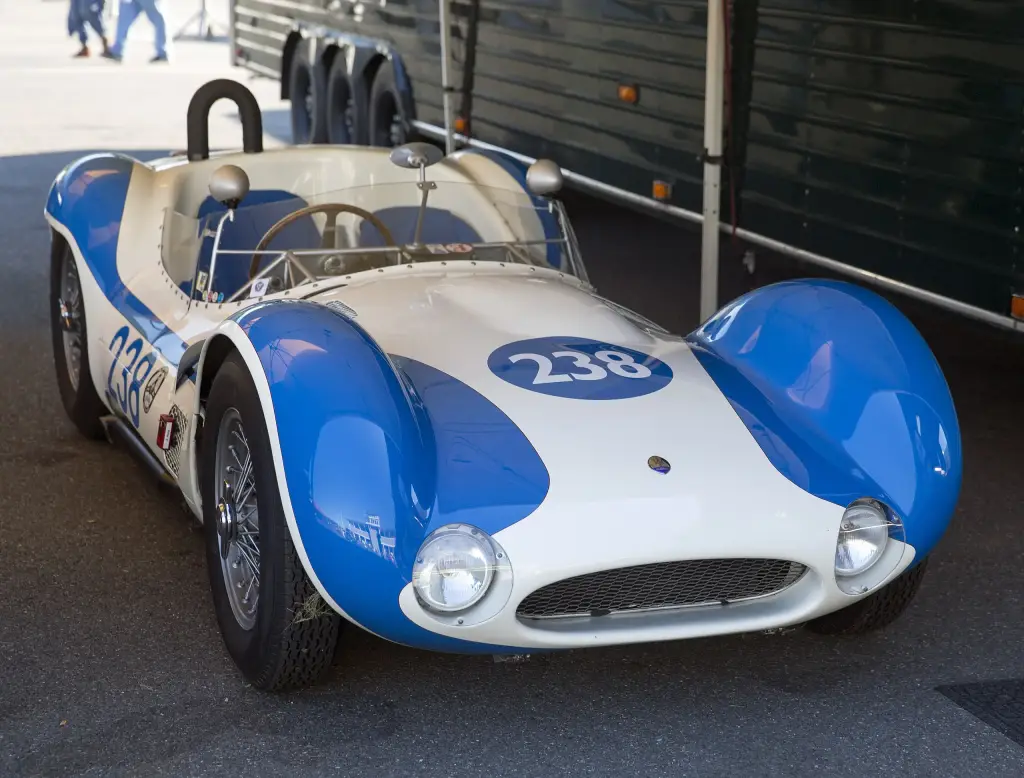
The Maserati Tipo 60 and Tipo 61, commonly called the Birdcage, were sports racing cars produced between 1959 and 1961 for privateers in two- and three-litre sports car events, including the 24 Hours of Le Mans. Their nickname came from a chassis of about 200 chrome-molybdenum steel tubes welded into a complex cage, which was both stiffer and lighter than other racing car chassis of the time.
Maserati Birdcage at a glance
| Maker | Maserati, Modena |
|---|---|
| Production | 1959–1961 |
| Chassis | space frame of about 200 chrome-molybdenum steel tubes |
| Tipo 60 engine | 1,990 cc four-cylinder, 200 hp |
| Tipo 61 engine | 2,890 cc four-cylinder, 250 hp |
| Engine position | front, tilted at 45 degrees towards the centre |
| Carburettors | twin Weber 45 DCO3 |
| Ignition | Marelli dual ignition |
| Tipo 60 weight | 570 kg |
| Tipo 61 weight | 600 kg |
| Tipo 60 top speed | 270 km/h |
| Tipo 61 top speed | 285 km/h |
Based on one source: the English Wikipedia article on the Tipo 60/61.
History of the Maserati Birdcage
In 1958 the Orsi family gave technical director Giulio Alfieri freedom to find technical solutions that would make Maserati race cars more competitive, despite the company’s difficult finances. The first idea was a backbone chassis like those of Maserati’s competitors, but it was dropped. In October 1958 Alfieri and his team came up with something different: about 200 small steel tubes of 10 to 15 mm diameter welded together in very short lengths into a complex mesh that formed a cage-like structure.
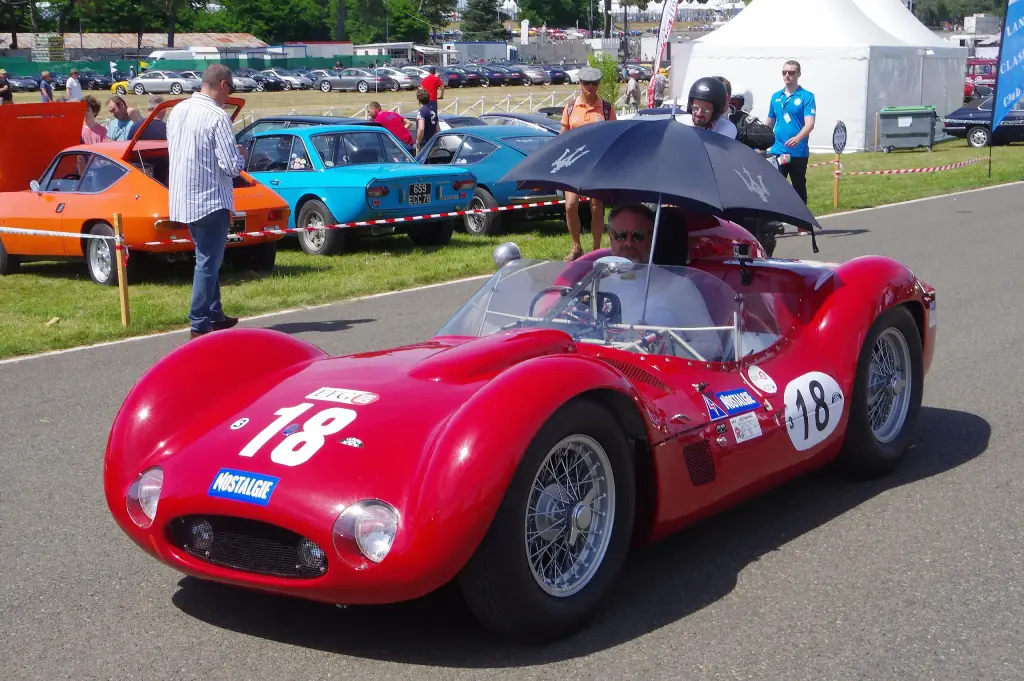
A compact 1,990 cc four-cylinder engine taken from the 200S was mounted at the front at a 45-degree angle and towards the centre of the car for a better centre of gravity. It was significantly modified, with new cylinder heads, a 93 × 72 mm bore and stroke, twin Weber 45 DCO3 carburettors, Marelli battery dual ignition and a revised exhaust, and was rated at 200 hp. Suspension used coil springs at the front and a de Dion rear axle with a single transverse leaf spring. The construction technique kept weight down to 570 kg, and the Tipo 60 reached 270 km/h. By recessing the base of the windscreen into the bodywork, Maserati reduced the effect of new Le Mans rules demanding a tall windscreen.
Tipo 60 and Tipo 61
The first car was completed in May 1959 and handed to Stirling Moss for testing; the first runs revealed cracks in the chassis, solved by changing the grade of steel. On 12 July 1959 the Tipo 60 won its debut race in Moss’s hands. That attracted the attention of American teams racing in the three-litre class, and after demands for a three-litre variant the engine was enlarged to 2,890 cc, adding 50 hp. Weight rose to 600 kg because of a revised propeller shaft, but fuel consumption was unaffected, which gave the car an advantage in races. The revised model was called the Tipo 61, with 250 hp and a 285 km/h top speed.
Camoradi and Le Mans
The performance caught the eye of “Lucky” Casner. After testing a prototype at the Modena Autodrome he asked for a Tipo 60 to be converted to Tipo 61 specification and delivered to him. Early races with Carroll Shelby driving were troublesome, and at the 1960 Targa Florio Umberto Maglioli retired with engine failure. Casner founded the Casner Motor Racing Division, which ran three Tipo 61s at the 1960 24 Hours of Le Mans. The cars reached 272 km/h and led the Ferraris by more than four minutes, but a starter motor problem dropped them to last place and rain, combined with the impractical windscreen, prevented a finish. The Birdcages never won Le Mans because of reliability problems, and the drivetrain caused many retirements, but the Camoradi team won the 1000 km Nürburgring in both 1960 and 1961.
The Birdcage series
The Tipo 61 was the best-known model, but Alfieri designed five cars on the multi-tubular frame concept. All had independent front suspension, four-wheel disc brakes and a five-speed gearbox, and the Tipo 60 and 61 used a de Dion rear axle. The mid-engined cars began with the Tipo 63, which used the same kind of frame but independent double wishbones at the rear; the Tipo 63 to 65 have been called a historian’s nightmare, because Maserati, short of money, took engines from its parts bins and installed them in ten chassis. The Tipo 60/61 were succeeded by the Tipo 151, which used a more conventional tubular chassis. The white-with-blue-stripes livery of the 2004 Maserati MC12 road car was a tribute to the Tipo 61 and the Camoradi team.
Design and features
- 200-tube space frame: a light and rigid cage that gave the car its nickname.
- Slanted four-cylinder: the engine sat at 45 degrees for a lower centre of gravity.
- Low weight: 570 kg for the Tipo 60 and 600 kg for the Tipo 61.
- Le Mans trick: the recessed windscreen base reduced the effect of the tall-screen rule.
- Camoradi success: two wins in the 1000 km Nürburgring, in 1960 and 1961.
Maserati Birdcage versions
- Tipo 60 (1959): two-litre four with 200 hp and 570 kg.
- Tipo 61 (1959–1961): 2.9-litre four with 250 hp and 600 kg.
- Tipo 63–65: mid-engined Birdcages with double-wishbone rear suspension.
- Tipo 151: the conventional-tubular successor.
The Birdcage’s four-cylinder engine came from the Maserati 200S, and its space frame was a step beyond the frame of the 300S. The later MC12 wore a tribute livery to it. More cars are in the Maserati collection.
Sources
- Maserati Tipo 61, English Wikipedia: chassis, engine, racing history, Birdcage series