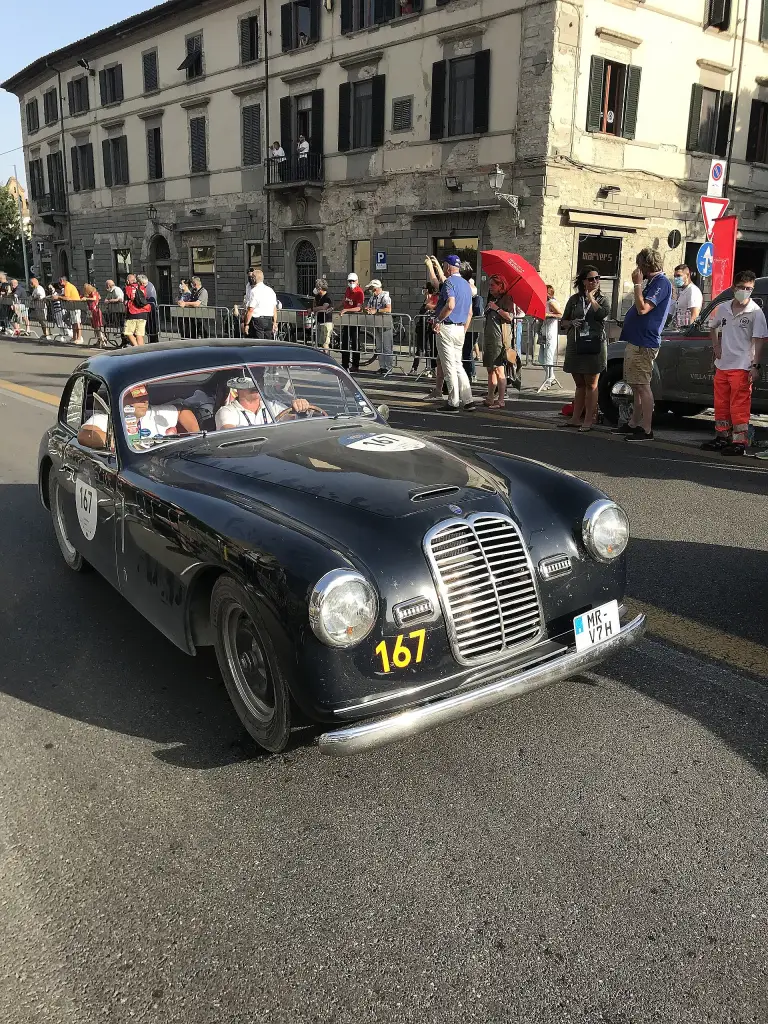
The Maserati A6 was a series of grand tourers, racing sports cars and single-seaters made between 1947 and 1956. The name honoured Alfieri Maserati, one of the founding brothers, and the straight-six engine. The A6 1500 of 1947 was Maserati’s first production road car, and the racing members of the family kept the marque winning in the years before the 250F.
Maserati A6 at a glance
| Maker | Maserati, Modena |
|---|---|
| Production | 1947–1956 |
| Name | A for Alfieri Maserati, 6 for six cylinders |
| A6 1500 engine | 1,488 cc inline-six, single overhead camshaft, 65 hp |
| A6G 2000 engine | 1,954.3 cc, 72 mm × 80 mm, 90–100 hp |
| A6GCS engine | 1,978 cc, 72 mm × 81 mm, 120 hp |
| A6 1500 body | Pinin Farina berlinetta and Convertibile |
| A6G bodies | Pinin Farina, Frua, Ghia, Bertone, Allemano, Zagato, Vignale |
| A6 1500 built | 61 between 1947 and 1950 |
| A6G 2000 built | 16 between 1950 and 1951 |
| A6GCS built | 15 between 1947 and 1953 |
| Wheels and tyres | 16-inch Borrani wheels, Pirelli Stella Bianca tyres |
Based on one source: the English Wikipedia article on the A6 family, which covers all the variants described here.
History of the Maserati A6
The 1.5-litre straight-six, named A6 TR for its detachable cylinder head (Testa Riportata), was based on the pre-war 6CM and produced 65 hp. It first appeared in the A6 Sport, also called Tipo 6CS/46, a barchetta prototype developed by Ernesto Maserati and Alberto Massimino. Two prototypes were completed in late 1946 for the 1947 racing season, and they took the first two places at the Circuito di Piacenza on 11 May 1947 with Giulio Barbieri and Mario Angiolini; the “Maserati 6CS 1500” that won at Voghera in October 1946 with Luigi Villoresi is probably one of the same type.
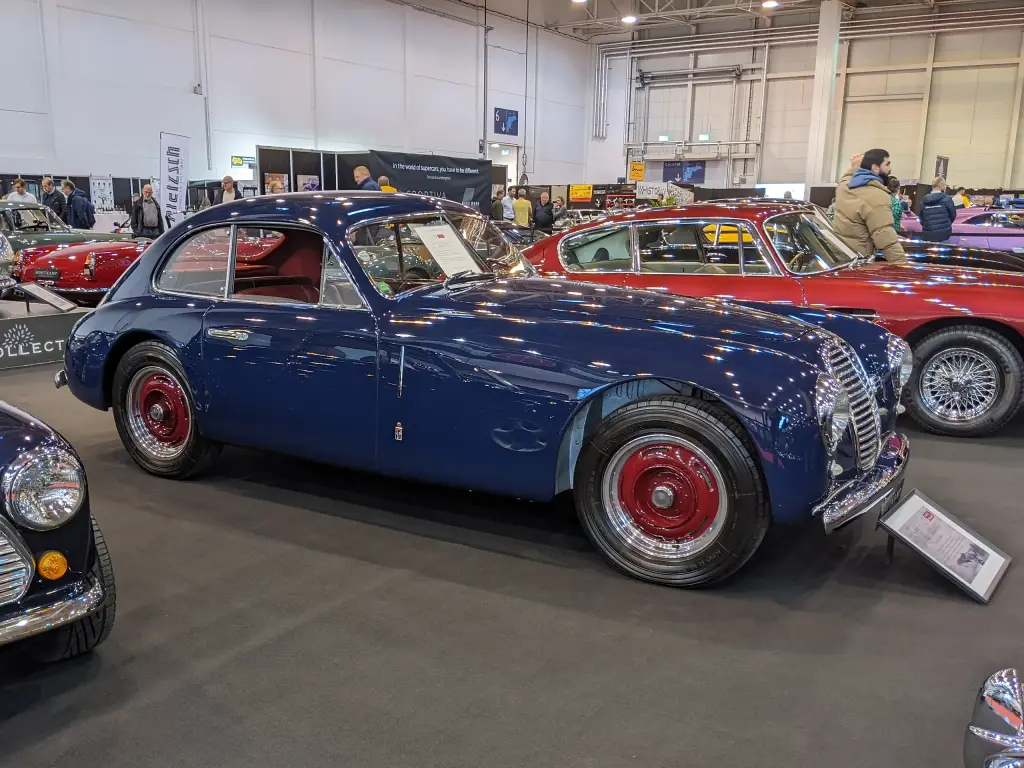
A6 1500
The A6 1500, officially 1500 Gran Turismo, was Maserati’s first production road car. Development began in 1941 but was halted when priorities shifted to wartime production and completed only after the war. The first chassis, bodied by Pinin Farina, debuted at the Geneva salon in March 1947: a two-door, two-seat, three-window berlinetta with triple square portholes on the front wings, a tapered cabin and hidden headlamps. For production Pinin Farina toned the design down with conventional headlamps and soon added a second side window, and later cars received a 2+2 fastback body. A Convertibile was shown at Turin in 1948 and two were made, while Zagato built one coupé with a Panoramica body in 1949. Sixty-one cars were built between 1947 and 1950. The engine was a 1,488 cc inline-six with a 66 mm bore and 72.5 mm stroke, a single overhead camshaft and a single Weber carburettor giving 65 hp, with triple carburettors from 1949; top speed was 146 to 154 km/h. The chassis was built from tubular and sheet steel sections, with double wishbones at the front, a solid axle at the rear and Houdaille dampers with coil springs on all four corners.
A6G 2000
The improved A6G 2000, officially 2000 Gran Turismo, began to replace the A6 1500 from 1950. The engine was enlarged to 1,954.3 cc with a 72 × 80 mm bore and stroke while keeping the single overhead camshaft, and with triple carburettors it gave 90 to 100 hp for a top speed of 160 to 180 km/h. The chassis kept the A6 1500’s dimensions but the rear axle was now on semi-elliptic leaf springs. The car debuted at the 1950 Turin Motor Show with Pinin Farina bodywork; sixteen were built in 1950–1951, nine as Pinin Farina 2+2 fastbacks, five as Frua convertibles, one as a Frua coupé and one with a Vignale coupé body by Giovanni Michelotti.
Racing A6s
In 1947 Maserati developed the A6GCS, a two-seat sports racing car with a two-litre engine of 1,978 cc from a 72 × 81 mm bore and stroke, at first giving 120 hp and upgraded in 1952. The A6GCS, often called Monofaro for its single headlamp, made its competition debut at Modena in 1947 with Luigi Villoresi and Alberto Ascari and won the 1948 Italian Championship with Giovanni Bracco. Weight ranged from 580 to 670 kg and fifteen cars were made between 1947 and 1953, two exported to Brazil and one to the United States. The A6GCM of 1951–1953 were twelve two-litre single-seaters developed by Gioacchino Colombo and built by Medardo Fantuzzi, with 160 to 190 PS depending on tune; the A6 SSG of 1953 was a GCM revision pointing towards the 250F and won the 1953 Italian Grand Prix with Juan Manuel Fangio.
Design and features
- First production Maserati: the A6 1500 of 1947 put the marque on the road.
- One engine, many cars: the straight-six served road cars, sports racers and single-seaters.
- Coachbuilt bodies: Pinin Farina, Frua, Ghia, Bertone, Allemano, Zagato and Vignale all bodied A6s.
- A6GCS Monofaro: the single-headlamp sports racer that won the 1948 Italian Championship.
- A6GCM: the two-litre single-seater that led to the 250F and won at Monza in 1953.
Maserati A6 versions
- A6 Sport / 6CS/46 (1946–1947): barchetta prototypes with the 1.5-litre six.
- A6 1500 (1947–1950): Pinin Farina berlinetta and Convertibile, 61 built.
- A6G 2000 (1950–1951): two-litre road car, 16 built by Pinin Farina, Frua and Vignale.
- A6GCS (1947–1953): two-seat sports racer, 15 built.
- A6GCM and A6 SSG (1951–1953): two-litre single-seaters, up to 190 PS.
The A6 led to the Maserati 3500 GT, the company’s first series-production grand tourer, and its racing variants were replaced by the 150S and 200S. The six-cylinder line ended with the 250F. More cars are in the Maserati collection.
Sources
- Maserati A6, English Wikipedia: history, models, engines, production