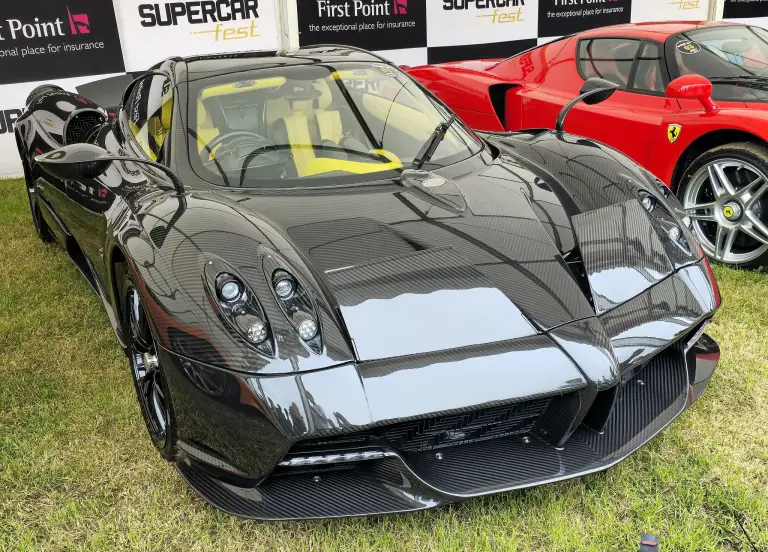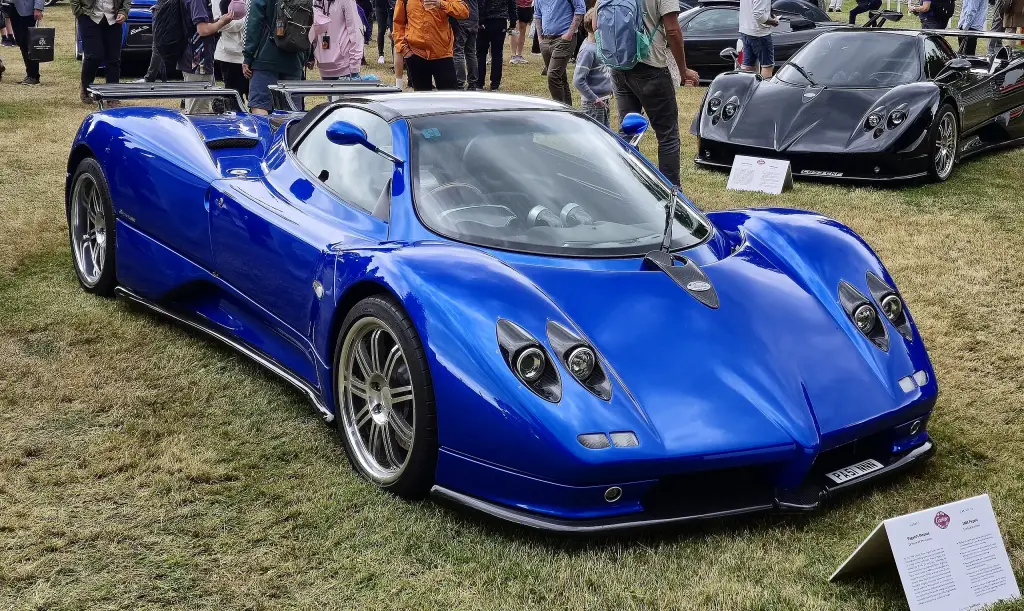
The Pagani Zonda is a mid-engine sports car built by the Italian maker Pagani. It debuted at the 1999 Geneva Motor Show and was produced to order in tiny numbers: English Wikipedia counts 140 cars as of 2019, including development mules. Its construction is mainly of carbon fibre.
Pagani Zonda at a glance
| Maker | Pagani, Italy |
|---|---|
| Debut | 1999 Geneva Motor Show |
| Production | 1999–2017 |
| Total built | about 140 as of 2019, including development mules (English Wikipedia) |
| Layout | mid-engine, two seats |
| Construction | mainly carbon fibre |
| Engine | Mercedes-Benz/AMG V12: 6.0 L (C12), 7.0 L (C12 S), 7.3 L (S 7.3 and later) |
| Power | from 408 PS (C12) to 800 PS (HP Barchetta) |
| Top speed | 335 km/h (208 mph) for the C12 S; 345 km/h (214 mph) for the Zonda F |
| Name | after the Zonda, a hot wind in Argentina |
| Successor | Huayra, shown at Geneva in March 2011 |
Production figures differ: English and Italian Wikipedia give 140 cars, German Wikipedia mentions both about 130 and 158. Power figures are those of the English Wikipedia page.
History of the Pagani Zonda
A name taken from the wind
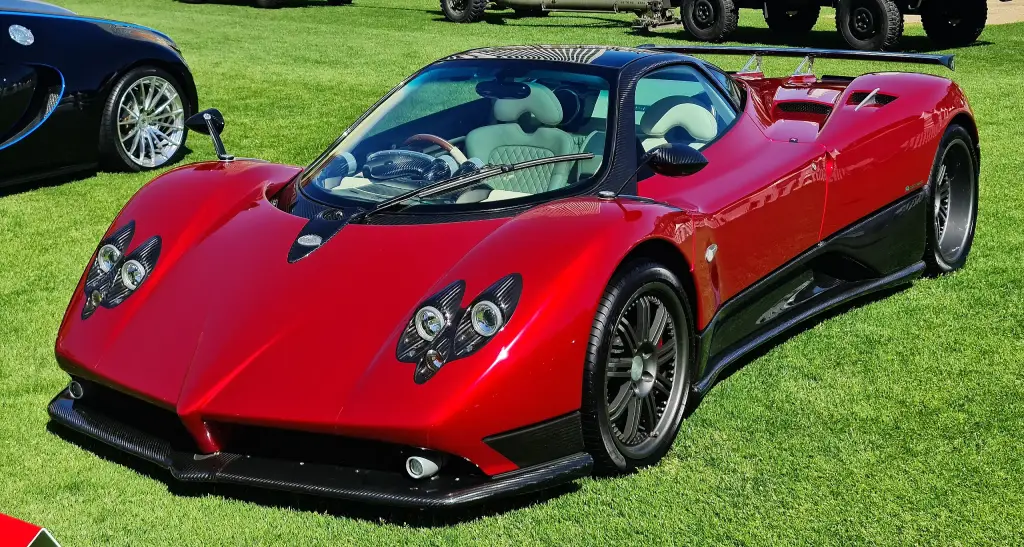
The car was meant to be called the “Fangio F1” after the Formula One champion Juan Manuel Fangio, who helped with the early development. After he died in 1995 it was renamed after the Zonda, a hot air current above Argentina. Horacio Pagani, who had worked at Lamborghini, started the project in the early 1990s, and with Fangio’s introduction secured V12 engines from Mercedes-AMG. The first car was shown as the Zonda C12 in Geneva in 1999.
From C12 to F
The C12 used a 6.0-litre Mercedes-Benz V12 and a five-speed manual gearbox; only five were built, one for crash testing and one as a show car. The C12 S followed with an enlarged 7.0-litre engine tuned by Mercedes-AMG, 550 PS and a new six-speed gearbox. In 2002 the Zonda S 7.3 brought a 7,291 cc V12 with 555 PS and traction control and ABS as standard, and in 2003 came an open roadster of the same car. The Zonda F, shown in Geneva in 2005, was the most extensively re-engineered version: 602 PS, revised bodywork and optional carbon-ceramic brakes, limited to 25 cars. A Roadster F with a removable carbon roof and 650 PS followed in 2006.
Track cars and the last Zondas
The Zonda R was a track-only version shown in 2007, and the road-legal Zonda Cinque (five were built) used carbon-titanium and an automated manual gearbox with 678 PS. The Zonda Tricolore, a tribute to the Italian aerobatic team Frecce Tricolori, reached three cars. The Zonda Revolución appeared in 2012, and the Zonda HP Barchetta, unveiled at Pebble Beach in 2017 as a birthday present for Horacio Pagani, was limited to three cars with 800 PS and ended the Zonda’s run. A racing version, the Zonda GR, entered the 2003 24 Hours of Le Mans and retired after ten laps with a gearbox failure.
Design and features
- Carbon construction: a carbon-fibre chassis and body, later with carbo-titanium weave in the Cinque.
- V12 from Mercedes-AMG: from 6.0 to 7.3 litres across the versions.
- Small series: many variants were limited to between three and 25 cars.
- Racing: the Zonda GR was built for the 24 Hours of Le Mans in 2003.
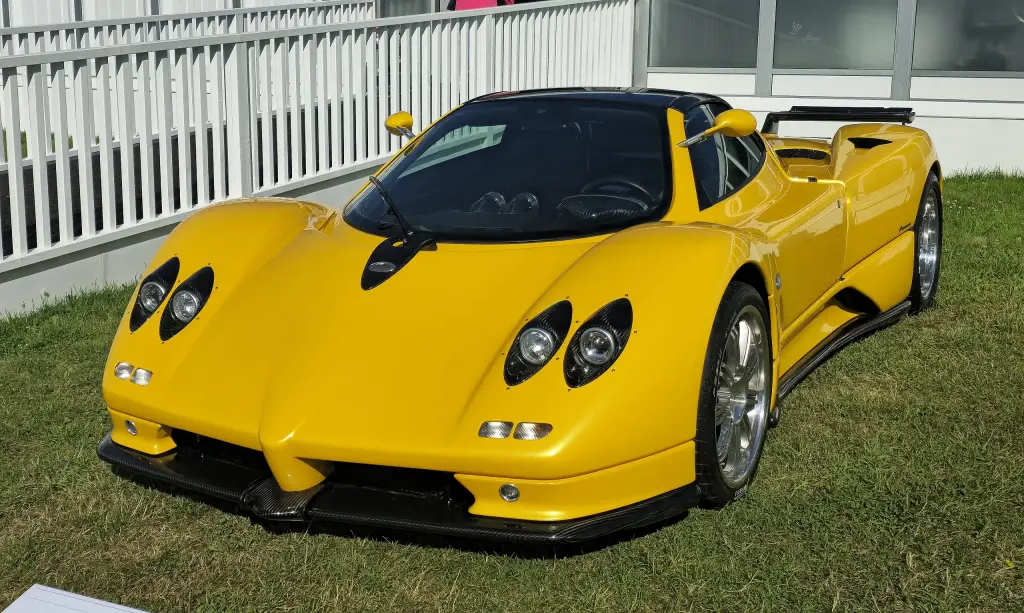
Pagani Zonda versions
- C12 (1999): 6.0 L V12, five-speed manual.
- C12 S: 7.0 L, 550 PS, six-speed manual; 335 km/h.
- S 7.3 and Roadster (2002–2003): 7.3 L, 555 PS, with traction control and ABS.
- F and Roadster F (2005–2006): 602 and 650 PS; 25 of each.
- R and Cinque (2007–2009): track-only R; road-legal Cinque with 678 PS.
- Tricolore, Revolución, HP Barchetta: late special editions of three or fewer cars.
More Pagani cars are in our Pagani collection; the Zonda’s successor is the Huayra.
Pagani Zonda questions and answers
When was the Zonda introduced?
At the Geneva Motor Show in 1999.
What engine does it use?
A naturally aspirated Mercedes-AMG V12, from 6.0 to 7.3 litres depending on the version.
How many were built?
English Wikipedia counts 140 as of 2019, including development mules; German Wikipedia gives lower and higher figures, so treat the total as approximate.
Why is it called Zonda?
After the Zonda wind of Argentina; the car was first to be named for Juan Manuel Fangio.
What came after the Zonda?
The Huayra, presented in March 2011.
Video: Pagani Zonda 760LM Sound – Start, Rev and Driving
Video by Marchettino on YouTube.
Sources
- Pagani Zonda, English Wikipedia: variants, power, performance
- Pagani Zonda, German Wikipedia: name, successor, Huayra
- Pagani Zonda, Italian Wikipedia: history and early development