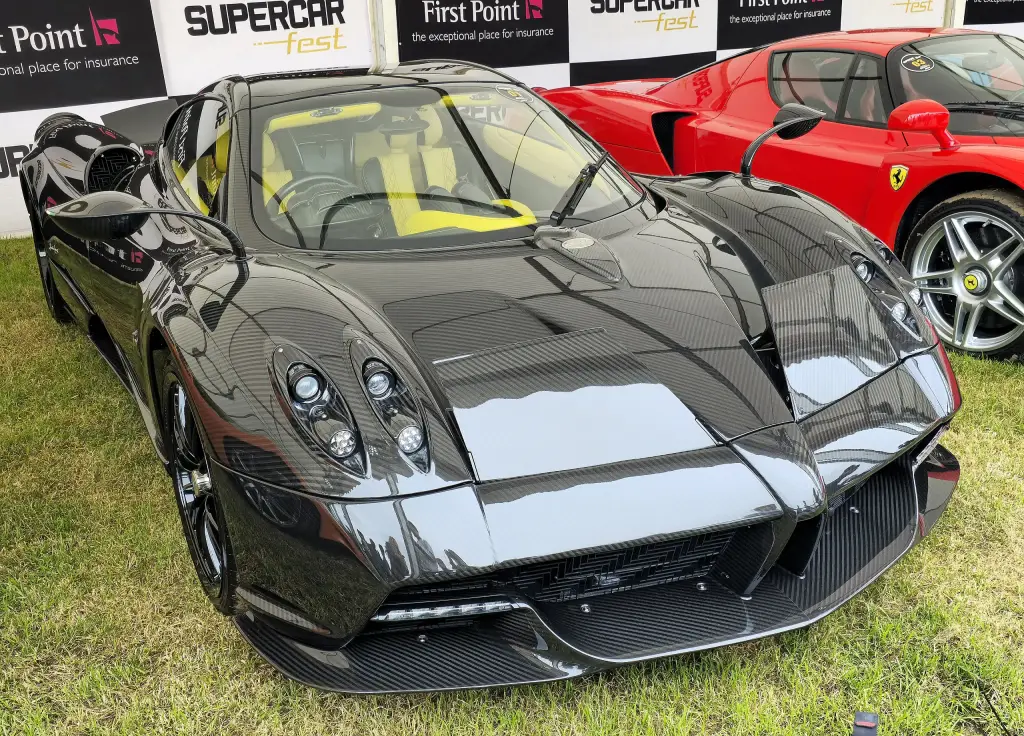
The Pagani Huayra is a mid-engine hypercar built by the Italian manufacturer Pagani as the successor to the Zonda. It was unveiled online on 25 January 2011 and made its public debut at Pirelli’s headquarters in Milan the following month. Its name comes from Wayra Tata, the Quechua god of wind.
Pagani Huayra at a glance
| Maker | Pagani, Italy |
|---|---|
| Unveiled | 25 January 2011, online; public debut in Milan, February 2011 |
| Predecessor | Pagani Zonda |
| Production | limited to 100 cars |
| Engine | 6.0-litre M158 twin-turbocharged 60° V12 by Mercedes-AMG |
| Power | 740 PS (544 kW; 730 hp) at 5,800 rpm |
| Torque | 1,000 N·m at 2,250–4,500 rpm |
| Gearbox | seven-speed sequential with a single-disc clutch |
| Top speed | about 383 km/h |
| 0–97 km/h | 2.8 seconds |
| Brakes | Brembo carbon-ceramic, 380 mm discs |
| Drag coefficient | 0.31 to 0.37, variable |
The Huayra is described on a single Wikipedia article; page based on one source.
History of the Pagani Huayra
A successor to the Zonda, 2011
The Huayra was Pagani’s answer to its own Zonda. Unlike the older car it was built around active aerodynamics, and it was the first Pagani designed from the start to be sold worldwide rather than as a limited series of specials. The car was shown online with a set of official pictures on 25 January 2011, and the public premiere followed in February at the headquarters of Pirelli in Milan, the company that supplied its tyres. Top Gear magazine named it The Hypercar of the Year 2012.
Sold out, 2015
Production was capped at 100 cars under Pagani’s agreement with Mercedes-AMG, which built the engine specially for the model. On 11 February 2015 it was reported that the entire run had been sold. The Huayra’s engine was designed at Pagani’s request to cut turbo lag: AMG used smaller turbochargers, a different intercooler layout and recalibrated engine management. The car also uses dry-sump lubrication, which keeps oil flowing under extreme cornering and allows the engine to sit lower in the chassis.
Design and features
- Active aerodynamics: four independently moving flaps, two at the front and two at the rear, controlled by their own computer that reads data from the ABS and engine management. The front of the car can also change its height above the ground, and the rear flaps work as an airbrake under hard braking.
- Mercedes-AMG V12: a 6.0-litre twin-turbocharged unit with 730 hp, mounted amidships and driving through a seven-speed sequential gearbox.
- Single-disc clutch: Pagani chose a sequential gearbox with one clutch because a dual-clutch unit would have added more than 70 kg, cancelling out the benefit of faster shifts; the complete transmission weighs 96 kg.
- Carbon-ceramic brakes: Brembo calipers with six pistons at the front and four at the rear, gripping 380 mm drilled discs.
- Titanium exhaust: built by MHG-Fahrzeugtechnik with hydroformed joints to reduce back pressure and Inconel silencers for the hottest sections; the whole system weighs less than 10 kg.
Pagani Huayra versions
- Huayra (2011): the standard car, with the 730 hp version of the AMG V12.
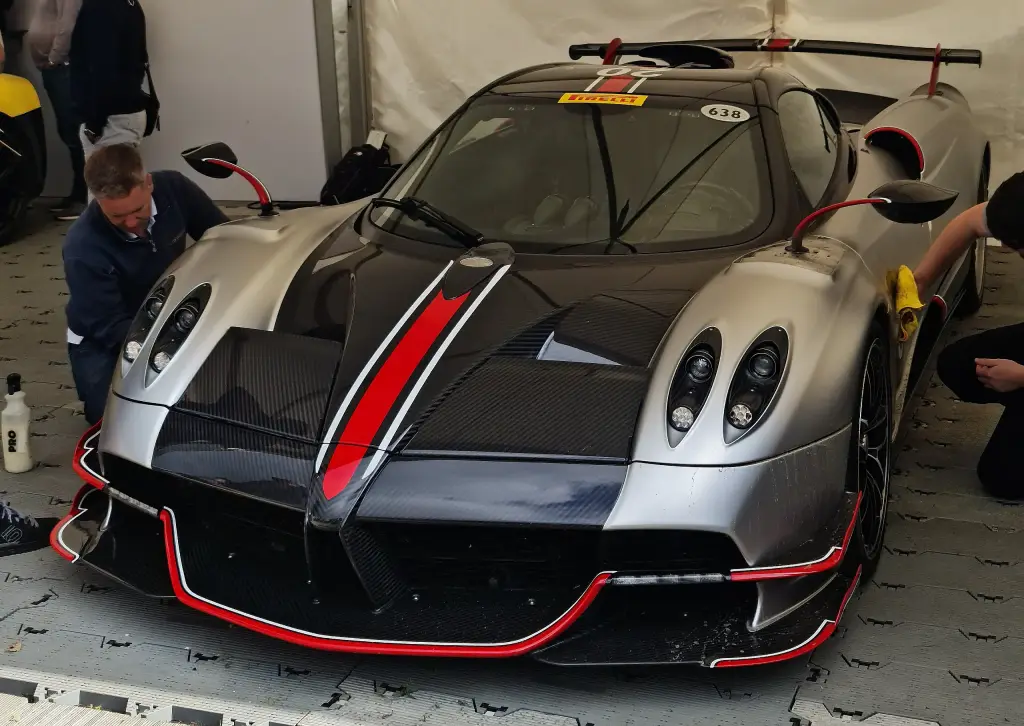
- Huayra BC (2016): a track-focused version unveiled at the Geneva Motor Show, named after Benny Caiola, Horacio Pagani’s friend and the brand’s first customer. Its engine produces 764 PS, dry weight falls by 132 kg to 1,218 kg thanks to a new ‘carbon triax’ material, and it wears a deeper front splitter, side skirts and a full-width rear diffuser with a large wing.
The Huayra replaced the Pagani Zonda in the range. More cars like it are in the Pagani collection.
Video: Pagani Huayra | Richard Hammond reviews | Top Gear Series 19 | BBC
Video by Top Gear on YouTube.
Sources
- Pagani Huayra, English Wikipedia: debut, specifications, aerodynamics, variants