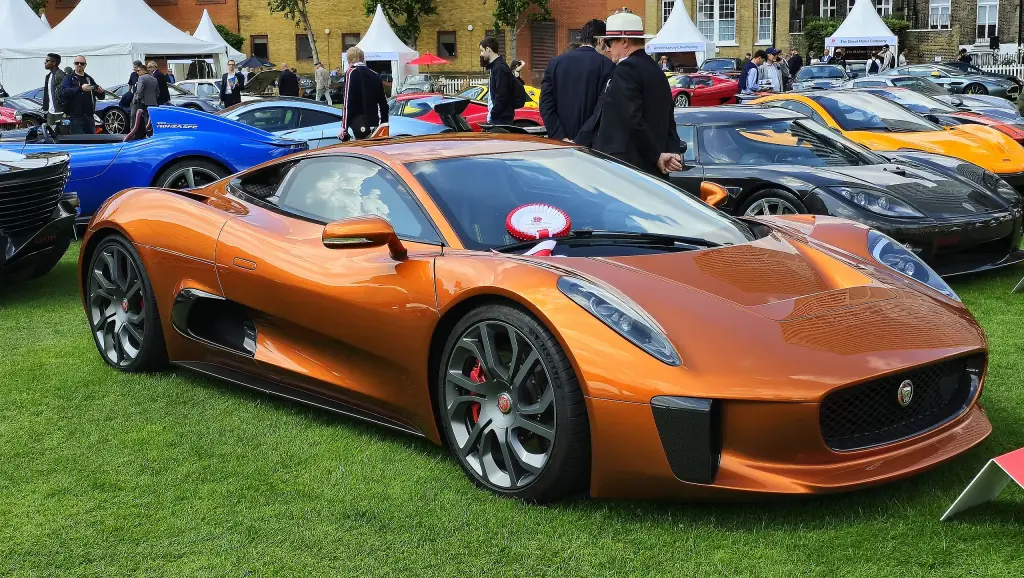
The Jaguar C-X75 is a hybrid-electric, two-seat concept car produced by Jaguar Cars with Williams Advanced Engineering and shown at the 2010 Paris Motor Show. Its concept powertrain rated 778 hp from four YASA electric motors, one at each wheel, with the batteries recharged by two diesel-fed micro gas turbines instead of a conventional engine.
Jaguar C-X75 at a glance
| Shown | Paris Motor Show, 2010 |
|---|---|
| Developed with | Williams Advanced Engineering |
| Motors | four YASA electric motors, one per wheel |
| Motor output | 145 kW each, 780 hp in total |
| Torque | 1,600 N·m |
| Generators | two Bladon Jets micro gas turbines |
| Battery | 15 kWh lithium-ion, 185 kg |
| Electric range | 110 km on batteries alone |
| Total range | 900 km with the turbines running |
| CO2 on EU cycle | 28 g/km |
| Planned production | up to 250 cars, 2013–2015 |
| Cancelled | December 2012 |
History of the Jaguar C-X75
Concept
The C-X75 debuted at the 2010 Paris Motor Show as a design and technology study. Each wheel was driven by a 145 kW electric motor, giving a total of 780 hp and 1,600 N·m with the ability to drive each wheel independently, a form of torque vectoring. Each motor weighs 50 kg. Two Bladon Jets micro gas turbines generate electricity to extend the range to 900 km while producing 28 g of CO2 per kilometre on the EU test cycle; the turbines can run on diesel, biofuels, compressed natural gas and liquid petroleum gas. The 15 kWh lithium-ion battery pack weighs 185 kg.
Aerodynamics and chassis
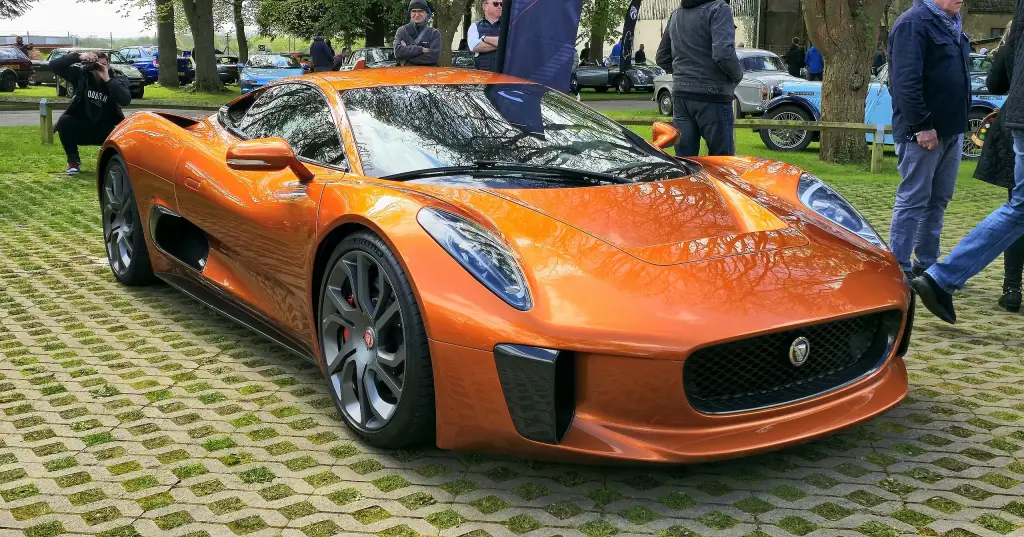
Jaguar also worked on the aerodynamics: the carbon-fibre rear diffuser includes an active aerofoil that lowers automatically as speed rises, creating over 200 kg of downforce at 321 km/h. The car uses an extruded and bonded, aerospace-inspired aluminium chassis.
Production and cancellation
In May 2011 Jaguar announced a limited production run of up to 250 cars from 2013 to 2015 with Williams Advanced Engineering, dropping the micro turbines in favour of a downsized forced-induction petrol engine with one electric motor at each axle, a carbon-fibre chassis and a reduced all-electric range of 50 km. The plan was part of a £5 billion investment programme announced by Jaguar Land Rover in March 2011. In December 2012 the company cancelled production because of the Great Recession, judging it the wrong time to launch an £800,000 to £1 million supercar. Five developmental prototypes were built in 2013 with a 1.6-litre turbocharged and supercharged four-cylinder engine and two electric motors, producing 850 hp combined and reaching 200 mph in testing.
Design and features
- Four electric motors: one per wheel, allowing individual wheel control.
- Micro gas turbines: two Bladon Jets units acting as range extenders.
- Long range: 900 km with the turbines running, 110 km on battery power alone.
- Active aerodynamics: a rear diffuser with an automatic aerofoil.
- Film appearance: a C-X75 appears in the 2015 James Bond film Spectre.
Jaguar C-X75 versions
- Concept (2010): four electric motors and two micro gas turbines.
- Production prototypes (2013): five cars with a 1.6-litre four-cylinder engine and two electric motors, 850 hp combined.
- Spectre cars (2015): seven examples supplied to the filmmakers, visually faithful but mechanically unrelated to the concept.
The C-X75’s styling fed into the Jaguar C-X16 concept and the production F-Type. More cars are in the Jaguar collection.
Sources
- Jaguar C-X75, English Wikipedia: powertrain, production plans, prototypes