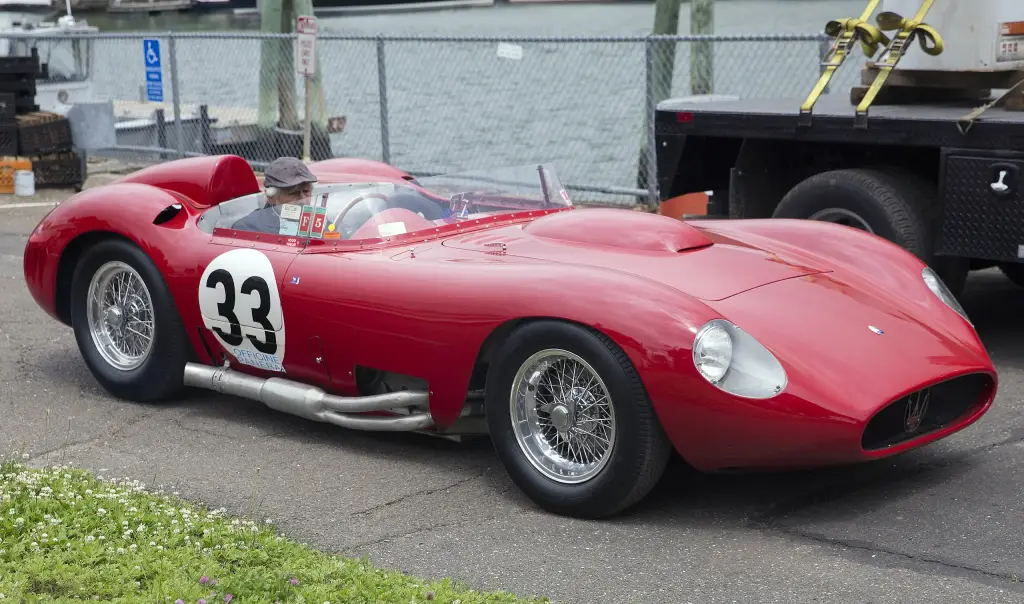
The Maserati 450S, internally Tipo 54, was a sports prototype built to compete in the FIA World Sportscar Championship. Nine cars were made. Its 4.5-litre V8 gave 400 PS, and the cars were raced by Juan Manuel Fangio, Stirling Moss and Jean Behra in the 1957 season.
Maserati 450S at a glance
| Maker | Maserati, Modena |
|---|---|
| Project code | Tipo 54 |
| Production | 1956–1957 |
| Engine | 4,478 cc V8, four Weber 45 IDM carburettors between the banks |
| Bore and stroke | 93.8 mm × 81 mm |
| Power | 400 PS (294 kW) at 7,200 rpm; 410 PS for the 4.7-litre unit |
| Chassis | tubular frame by Valerio Colotti |
| Front suspension | double wishbones with coil springs |
| Rear suspension | reinforced de Dion with five-speed transaxle |
| Brakes | drums from the 300S with improved cooling |
| Body | open Fantuzzi bodywork |
| Built | 9 |
Based on one source: the English Wikipedia article on the 450S.
History of the Maserati 450S
Development of the 450S began in 1954 under the codename Tipo 54, led by Vittorio Bellentani and Guido Taddeucci, with the intention of using larger engines than Maserati had so far. Work started with the engine, a 4,478 cc short-stroke V8 with four 45 IDM Weber carburettors mounted between the Vee, an 93.8 × 81 mm bore and stroke, double overhead camshafts and 400 PS at 7,200 rpm. During 1957 chassis 4508 received an upgraded 4.7-litre unit of 410 PS, and later some cars got 5.6-litre engines of 526 PS based on Maserati’s boat racing units.
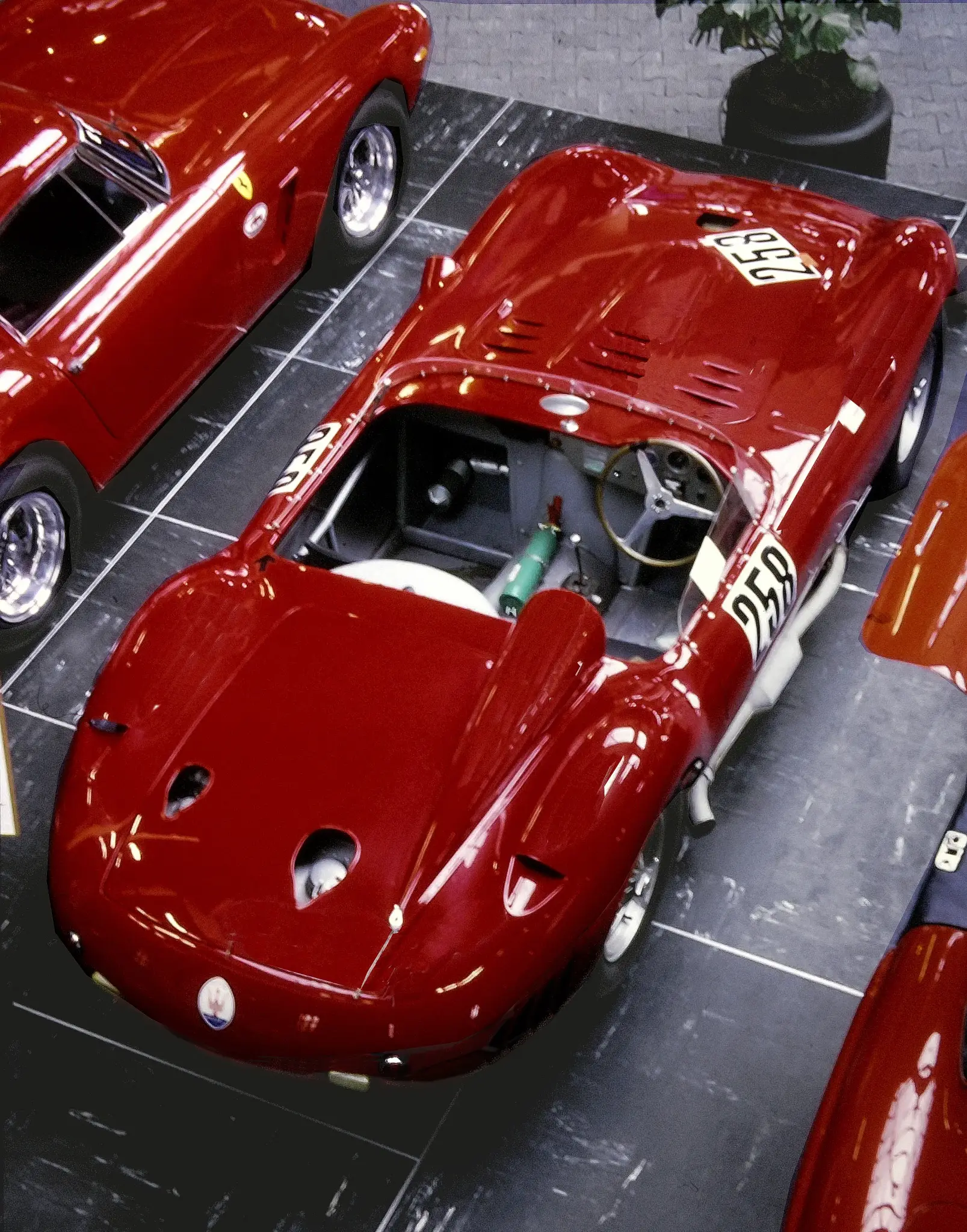
The Tipo 54 project was shelved in 1955 after a catastrophic crash at Le Mans. In early 1956 the American housing developer Tony Parravano commissioned Maserati to build a large-bore V8 for a Kurtis Indy chassis, which prompted the company to restart the project. Chassis 3501, a 350S, was chosen for testing the engine and lengthened to take it, with Valerio Colotti designing the tubular frame. Independent front suspension with double wishbones and coil springs was retained, but a much reinforced de Dion rear end was added around a new five-speed transaxle mounted ahead of the de Dion tube. The drum brakes came from the 300S with better cooling, and the open body by Medardo Fantuzzi resembled the 300S.
Racing
The prototype debuted at the 1956 Swedish Grand Prix, renumbered 4501. It showed impressive performance but suffered from shortcomings: the chassis could not handle the V8’s power and the wrong firing order produced intolerable vibration. The car qualified third in practice but was not raced and went back to the factory, where a purpose-built chassis with the same number was made. In 1957 chassis 4501 was entered at the Buenos Aires 1000 km with Moss and Fangio, but a clutch failure ended a promising start. It was later rebodied as a coupé by Frank Costin and built by Zagato, raced again by Moss at Le Mans and did not finish; it was restored by Fantuzzi with a new chassis number, 4512, and later converted into a road car.
Chassis 4503, driven by Fangio and Behra, won the 12 Hours of Sebring, was then crashed by Behra in practice for the Mille Miglia, crashed again at Le Mans and then won the Swedish Sports Car Grand Prix in the hands of Behra and Moss before being destroyed in Venezuela. Chassis 4505, with Moss and Denis Jenkinson, retired from the Mille Miglia when the brake pedal fell off and from the Nürburgring 1000 km when a wheel came off; it was later sold to Temple Buell with a 5.7-litre engine. Chassis 4507 was destroyed in a fiery crash in Venezuela that also involved 4503. Maserati finished the 1957 season second to Ferrari in the World Sports Car Championship with 25 points against 30, and stopped entering the 450S after all its cars crashed at the final round, which caused financial trouble for the company. Between 1956 and 1962 the 450S had 119 appearances and 31 victories, and its career ended with the new three-litre regulations. In 2015 Zagato presented the Mostro, a car inspired by the 450S Costin Zagato Coupé.
Design and features
- Big V8: 4.5 litres, 400 PS, later enlarged to 4.7 and 5.6 litres.
- Colotti frame: a tubular chassis designed to take the larger engine.
- Five-speed transaxle: mounted ahead of a reinforced de Dion rear end.
- Fantuzzi body: open bodywork closely related to the 300S.
- Works drivers: Fangio, Moss and Behra all raced the car in 1957.
Maserati 450S versions
- 450S (1956–1957): the standard open sports prototype, nine built.
- 4501/4512: the prototype, later a Costin-Zagato coupé and then a road car.
- 4.7- and 5.6-litre cars: enlarged engines for customer racing, up to 526 PS.
The 450S was the biggest of the 1950s Maserati sports racers, above the Maserati 300S and the Maserati 250F single-seater. Its V8 line later returned in the 3500 GT era. More cars are in the Maserati collection.
Sources
- Maserati 450S, English Wikipedia: engine, chassis, racing history