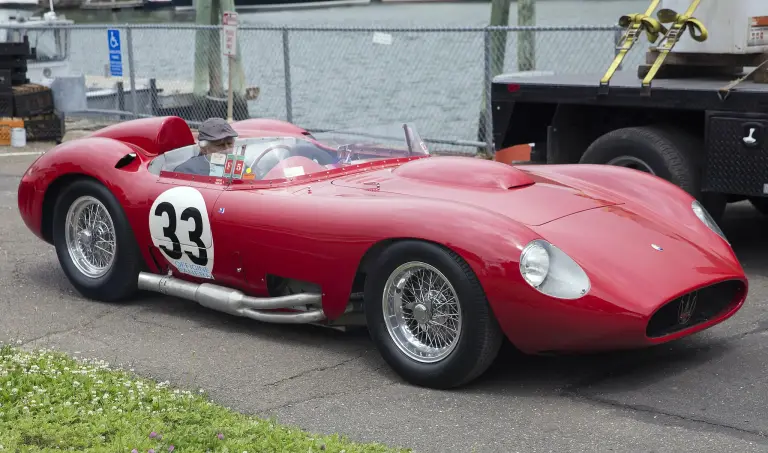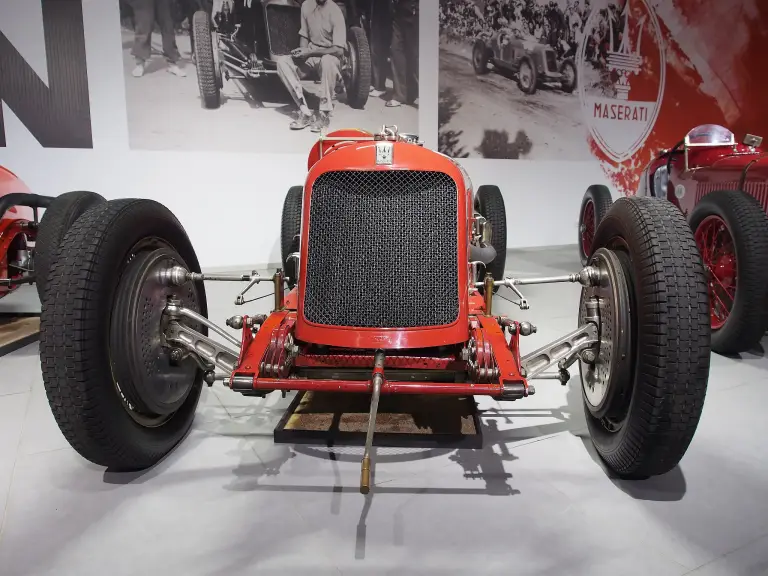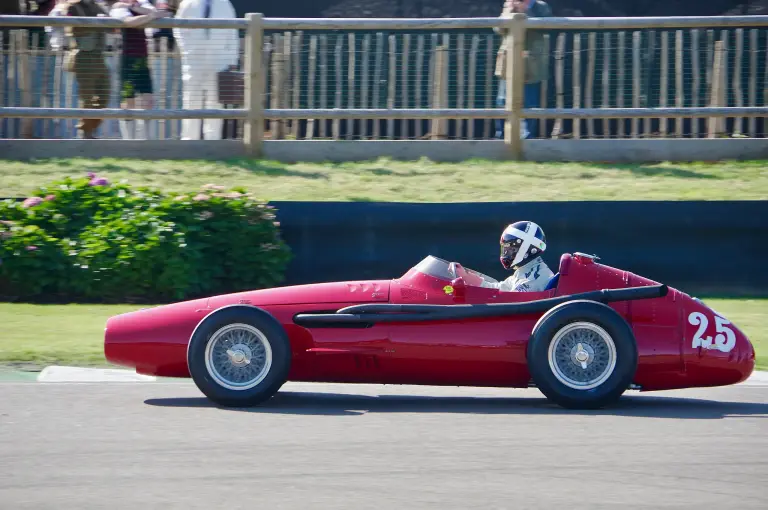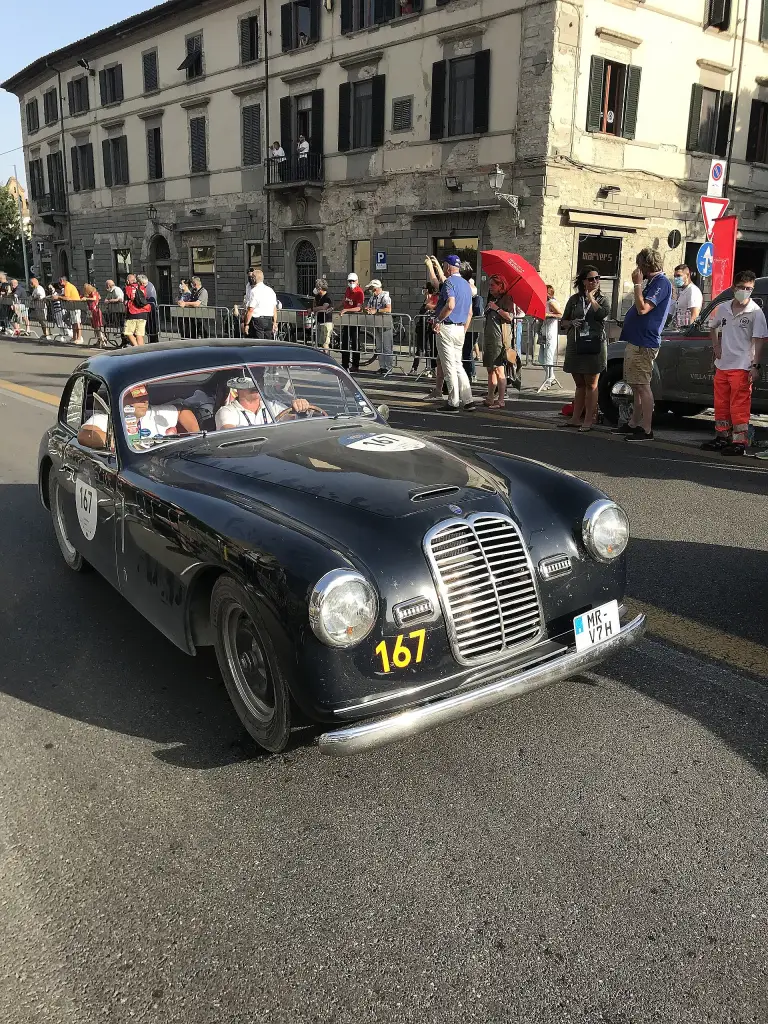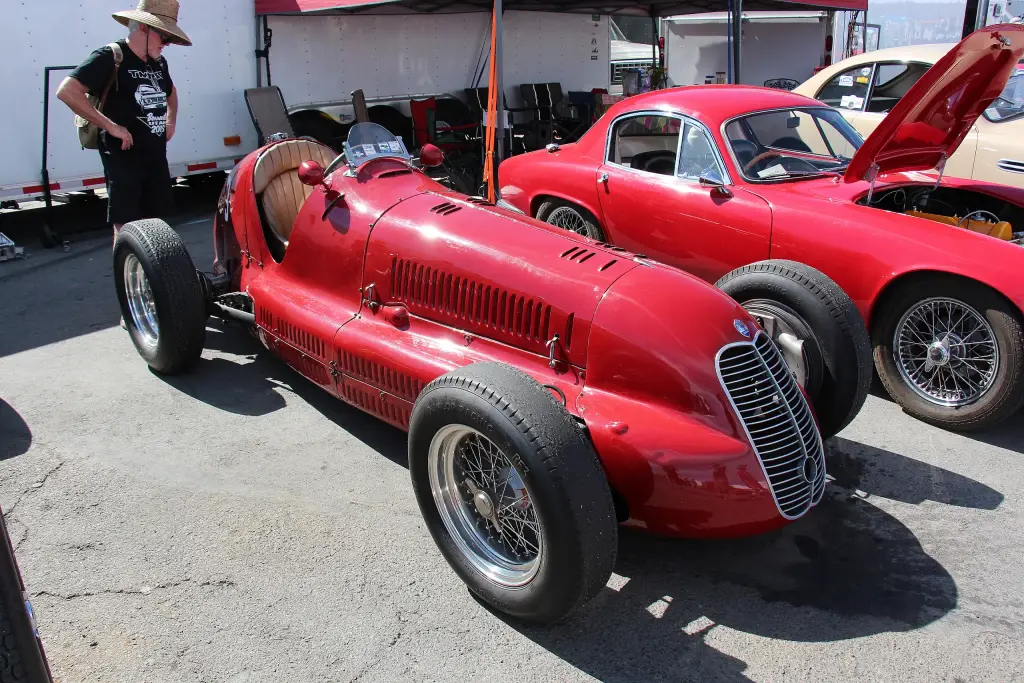
The Maserati 4CL and its sister model the 4CLT were single-seat Grand Prix racing cars. The 4CL appeared at the start of the 1939 season as a rival to the Alfa Romeo 158 and the ERA voiturettes, and the revised 4CLT of 1948 became the car of choice for privateers in the first years of the Formula One World Championship.
Maserati 4CL at a glance
| Maker | Maserati, Modena |
|---|---|
| Class | Voiturette, later Formula One |
| 4CL introduced | 1939 |
| 4CLT introduced | 1948 |
| Engine | 1,490.85 cc inline-four, 78 mm × 78 mm square bore and stroke |
| Valves | four per cylinder |
| Supercharger | single Roots type; twin superchargers on the 4CLT |
| 4CL power | about 220 bhp |
| 4CLT power | about 260 bhp |
| Chassis | twin box-section spars on the 4CL; tubular on the 4CLT |
| Built by | Maserati, for works and private entrants |
Based on one source: the English Wikipedia article on the 4CL and 4CLT.
History of the Maserati 4CL
In the late 1930s rapid development in the voiturette class, and the arrival of the Alfa Romeo 158 and the ERA B- and C-types, forced the Maserati brothers to design a new square-bore inline-four with a 78 mm bore and stroke and a displacement of 1,490.85 cc. The engine gave 30–50 bhp more than the previous straight-six, mostly thanks to four valves per cylinder, a more powerful supercharger and a small increase in compression. As usual at Maserati, it went into a chassis almost identical to that of its predecessor, the 6CM: twin box-section spars joined ladder-fashion by smaller cross members, though with more aluminium components. The track was 5 cm wider than the 6CM’s and the car sat lower after the spring hangers were repositioned, and a low, curvaceous alloy body was built in-house. A streamlined version was offered from the outset.
Racing before and after the war
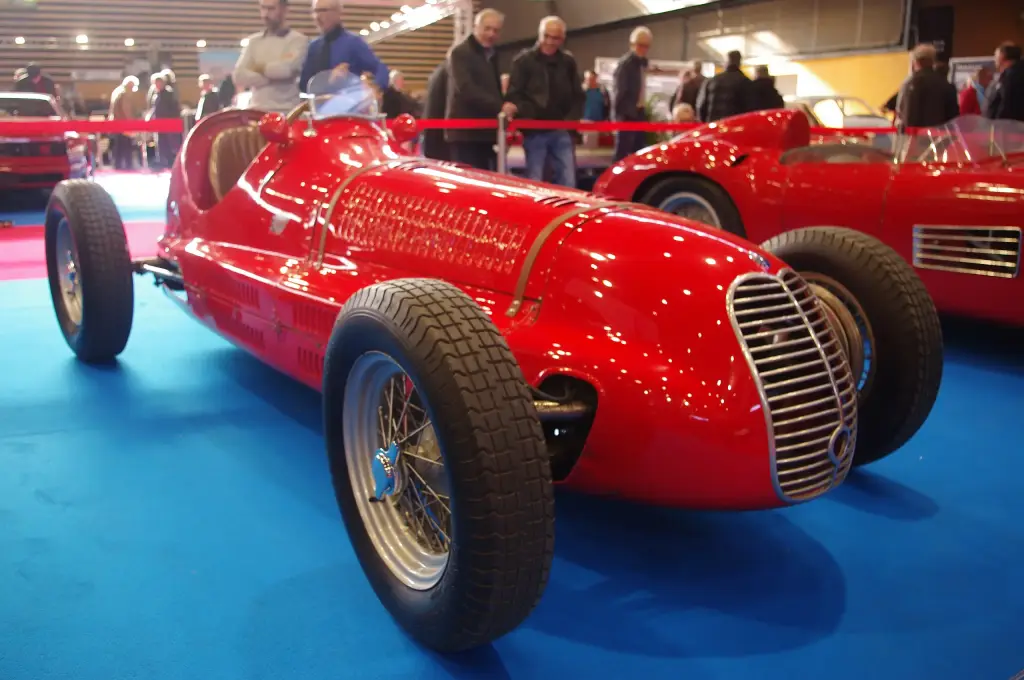
Luigi Villoresi took pole position with the streamliner on the 4CL’s debut at the 1939 Tripoli Grand Prix, ahead of Mercedes’ new W165s, but it and two of the three conventional 4CLs retired with engine trouble. The first victory came two races later in the hands of the privateer Johnnie Wakefield at the Naples Grand Prix; Wakefield won twice more in 1939 and the works cars added two more wins before the war stopped international racing. Villoresi won the 1940 Targa Florio, although entries were restricted to Axis countries and only Maserati fielded a works team.
When competition resumed in 1946 the 4CL was the class of the field. Villoresi won the first post-war race, the 1946 Nice Grand Prix, Tazio Nuvolari and Giorgio Pelassa also won, and Raymond Sommer dominated the season. 1947 was the 4CL’s most successful year: despite Alfa Romeo fielding the revised 158 and the new 308, Maserati drivers took ten individual victories. After the works team switched to the 4CLT, many 4CLs passed to privateers, which is why so many were still racing at the top level when the Formula One World Championship began in 1950.
The 4CLT
Chassis and engine changes made to the experimental 4CLs came together in the 4CLT, where the T stood for the tubular chassis. The extra torsional rigidity was needed for the torque and power of the twin-supercharger upgrade of the inline-four, which raised output from about 220 to about 260 bhp. The 4CLT also used roller bearings for the crankshaft, forged rather than cast rear suspension parts and hydraulic dampers from the start. The first variant, the 4CLT/48, was nicknamed Sanremo after the 1948 San Remo Grand Prix, its first race, which Alberto Ascari won; Villoresi and Reg Parnell then won five of the season’s remaining races. In the first Formula One season a Sanremo gave Maserati its best championship result when Louis Chiron finished third at the 1950 Monaco Grand Prix. A 4CLT/48 modified by the Arzani-Volpini team was the last variant to enter a championship race, failing to qualify for the 1955 Italian Grand Prix.
Design and features
- Square four: a 1,490.85 cc inline-four with a 78 mm bore and stroke and four valves per cylinder.
- Supercharging: a single Roots blower on the 4CL, twin blowers on the 4CLT for about 260 bhp.
- Tubular chassis: the 4CLT’s frame was stiffer to cope with the extra power.
- Privateer favourite: cheap and plentiful after the war, the 4CL filled grids into the 1950s.
- Proven record: ten wins in 1947 and a third place at Monaco in the first world championship year.
Maserati 4CL versions
- 4CL (1939): the original voiturette car, with a box-section chassis and about 220 bhp.
- 4CL streamliner: a closed-wheel body offered from 1939.
- 4CLT/48 Sanremo (1948): tubular chassis and twin superchargers, about 260 bhp.
- 4CLT/50: the ultimate development, introduced for the first Formula One season in 1950.
The 4CL replaced the Maserati 6CM and was developed into the 4CLT before the 250F took over in Formula One. The pre-war six-cylinder cars are covered by the 6C 34. More cars are in the Maserati collection.
Sources
- Maserati 4CL and 4CLT, English Wikipedia: design, racing history, 4CLT variants