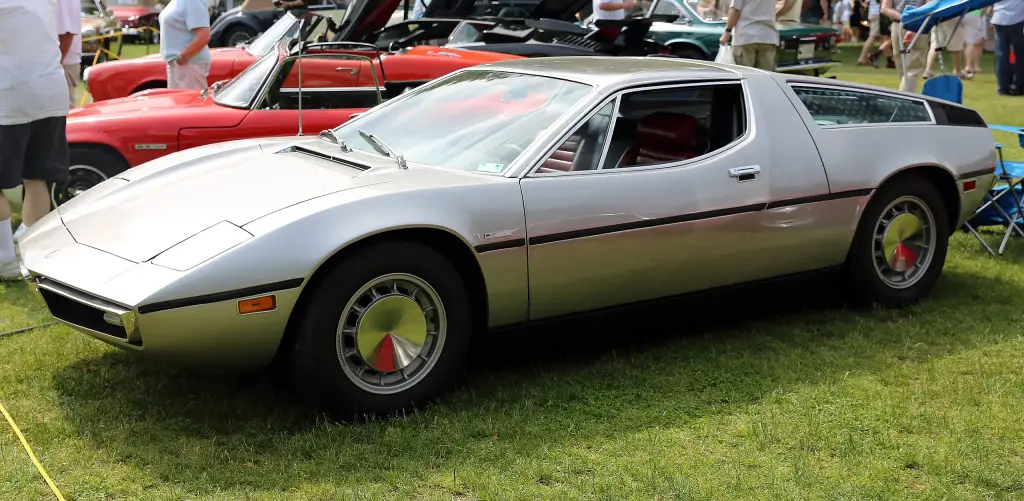
The Maserati Bora, internally Tipo AM117, is a two-seat, rear mid-engine sports car and grand tourer made from 1971 to 1978. Named after the wind of Trieste, it was Maserati’s first mid-engined street car and the first with four-wheel independent suspension. It ended the marque’s reputation for fast but technologically out-of-date cars.
Maserati Bora at a glance
| Maker | Maserati, Modena |
|---|---|
| Project code | Tipo AM117 |
| Production | 1971–1978 |
| Design | Giorgetto Giugiaro, Italdesign |
| Body | two-seat coupé, all-steel panels by Officine Padane |
| Drag coefficient | 0.30 |
| 4.7-litre V8 | 4,719 cc, 310 PS at 6,000 rpm |
| 4.9-litre V8 | 4,930 cc, 330 PS at 5,500 rpm from 1976 |
| Carburettors | four Weber 42 DCNF downdraught |
| Gearbox | five-speed ZF transaxle |
| Built | 564, of which 289 with the 4.7 and 275 with the 4.9 |
Based on one source: the English Wikipedia article on the Bora.
History of the Maserati Bora
Shortly after Citroën took a controlling interest in Maserati in 1968, a mid-engined two-seat sports car was proposed. Lamborghini and De Tomaso already had the Miura and Mangusta, and Ferrari was known to be developing its own mid-engined contender. Initially known as Tipo 117 and later as the Bora, the project got under way in October 1968 and a prototype was on the road by mid-1969. The final car was shown at the Geneva Salon in March 1971 and deliveries began before the end of that year. Maserati struggled after De Tomaso bought it in 1975, and the Bora was discontinued during 1978. In total 564 were built, 275 with 4.9-litre engines and 289 with 4.7-litre engines.
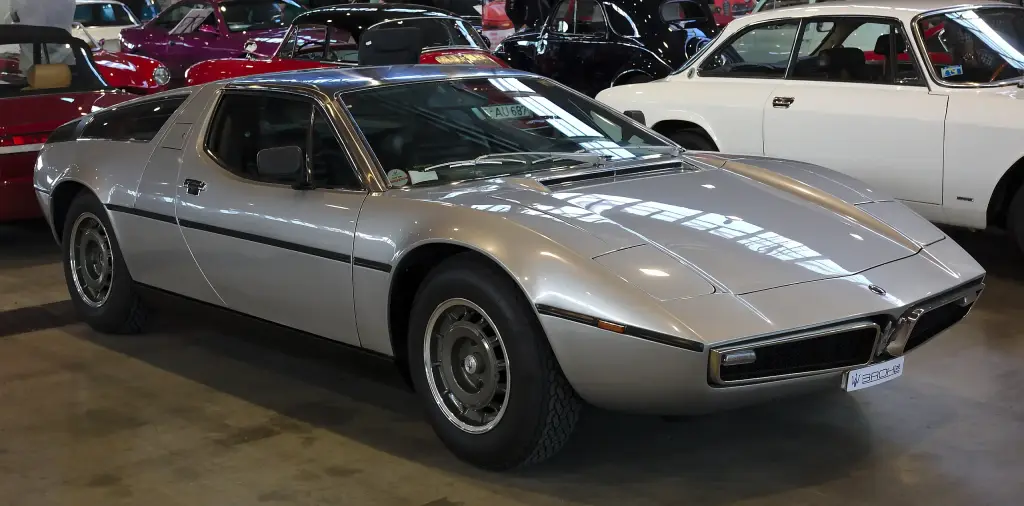
Design and practicality
The Bora was designed by Giorgetto Giugiaro at Italdesign in the late 1960s and came to market with a drag coefficient of 0.30, a figure still considered very aerodynamic a decade later; the all-steel panels were made by Officine Padane of Modena. Compared with other supercars the Bora was civilised and practical. It had a hydraulically powered pedal cluster that could be moved forwards and backwards at the touch of a button, and a steering wheel that could be tilted as well as telescoped, which addressed the usual difficulty of getting in and out. It had a full-size trunk in the front and used dual-pane insulative glazing between cabin and engine compartment, plus a carpeted aluminium engine cover, to reduce noise, harshness and vibration. The engine and five-speed ZF transaxle were mounted on a subframe attached to the floor pan through four flexible mounts, which also helped ride quality.
Engines
The original engine was a high-revving 4,719 cc V8 producing 310 PS at 6,000 rpm and 461 N·m at 4,200 rpm. US-bound cars used the larger 4.9-litre engine from the Ghibli to compensate for power lost to exhaust emission regulations. In 1976 Maserati switched to the larger 4.9-litre engine with an 8.75:1 compression ratio, rated at 330 PS at 5,500 rpm and 481 N·m at 4,000 rpm outside the United States. Both engines traced their lineage to the 450S racing car, were made of aluminium alloy and had hemispherical combustion chambers with 16 valves operated by four chain-driven camshafts. They were mounted longitudinally in the middle of the car, mated to a ZF-1 five-speed transaxle driving the rear wheels, and fed by four 42 DCNF/14 downdraught Weber carburettors with Bosch electronic ignition. The most distinctive details were the brushed stainless steel roof and windscreen pillars, and inside the bucket seats, dash, door trim, centre console and rear bulkhead were trimmed in leather, with electric windows and air conditioning as standard.
Merak and racing
The Bora provided the basis for the Merak, which used the same front bodyshell in a 2+2 configuration made possible by a smaller, lighter and less powerful Maserati V6 also used in the Citroën SM; the Merak had an open rear engine cover instead of the Bora’s heavier glass-enclosed one. Maserati also built two Group 4 racing cars at the request of Thepenier, a French Maserati dealer. Tuned to 430 PS they were fully competitive, but Maserati could not build the 500 road cars required for homologation and the project was shelved.
Design and features
- First mid-engined Maserati: the engine sat behind the cabin in a steel monocoque.
- Independent suspension: the first Maserati with all-independent suspension.
- Aerodynamic body: Giugiaro styling with a drag coefficient of 0.30.
- Adjustable controls: a movable pedal box and a tilting, telescoping steering wheel.
- Refinement: dual-pane glazing and a carpeted engine cover kept noise out of the cabin.
Maserati Bora versions
- Bora 4.7 (1971–1976): the original car with 310 PS, 289 built.
- Bora 4.9 (1976–1978): the larger engine with 330 PS outside the US, 275 built.
- US-specification Bora: 4.9-litre engine with emission equipment and lower output.
- Group 4 cars: two 430 PS racing cars built for a French dealer.
The Bora was joined in the range by the Maserati Merak, which shared its bodyshell, and it was replaced at the top by the Maserati Khamsin. Its V8 line came from the 450S racing car. More cars are in the Maserati collection.
Sources
- Maserati Bora, English Wikipedia: history, design, engines, production