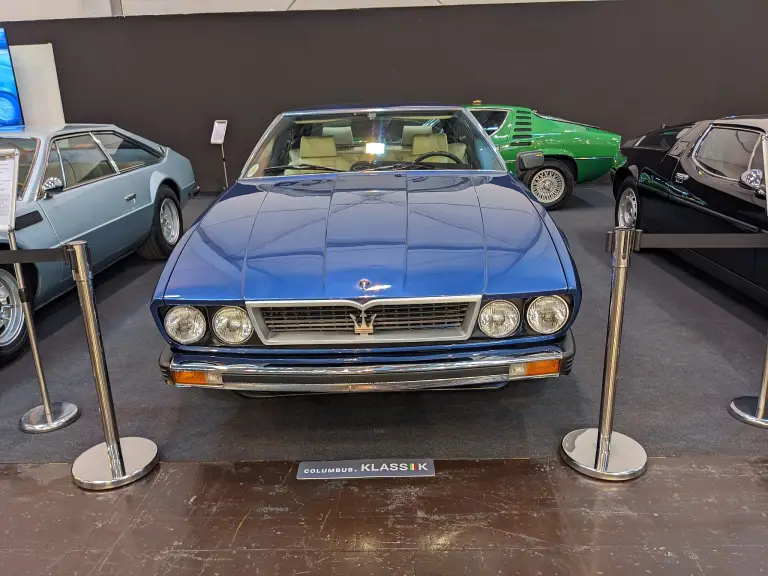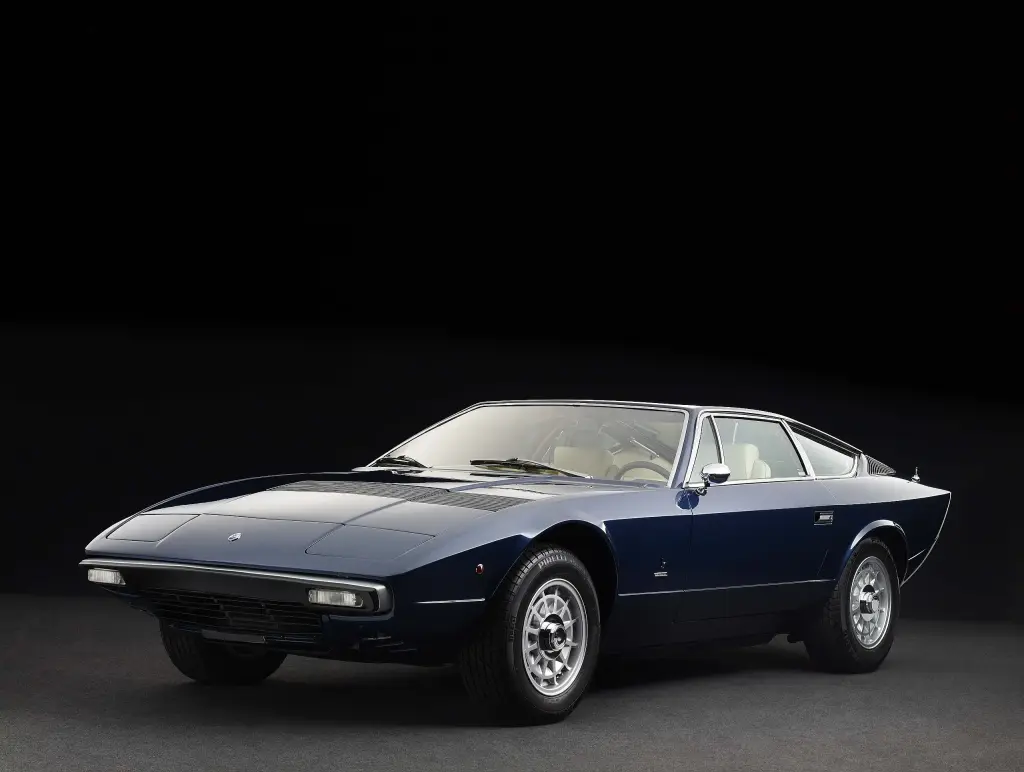
The Maserati Khamsin, internally Tipo AM120, is a grand tourer produced between 1974 and 1982. Following Maserati tradition it was named after a wind, the Khamsin, a hot, violent gust that blows in the Egyptian desert for fifty days a year. It was sold alongside the De Tomaso-based Maserati Kyalami, also a V8 GT, between 1976 and 1982.
Maserati Khamsin at a glance
| Maker | Maserati, Modena |
|---|---|
| Project code | Tipo AM120 |
| Production | 1974–1982 |
| Design | Marcello Gandini, Bertone |
| Body | wedge-shaped fastback coupé with a glazed tail panel |
| Engine | 4,930 cc DOHC 16-valve V8, dry sump |
| Power | 330 PS (240 kW) at 5,500 rpm |
| Torque | 482 N·m at 4,000 rpm |
| Carburettors | four Weber 42 DCNF 41 |
| Gearbox | five-speed ZF manual; three-speed Borg Warner automatic optional |
| Suspension | double wishbones all round |
| Built | 435, of which 155 to the United States |
Based on one source: the English Wikipedia article on the Khamsin.
History of the Maserati Khamsin
The Khamsin was introduced on the Bertone stand at the November 1972 Turin Auto Show as a concept car. Designed by Marcello Gandini, it was Bertone’s first work for Maserati. Its design highlight was a clear rear section housing the tail lights, along with a sharp, angular shape in contrast to its predecessor. The production model was shown at the Paris Motor Show in March 1973, and regular production began only a year later, in 1974.
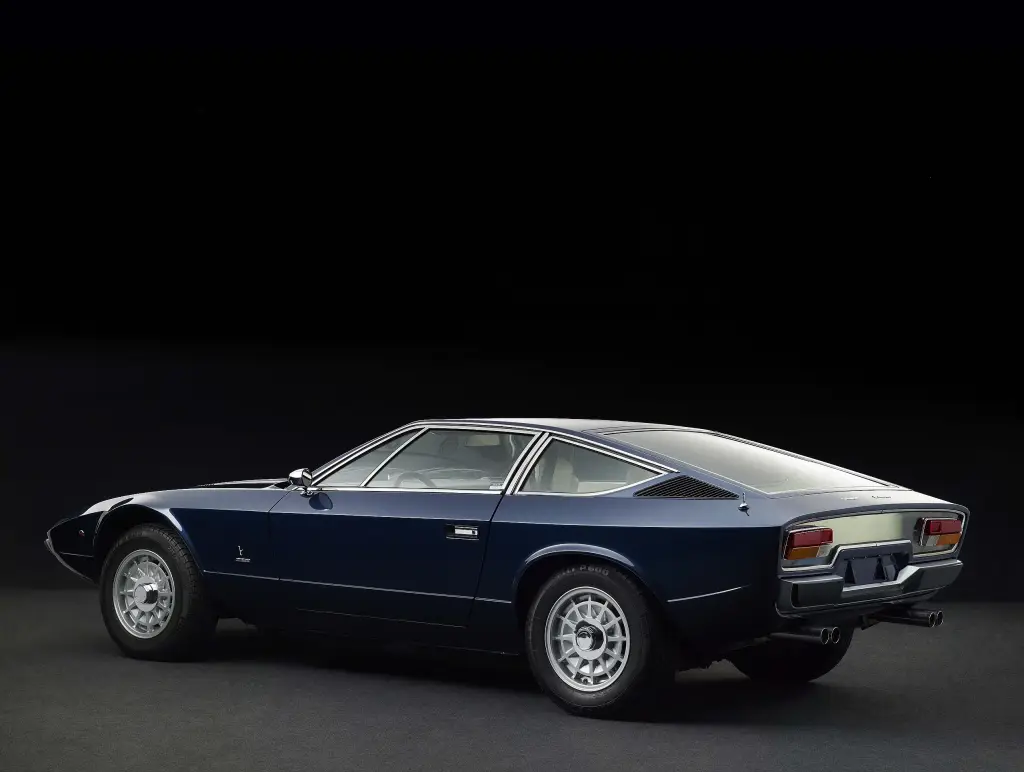
The Khamsin was developed under Citroën’s ownership for customers who wanted a front-engined grand tourer on the lines of the previous Ghibli, a more conventional proposition than the mid-engined Bora. In 1977 a mild facelift added three horizontal slats on the nose to aid cooling, a restyled dashboard and a new padded steering wheel. Despite the improvements over its predecessor the Khamsin did not repeat its success, partly because the fuel crisis reduced demand for large-displacement cars. Production ended in 1982 with 435 cars made, 155 of them exported to the United States, barely a third of the Ghibli’s total of 1,295.
Design
The body is prominently wedge-shaped with a fastback roofline and a kammback rear end. The tail is characterised by a full-width glass rear panel carrying inset “floating” tail lights; combined with the wide, almost all-glass rear hatch this gave exceptional rear visibility compared with most cars, especially sports cars. Cosmetic triangular vented panels are inlaid in the C-pillar, the right-hand one hiding the fuel filler cap, and the bonnet is pierced by asymmetrical vents. The wedge body, glazed tail panel and fuel filler position all carry Gandini’s signature and were present on his earlier Lamborghini Espada. Although marketed as a 2+2, the leather-trimmed rear seats, nestled between the two fuel tanks, lacked headroom and legroom. Instrumentation included speedometer, tachometer, water and oil temperature, oil pressure, voltmeter and a clock.
Engineering
The Khamsin used all-steel monocoque construction with a rear tubular subframe, insulated by Silentbloc bushings, carrying the rear suspension and differential. Suspension was double wishbones all round, a major improvement over the Ghibli’s leaf-sprung solid axle, with coaxial springs and dampers and anti-roll bars. The front-mid mounted engine gave a 50/50 weight distribution and sat so far back that the full-size spare wheel was stored beneath the radiator in front of it, freeing space in the boot. Apart from Bosch electronic ignition, the 4,930 cc double-overhead-camshaft 16-valve V8 was carried over from the Ghibli SS, giving 330 PS at 5,500 rpm and 482 N·m at 4,000 rpm, fed through four double-barrel Weber 42 DCNF 41 carburettors and using dry-sump lubrication. The twin fuel tanks were retained from the Ghibli, with a small tank on the right feeding the main tank below the cargo floor through a single filler. Power went to the rear wheels through a five-speed all-synchromesh ZF manual with a single-plate dry clutch, or a three-speed Borg Warner automatic on request, on 215/70 Michelin XWX or Pirelli Cinturato CN12 tyres and 7½J 15-inch Campagnolo alloy wheels.
Having been developed under Citroën ownership, the Khamsin made wide use of Citroën high-pressure hydraulics. The power steering used the Citroën SM’s DIRAVI speed-sensitive variable assistance, the all-round vented disc brakes and the clutch were hydraulically actuated and assisted, and the adjustable seats and pop-up headlights were hydraulically operated. An adjustable steering column, air conditioning, electric windows, a radio and full leather upholstery were standard. Maserati claimed a 270 km/h top speed for the European-specification car. The DIRAVI system is full power steering with no mechanical connection between the wheel and the steering linkage in normal operation; only if hydraulic pressure is lost does a mechanical pinion drive the rack, and then with significant free play.
Design and features
- Gandini wedge: Bertone’s first Maserati, with a sharp nose and a glass tail panel.
- Exceptional rear visibility: a full-width glass tail and an almost all-glass hatch.
- 4.9-litre V8: the Ghibli SS engine with 330 PS and dry-sump lubrication.
- Balanced chassis: front-mid engine, 50/50 weight distribution and double wishbones all round.
- Citroën hydraulics: DIRAVI steering, hydraulic brakes, clutch, seats and headlights.
Maserati Khamsin versions
- Khamsin (1974–1977): the original car without nose slats.
- 1977 facelift: three cooling slats, restyled dashboard and padded wheel.
- US-specification cars: 155 of the 435 built were exported to the United States.
The Khamsin replaced the Maserati Ghibli and was sold alongside the Maserati Kyalami; its engine came from the Ghibli SS and its hydraulic systems from Citroën, as on the Merak. More cars are in the Maserati collection.
Sources
- Maserati Khamsin, English Wikipedia: history, design, engineering, production