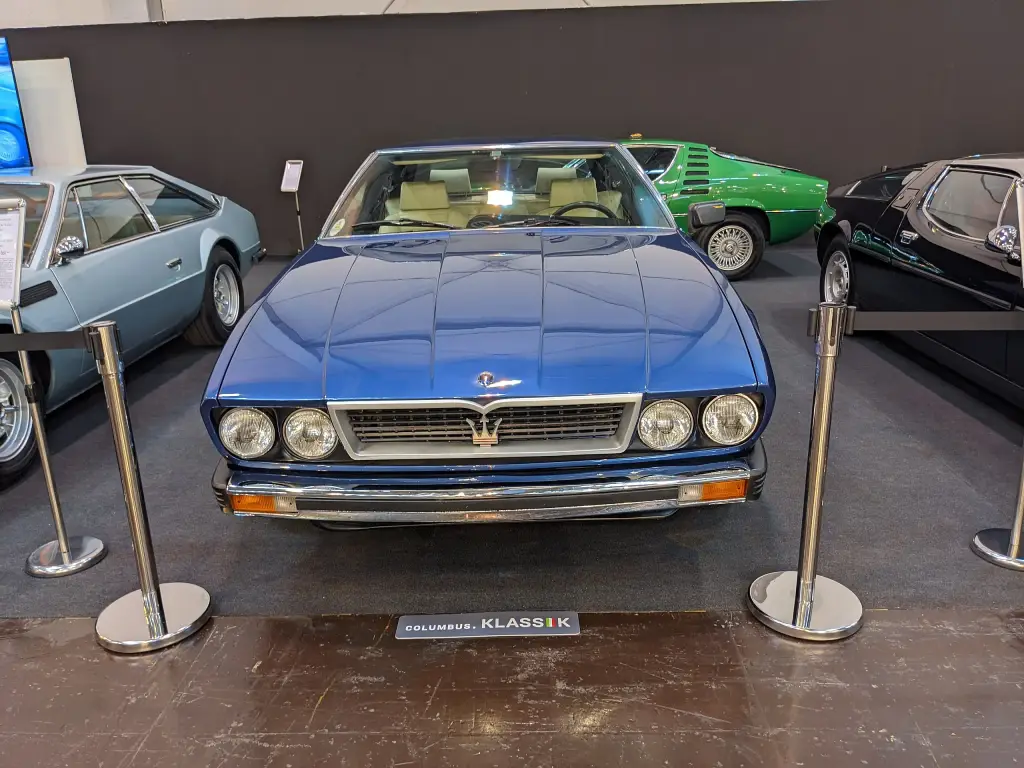
The Maserati Kyalami, internally Tipo AM129, is a four-seat GT coupé produced from 1976 to 1983. It was named after the Kyalami Grand Prix Circuit in South Africa, where a Maserati-powered Cooper T81 won the 1967 South African Grand Prix. It was the first new model developed under Alejandro de Tomaso’s ownership and the last Maserati to use the quad-cam V8.
Maserati Kyalami at a glance
| Maker | Maserati, Modena |
|---|---|
| Project code | Tipo AM129 |
| Production | 1976–1983 |
| Design | Pietro Frua, restyling a Tom Tjaarda body |
| Based on | De Tomaso Longchamp |
| Body | two-door notchback four-seat coupé |
| 4.2-litre V8 | 265 PS at 6,000 rpm |
| 4.9-litre V8 | 280 PS at 5,600 rpm, from 1978 |
| Gearbox | five-speed ZF manual; three-speed Borg Warner automatic optional |
| Top speed | 240 km/h claimed for both versions |
| Built | 210, of which 54 right-hand drive |
Based on one source: the English Wikipedia article on the Kyalami.
History of the Maserati Kyalami
The Kyalami, a notchback two-door grand tourer, was the first new model developed under De Tomaso’s ownership. It was derived from the De Tomaso Longchamp and is hard to tell apart from it, even though the two share no body panels. When De Tomaso acquired Maserati after the end of Citroën ownership in 1975 he found the brand in dire financial straits. Needing a new flagship model to improve sales, he used the recently unsuccessful Longchamp as a base to save development costs, and commissioned Pietro Frua to restyle the Tom Tjaarda-designed car and give it a distinctive Maserati feel.
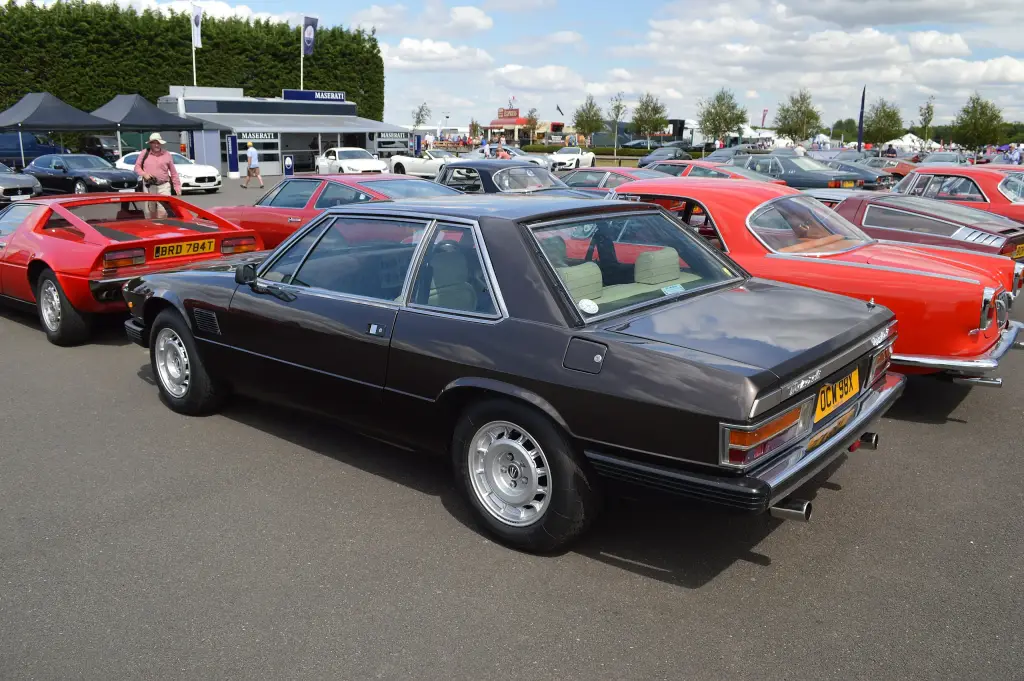
The edgy lines of the Longchamp were softened and the headlamps were replaced by quad-round units; the car was also lowered, lengthened and widened for a sportier character. The move was disliked by purists, which showed in declining interest. The interior was upgraded with classic Maserati elements such as the steering wheel and instrumentation, upholstered in premium Connolly leather with plush carpeting, and the boxy roof made it easy to seat taller passengers. A quad-cam Maserati 90-degree V8 replaced the American Ford V8 of the Longchamp, and the Kyalami was the last car to use this engine. It was not a sales success: 210 examples were built, 54 of them right-hand drive, before it was quietly discontinued.
Engines and chassis
The Kyalami was launched at the 1976 Geneva Motor Show with a 265 PS 4.2-litre V8 with a 6,000 rpm redline. From 1978 an enlarged 4.9-litre version was also available, rated at 280 PS at 5,600 rpm. Both engines were coupled to a five-speed ZF manual or, on request, a three-speed Borg Warner automatic, and were equipped with Weber downdraught carburettors and dry-sump lubrication; most cars built received the manual. Mechanically the Kyalami was closely related to the contemporary Quattroporte III, which used the same engines but a Chrysler-built automatic instead of the Borg Warner unit. Maserati claimed 240 km/h for both versions, and comparison tests found the Kyalami a better-performing car than the Longchamp it was based on, primarily because of its manual gearbox.
Convertible
A convertible prototype was built by Carrozzeria Frua but rejected by Maserati. Even so, some customers wanted such a variant and an independent German tuning company began offering a conversion; at least two cars are known to have been converted, both with the 4.2-litre engine.
Design and features
- De Tomaso base: the Longchamp structure with Maserati styling and engine.
- Quad-cam V8: 265 PS from 4.2 litres, or 280 PS from 4.9 litres.
- Frua restyling: softened lines, quad round headlamps and a more Maserati-like interior.
- Manual gearbox: most cars were built with the five-speed ZF.
- Rare: 210 built, 54 of them right-hand drive.
Maserati Kyalami versions
- Kyalami 4.2 (1976–1983): the original 265 PS car.
- Kyalami 4.9 (1978–1983): the enlarged 280 PS engine.
- Automatic cars: three-speed Borg Warner transmission on request.
- Convertible conversions: at least two cars converted by a German tuner.
The Kyalami was sold alongside the Maserati Khamsin and shared its engines with the Maserati Quattroporte III; it followed the De Tomaso takeover that also shaped the Biturbo. More cars are in the Maserati collection.
Sources
- Maserati Kyalami, English Wikipedia: history, engines, production