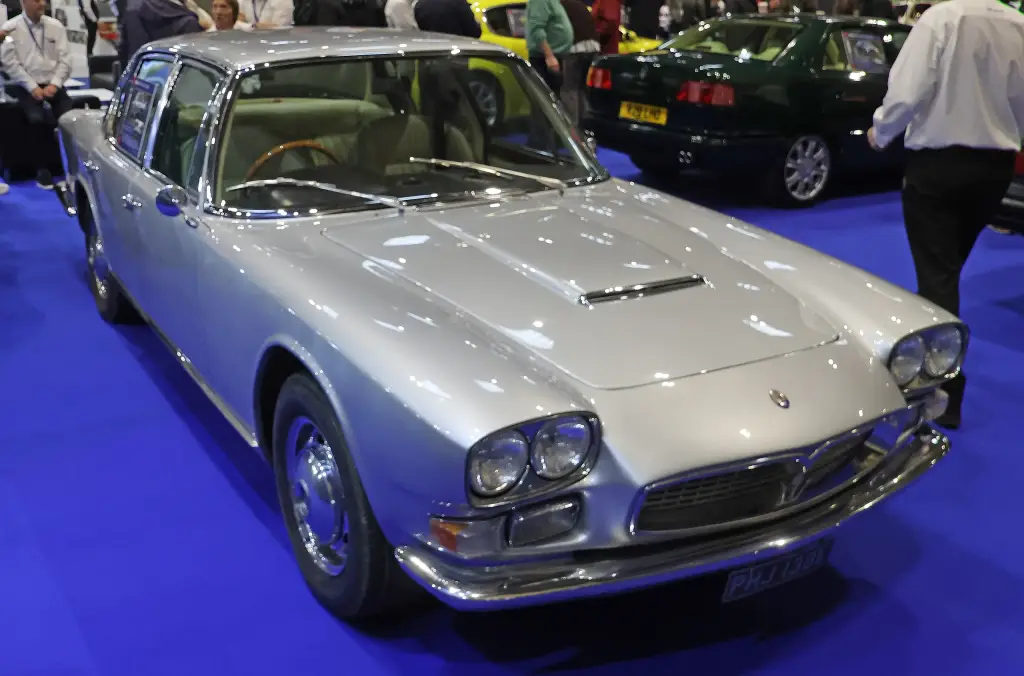
The Maserati Quattroporte is a four-door luxury saloon whose name means “four doors” in Italian. The first generation was introduced in 1963 and production of the sixth generation ended in late 2023. This article covers the first two generations, the V8 saloon of 1963–1969 and the Citroën-based car of 1974–1978.
Maserati Quattroporte at a glance
| Maker | Maserati, Modena |
|---|---|
| First generation | Tipo AM107, 1963–1969 |
| Second generation | Tipo AM123, 1974–1978 |
| First-generation design | Pietro Frua, built by Vignale |
| Series I engine | 4,136 cc V8, 260 PS at 5,000 rpm |
| Series II engine | 4.1 litres, and 4.7 litres from 1968 with 290 PS |
| Gearbox | five-speed ZF manual or three-speed Borg Warner automatic |
| Top speed | 230 km/h; 255 km/h for the 4.7 |
| First-generation built | 776 |
| Second-generation layout | front-mid engine, front-wheel drive, hydropneumatic suspension |
Based on one source: the English Wikipedia article on the Quattroporte. This page describes the first and second generations only, the part of the article used as material.
History of the Maserati Quattroporte
The original Quattroporte, Tipo AM107, was built between 1963 and 1969. It was a large saloon powered by a V8 engine, both firsts for a series-production Maserati. The task of styling it was given to the Turinese coachbuilder Pietro Frua, who drew inspiration from a special 5000 GT, chassis 103.060, which he had designed in 1962 for Prince Karim Aga Khan; the design was by Frua but the body was built by Vignale. The car was introduced at the Turin Motor Show in October–November 1963, with a pre-production prototype on the Maserati stand next to the Mistral coupé, and regular production began in 1964. The Tipo 107 joined two other grand tourers, the Facel Vega and the Lagonda Rapide, capable of 200 km/h on the new European motorways.
Series I and II
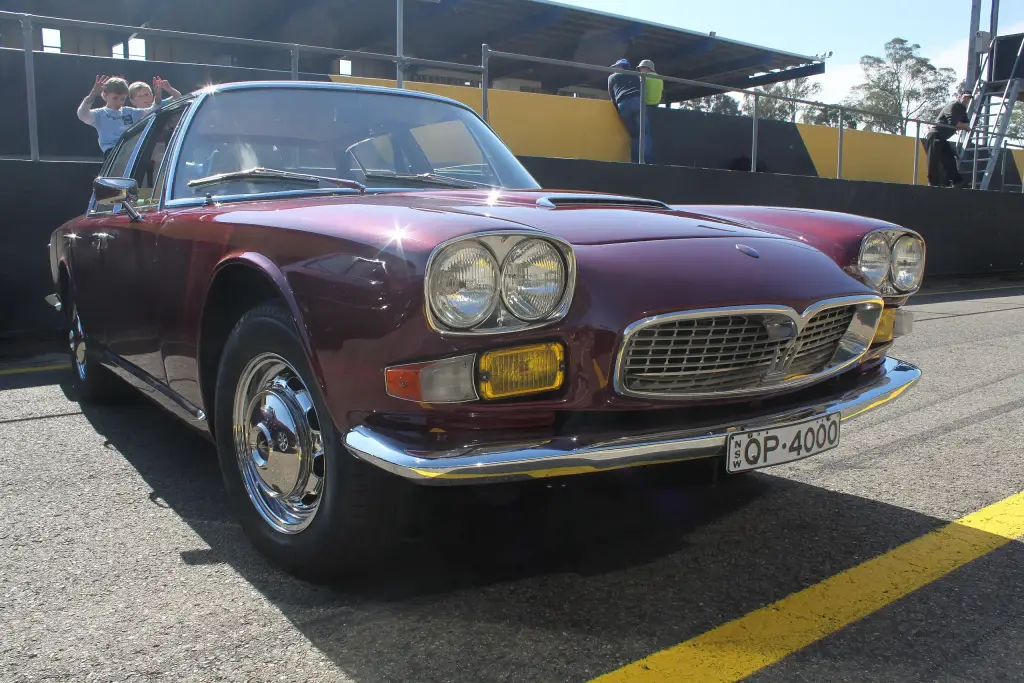
The first series was equipped with a 4,136 cc V8 rated at 260 PS at 5,000 rpm, with a five-speed ZF manual or a three-speed Borg Warner automatic on request, and Maserati claimed 230 km/h. The car was exported to the United States, where federal rules required twin round headlamps in place of the single rectangular ones of European models. Maserati built 230 first-generation Quattroportes between 1963 and 1966. In 1966 the Tipo 107 was revised with the twin headlights already used in the United States and a leaf-sprung solid axle in place of the previous de Dion tube, and the interior was completely redesigned with a full-width wood-trimmed fascia. In 1968 a 4.7-litre version, the AM107/4700, joined the 4.1-litre car with 290 PS and a claimed 255 km/h, making it the fastest four-door saloon in the world at the time. Around 500 second-series cars were made, for a total of 776 Tipo 107 Quattroportes, and production ended in 1969.
Engineering
The first generation had a steel unibody structure with a front subframe. Front suspension was independent with coil springs and hydraulic dampers; the rear used a coil-sprung de Dion tube with inboard brakes on the first series, later changed to a more conventional Salisbury leaf-sprung solid axle with a single trailing link. Both axles had anti-roll bars, brakes were solid Girling discs all round and a limited-slip differential was optional. The long-lived quad-cam all-aluminium Maserati V8 made its debut in the Quattroporte, with two chain-driven overhead camshafts per bank, 16 angled valves, hemispherical combustion chambers, inserted cast-iron wet liners and an aluminium water-cooled inlet manifold feeding four downdraft twin-choke Weber carburettors, initially 38 DCNL 5 and 40 DCNL 5 on the 4.2 and 4.7 cars and later 40 DCNF 5 and 42 DCNF 5 from December 1968.
The Aga Khan special and the second generation
In 1971 Karim Aga Khan ordered another one-off based on the Maserati Indy platform, with Rory Brown as chief engineer. It received the 4.9-litre V8 rated at 300 PS and a body designed by Frua, and was production-ready under its own chassis code, AM 121, but new owner Citroën used its influence to have Maserati develop the SM-based Quattroporte II instead; only two cars were finished, chassis 004 sold to the Aga Khan in 1974 and prototype 002 bought by the King of Spain directly from Frua. The second-generation Quattroporte, AM 123, was introduced at the Paris and Turin motor shows in October 1974. A result of Citroën’s joint venture with Maserati, it was very different from its predecessor: based on a stretched Citroën SM chassis, it had a front-mid engine, front-wheel drive, hydropneumatic suspension, four fixed headlamps with two swivelling directional lights and a V6 engine, with bodywork by Marcello Gandini at Bertone. Maserati had planned a V8 but the Tipo 107 unit was too large and obsolete for the SM-based chassis; a 4.0-litre V8 was built from two compact Citroën-Maserati V6 engines by cutting and welding blocks, giving an estimated 260 PS, and was tested in a Citroën SM for 17,000 km to prove the chassis could take the extra power. Alejandro de Tomaso, who took over Maserati in 1975, cancelled the V8 programme, and a single running prototype of the Quattroporte II was built and tested in 1974.
Design and features
- First four-door Maserati: a large V8 saloon introduced in 1963.
- Frua design: inspired by a 5000 GT built for the Aga Khan and bodied by Vignale.
- Fastest saloon of its time: the 4.7-litre Series II claimed 255 km/h.
- Quad-cam V8 debut: the all-aluminium engine that later powered other Maseratis.
- Citroën-era second generation: front-wheel drive, hydropneumatic suspension and a V6.
Maserati Quattroporte versions
- Quattroporte Series I (1963–1966): 4.1-litre V8, 230 built.
- Quattroporte Series II (1966–1969): twin headlights, leaf-sprung axle, 4.7 from 1968.
- AM 121 special (1971): Aga Khan one-off with a 4.9-litre V8, two cars finished.
- Quattroporte II (1974–1978): Citroën SM-based, front-wheel drive and V6.
The first Quattroporte’s chassis and V8 also served the Maserati Mexico, and its engines were shared with the Kyalami. The later generations continued the line up to the GranTurismo era. More cars are in the Maserati collection.
Sources
- Maserati Quattroporte, English Wikipedia: first and second generations, engineering