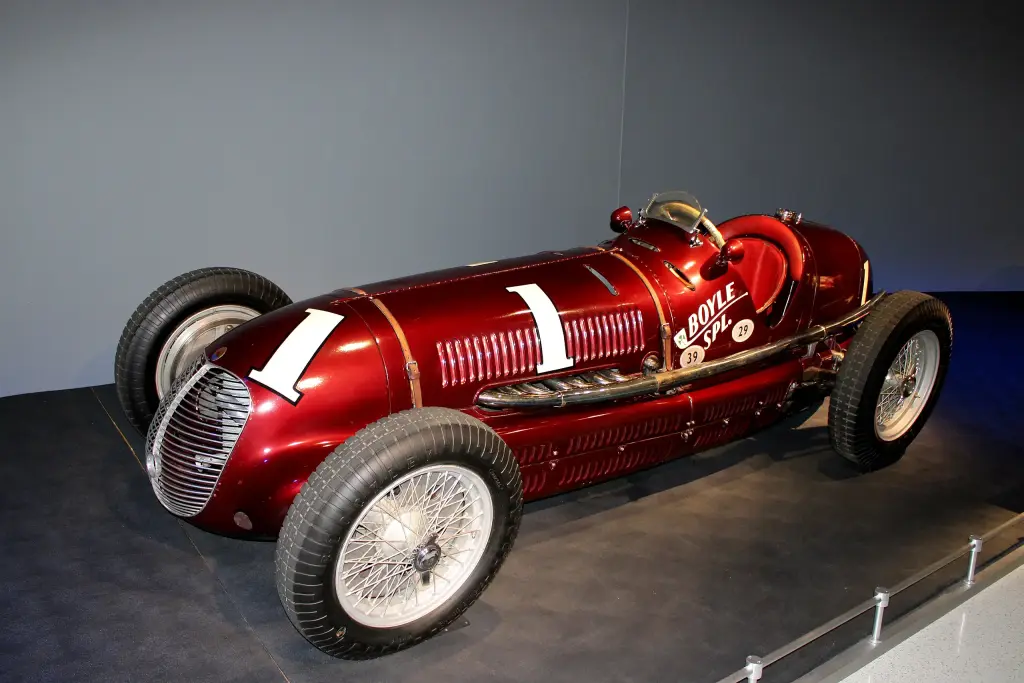
The Maserati 8CTF is an open-wheel Grand Prix racing car designed and built by Maserati from 1938 to 1939. It remains the only Italian-made car to win the Indianapolis 500, a feat achieved by Wilbur Shaw in 1939 and 1940 with the car nicknamed Boyle Special. Its name stands for eight cylinders, testa (head) and fissa (fixed).
Maserati 8CTF at a glance
| Maker | Maserati, Modena |
|---|---|
| Production | 1938–1939 |
| Class | Grand Prix, single-seater; Indianapolis 500 |
| Engine | 2,991.4 cc inline-eight, 69 mm × 100 mm |
| Superchargers | two Roots type, one per bank of four cylinders |
| Carburettors | two Memini MA12, upstream of the blowers |
| Power | 350–366 hp at 6,300 rpm |
| Compression | 6.5:1 |
| Brakes | hydraulic drums |
| Top speed | 290 km/h |
| Debut | Tripoli Grand Prix, 15 May 1938 |
| Indianapolis wins | 1939 and 1940, Wilbur Shaw |
History of the Maserati 8CTF
The 8CTF was created after Adolfo Orsi took over Maserati and solved the manufacturer’s financial problems. Ernesto Maserati was no longer so constrained by the budget and conceived a supercharged three-litre car, drawing on experience with that type of fuel. The abbreviation stands for 8C, the total number of cylinders, T for testa (head) and F for fissa (fixed). Its main feature was an independent power supply for each series of four cylinders, so it fitted two Roots-type compressors; after later improvements the engine delivered 366 hp in 1939. Another peculiarity was that the oil tank also acted as a central cross member of the frame.
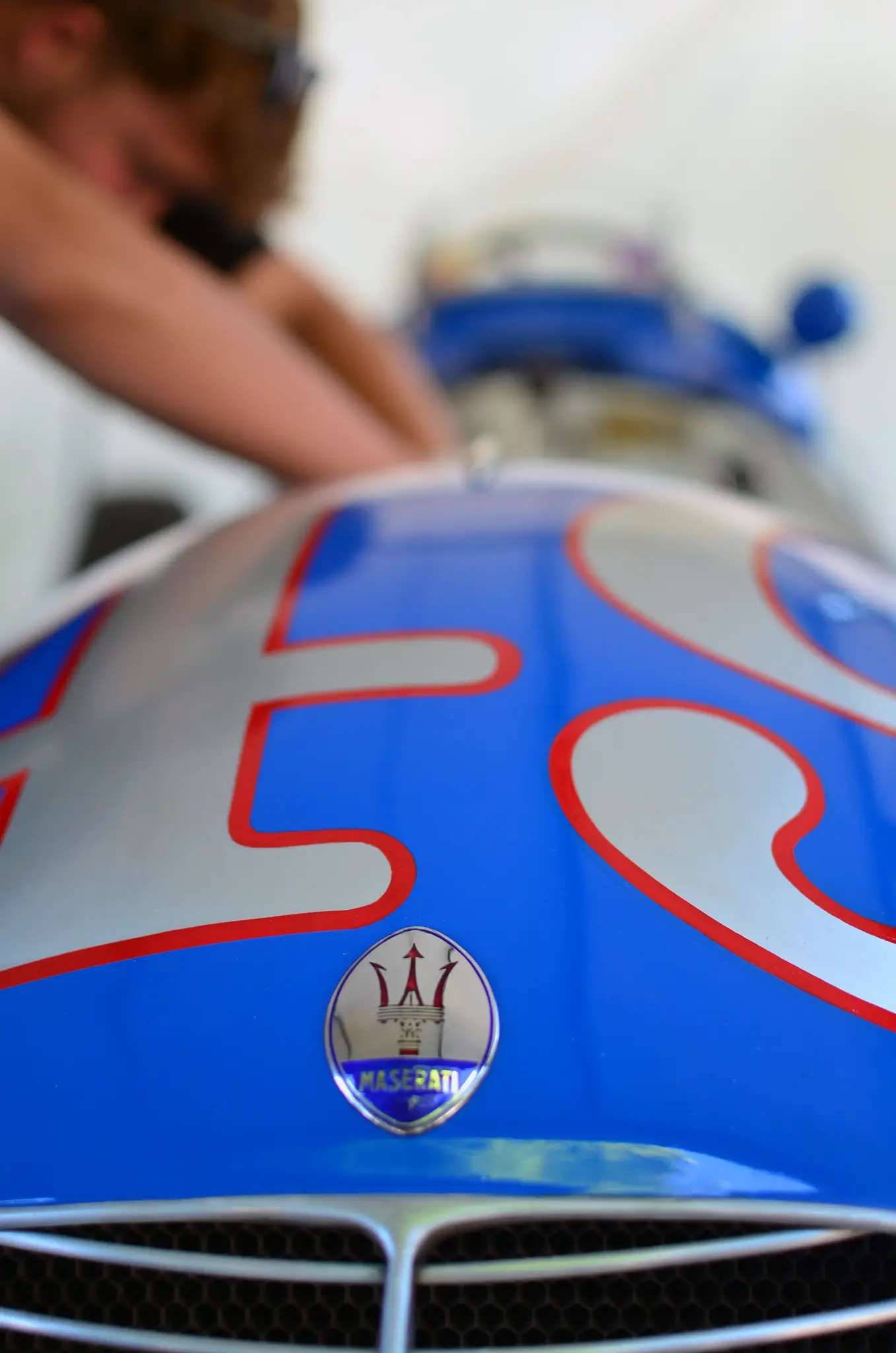
The model debuted on 15 May 1938 at the Tripoli Grand Prix with excellent performance but failed in the final result. As the Second World War approached, races thinned out considerably, which compromised the development of the car.
Indianapolis
With Wilbur Shaw at the wheel, the 8CTF won two editions of the Indianapolis 500, in 1939 and 1940. The car that won the famous race was nicknamed the Boyle Special and is now in the Indianapolis Motor Speedway Museum.
Engineering
Ignition was by a single magneto, induction was forced by two Roots-type compressors coupled to two Memini MA12 carburettors mounted upstream of the blowers, and the distribution had two valves per cylinder arranged at 90 degrees with twin overhead camshafts. Lubrication was forced with delivery and recovery pumps and cooling was by water circulation with a centrifugal pump. The eight-cylinder inline engine had a 2,991.4 cc displacement with a 69 mm bore and 100 mm stroke, a 6.5:1 compression ratio and 350 to 366 hp at 6,300 rpm. The brakes were hydraulic drums, the front suspension used independent wheels with torsion bars and the rear leaf springs, both with anti-roll bars and friction dampers, the steering was worm and sector and the transmission a four-speed gearbox plus reverse. The body was an open-wheel aluminium shell on a chassis of two steel side members with crossbars, and the car reached 290 km/h. The 8CTF was in effect a modified, lengthened 6CM with a three-litre supercharged engine, built to take on the Mercedes-Benz and Auto Union cars.
Design and features
- Two superchargers: independent induction for each bank of four cylinders.
- 366 hp: three litres with a 6.5:1 compression ratio and twin Memini carburettors.
- Indianapolis record: Wilbur Shaw’s wins of 1939 and 1940 in the Boyle Special.
- Oil tank as chassis member: an unusual piece of packaging that stiffened the frame.
- 290 km/h: a very high top speed for a 1939 Grand Prix car.
Maserati 8CTF versions
- 8CTF (1938–1939): the standard Grand Prix car, 350 to 366 hp.
- Boyle Special: the Indianapolis-winning car of Wilbur Shaw, 1939 and 1940.
- 1939 engine: later improvements raised output to 366 hp.
The 8CTF was a lengthened Maserati 6CM and followed the Maserati 6C 34; its six-cylinder voiturette sibling was the 4CL. More cars are in the Maserati collection.
Sources
- Maserati 8CTF, English Wikipedia: history, engine, chassis, Indianapolis wins
- Maserati 6CM, English Wikipedia: relationship to the 6CM