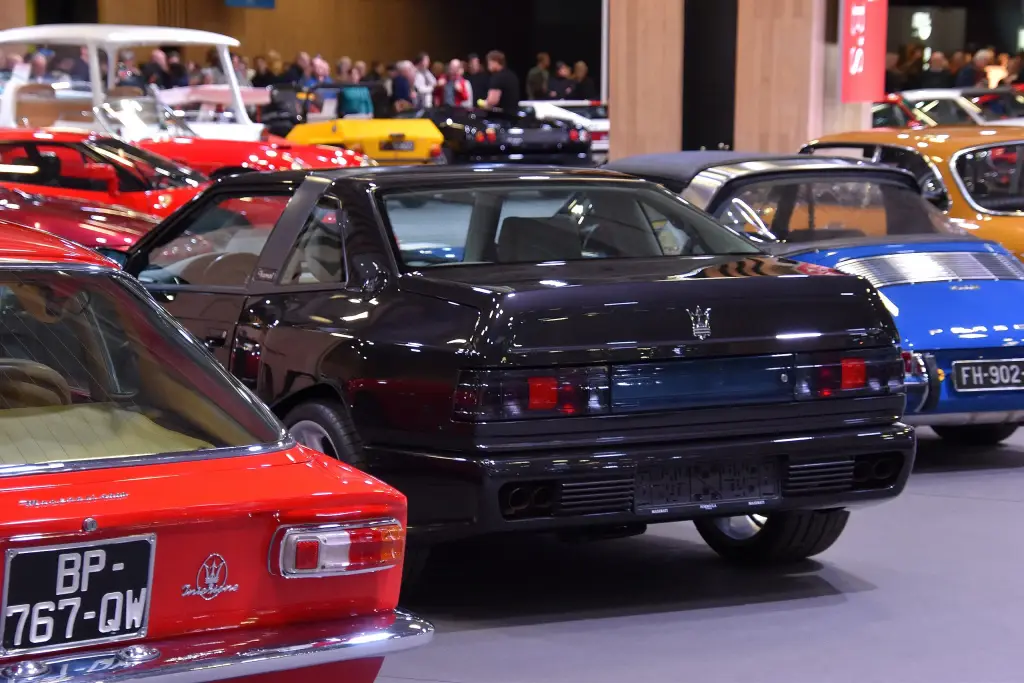
The Maserati Shamal, internally Tipo AM339, is a two-door grand touring coupé produced from 1990 to 1996. With its newly developed twin-turbocharged V8 it was Maserati’s flagship grand tourer, topping the line-up of V6-engined Biturbo coupés in both performance and price, at 125 million lire. Following Maserati tradition it was named after a wind, the shamal, a hot summer wind of Mesopotamia.
Maserati Shamal at a glance
| Maker | Maserati, Modena |
|---|---|
| Project code | Tipo AM339 |
| Production | 1990–1996 |
| Design | Marcello Gandini with the Maserati styling department |
| Body | two-door coupé on a 2.4 m wheelbase |
| Engine | 3,217 cc V8, 80 mm × 80 mm, twin-turbocharged |
| Power | 326 PS (240 kW) at 6,000 rpm |
| Torque | 431 N·m at 3,000 rpm |
| Gearbox | six-speed Getrag G560 manual |
| Suspension | MacPherson struts front, semi-trailing arms rear, Koni adaptive dampers |
| Top speed | 270 km/h |
| Built | 369 |
Based on one source: the English Wikipedia article on the Shamal.
History of the Maserati Shamal
The Shamal was introduced on 14 December 1989 in Modena, when Maserati president and owner Alejandro de Tomaso showed it to the press. It was the last model announced under De Tomaso ownership: in January 1990 half of the debt-plagued company was acquired by Fiat. Sales began in 1990 and the final year of production was 1996; factory figures indicate that 369 examples were produced. In 2020 Maserati revisited the Shamal with the cyberpunk-themed Project Rekall restomod concept.
Design
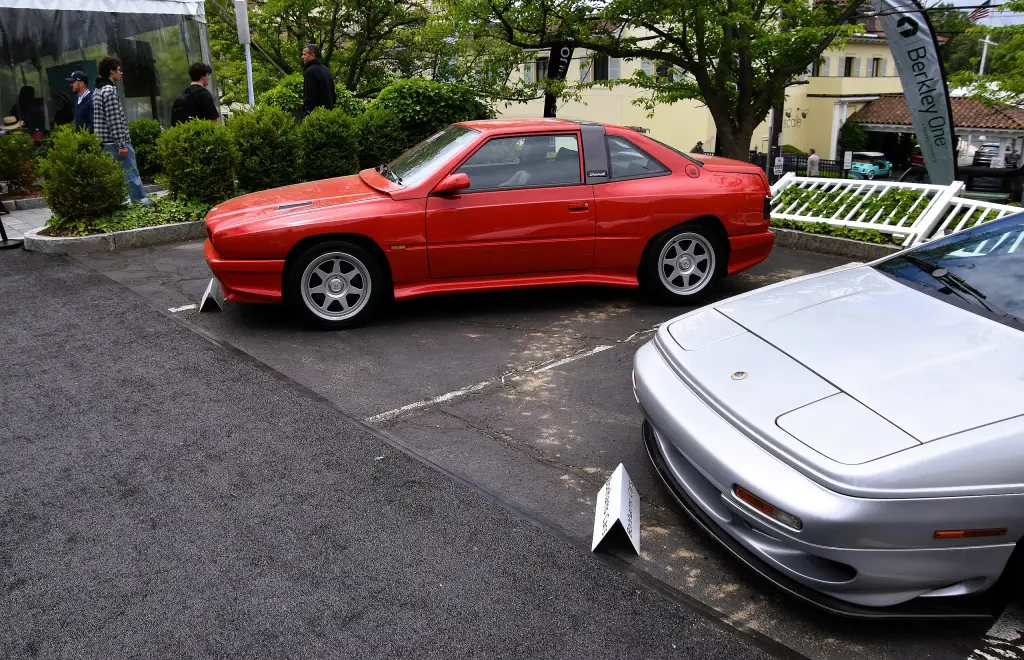
The Shamal was designed in collaboration by Marcello Gandini and Maserati’s own styling department. A debt-ridden Maserati could not develop an entirely new car, so the Shamal shows its Biturbo heritage in the doors, interior and basic bodyshell, which were carried over. It sits on the shorter 2.4-metre wheelbase also used by the Biturbo Spyder and Karif. Gandini’s signature is visible in the slanted rear wheel arch, also seen on the Quattroporte IV and first used on the Lamborghini Countach. An unusual element was the additional spoiler in front of the windscreen, also used on his redesign of the De Tomaso Pantera and later across the rest of the Biturbo-based line-up, intended to direct air and water across the screen and push the wipers down at speed; no other carmaker adopted it.
The centre pillar is an actual roll bar rather than a styling element, finished in black and wrapping around the cabin, with “Shamal” badging in chrome on either side. The car came with 16-inch alloy wheels, a small rear spoiler and a blacked-out grille with chrome accents, the only chrome apart from the badging. Another defining feature is its numerous headlamps in individual housings: outer round Carello low beams of the then-new projector type, inner rectangular high beams, combined turn signals and position lamps in the bumper and two pairs of square lights in the lower grille for fog and driving lamps. That headlight design was introduced across the rest of the updated Biturbo range in 1991. The two-seat interior features extended leather seat cushions, temperature control and the famous Maserati oval clock in the centre of the dashboard, with leather or wood on almost everything the occupant touches, including the burled elm gear lever; the Shamal was less luxurious than the contemporary Ghibli. It was initially available only in red or black, with other colours later in production.
Engineering
The Shamal used a traditional front-engine, rear-wheel-drive layout and an all-steel unibody. Suspension was by MacPherson struts at the front and semi-trailing arms at the rear, and all cars had an adaptive suspension developed by Maserati together with Koni that varied damping rates according to road conditions and the desired comfort. The engine could be removed without a lift: it was mounted on a subframe that also held the intercoolers and radiator and could be slipped out of the front once the bumper was removed. Power came from the AM 479 3,217 cc V8 with an 80 mm bore and stroke, two overhead camshafts per bank and four valves per cylinder; it was essentially the Biturbo V6 with an extra bank of cylinders, twin-turbocharged with two IHI turbines and intercoolers and equipped with a Marelli IAW integrated ignition and fuel injection ECU per cylinder bank. It produced 326 PS at 6,000 rpm and 431 N·m at 3,000 rpm, sent to the rear wheels through a six-speed Getrag G560 manual, the same gearbox BMW used in the 850CSi, and Maserati’s Ranger limited-slip differential. Maserati claimed 270 km/h and 0 to 100 km/h in 5.3 seconds.
Design and features
- New V8 flagship: the Biturbo V6 with two extra cylinders, twin turbochargers and 326 PS.
- Gandini details: slanted rear wheel arches, a windscreen spoiler and the roll-bar pillar.
- Adaptive damping: Koni-developed suspension that varied its rates.
- Getrag gearbox: the six-speed G560 also used by the BMW 850CSi.
- Rare flagship: 369 built between 1990 and 1996.
Maserati Shamal versions
- Shamal (1990–1996): the standard car, 369 built.
- Early colours: red or black only at first, with more later.
- Project Rekall (2020): a restomod concept revisiting the Shamal.
The Shamal was the flagship of the Maserati Biturbo family and stood above the Karif; it was replaced at the top of the range by the 3200 GT. More cars are in the Maserati collection.
Sources
- Maserati Shamal, English Wikipedia: history, design, engine, production