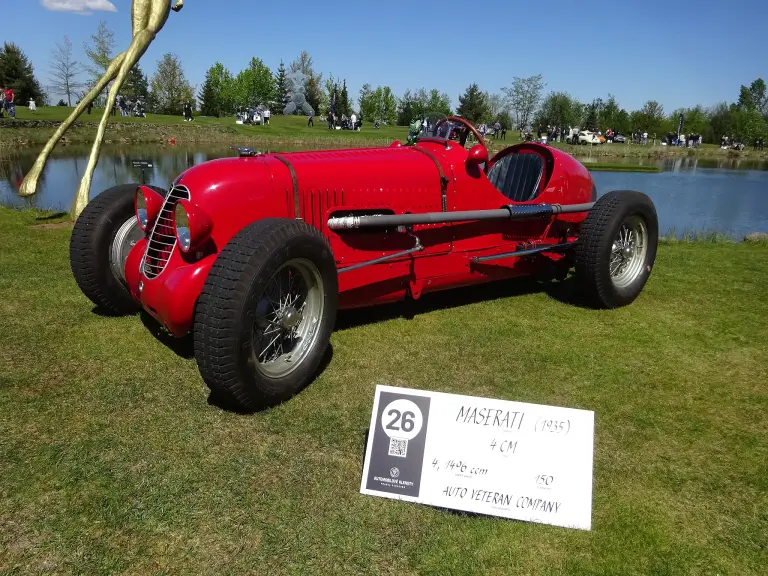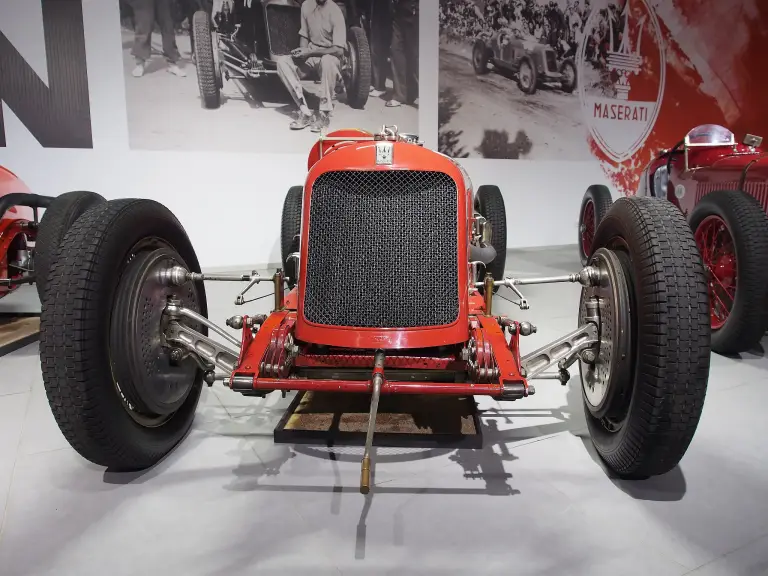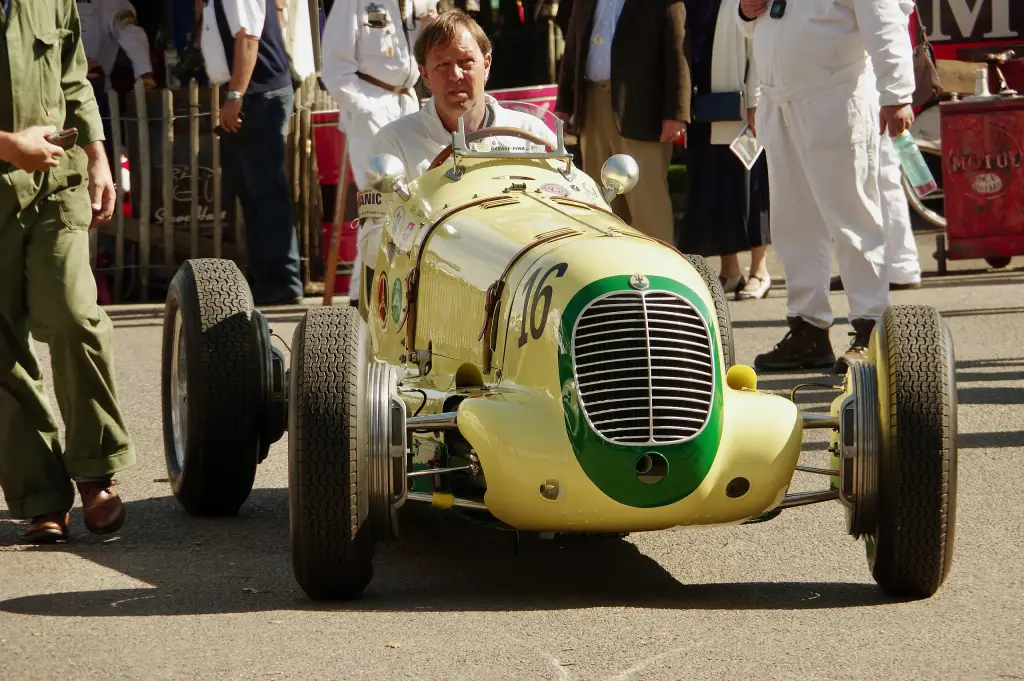
The Maserati 6CM is an Italian single-seater racing car built in Modena from 1936 to 1940 for the voiturette class. Twenty-seven were built on the Maserati 4CM frame, with front suspension as on the Maserati V8RI, and the car had a successful racing career from 1936 to 1939. It was shown to the public at the 1936 Milan Motor Show.
Maserati 6CM at a glance
| Maker | Maserati, Modena |
|---|---|
| Production | 1936–1940 |
| Class | Voiturette, single-seater |
| Engine | 1,493.2 cc inline-six, 65 mm × 75 mm |
| Valves | two per cylinder, mounted at 90 degrees; twin overhead camshafts |
| Supercharger | Roots type |
| Carburettor | Weber 55ASI |
| Ignition | Scintilla |
| Power | 155 bhp at 6,200 rpm; 175 bhp at 6,600 rpm by 1939 |
| Dimensions | 3.72 m long, 1.48 m wide, 1.2 m high, 2.49 m wheelbase |
| Weight | 650 kg |
| Built | 27 |
Based on one source: the English Wikipedia article on the 6CM.
History of the Maserati 6CM
Maserati spent much of its early years building cars for privateers, and the 6CM was no exception. The 1,493.2 cc inline-six had a 65 mm bore and 75 mm stroke, two overhead valves per cylinder mounted at 90 degrees, a Roots-type supercharger and a Weber 55ASI carburettor, with Scintilla ignition and Pirelli tyres. With a four-speed gearbox plus reverse the first cars gave 155 bhp at 6,200 rpm, and output was up to 175 bhp at 6,600 rpm by 1939. The car measured 3.72 m long, 1.48 m wide and 1.2 m high, sat on a 2.49 m wheelbase with equal 1.2 m tracks, carried a single 120-litre tank and weighed 650 kg; rear tyres were narrower and taller than the front ones.
Racing
The 6CM was successful in Europe at a time when Grand Prix racing was becoming dominated by state-funded German teams, as Hitler funded both Daimler-Benz and Auto Union to prove German superiority. One of the twenty-seven cars, chassis 1532, was raced by Count Felice “Didi” Trossi, who won four of the five races he entered and finished second in the other; his most rewarding win came at Monaco. Chassis 1531 was highly competitive in the hands of the American driver Harry Schell at races such as Monaco and Goodwood. Modena, Maserati’s home track, saw three Maserati victories in the mid to late 1930s: one with the 4CM in 1935 and 6CM wins in 1936 and 1938.
Most cars were sold to private owners such as Austin Dobson, Lord Howe and John Peter Wakefield, and private teams including Scuderia Ambrosiana and Ecurie Helvetica ran them. Maserati’s works team also raced the 6CM successfully at the Grand Prix of Naples and the Targa Florio with Aldo Marazza, Luigi Villoresi and Ettore Bianco.
The 8CTF connection
The 8CTF was a modified 6CM with a supercharged three-litre engine of 365 hp, built to take on the Mercedes and Auto Union cars; the chassis was modified and lengthened to fit the bigger engine. At the 1938 Donington Grand Prix, Rudolf Uhlenhaut, technical director of the Mercedes racing department, inspected an 8CTF entered by Luigi Villoresi and remarked that if the Mercedes team had prepared the car it could have won the race.
Design and features
- Purpose-built voiturette: a 1.5-litre six in a light 650 kg single-seater.
- Privateer car: twenty-seven built and sold to owners and small teams.
- Trossi’s record: four wins and a second place from five races with chassis 1532.
- Modena wins: victories at the home track in 1936 and 1938.
- Basis of the 8CTF: the three-litre Indianapolis winner was a modified, lengthened 6CM.
Maserati 6CM versions
- 6CM (1936): the original 155 bhp car.
- 1939 specification: 175 bhp at 6,600 rpm.
- 8CTF: a lengthened 6CM with a three-litre supercharged engine.
The 6CM replaced the Maserati 4CM and led to the three-litre Maserati 8CTF. Its four-cylinder successor in the voiturette class was the 4CL. More cars are in the Maserati collection.
Sources
- Maserati 6CM, English Wikipedia: engine, dimensions, racing history