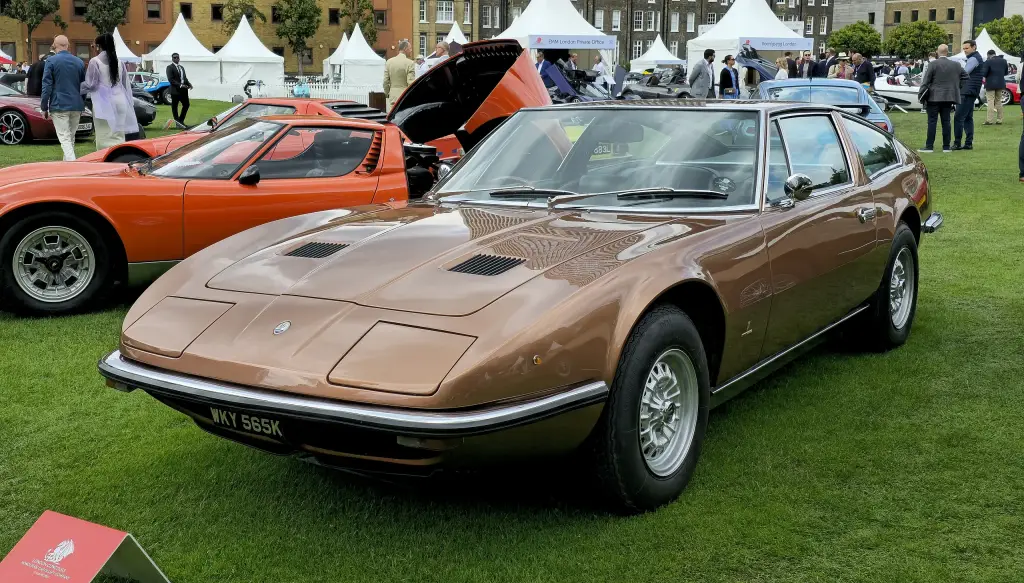
The Maserati Indy, internally Tipo AM116, is a four-seater fastback grand tourer produced from 1969 to 1975. It was the first car Maserati built under Citroën ownership, and it was named in honour of the marque’s two victories at the Indianapolis 500. In total 1,104 were made.
Maserati Indy at a glance
| Maker | Maserati, Modena |
|---|---|
| Project code | Tipo AM116 |
| Production | 1969–1975 |
| Body | four-seat fastback by Carrozzeria Vignale |
| Designers | Virginio Vairo and Elio Mainardi, Vignale technical office |
| Engine | all-aluminium V8, four overhead camshafts, four Weber 42 DCNF carburettors |
| Indy 4200 | 4.2-litre V8, from 1969, 440 built |
| Indy 4700 | 4.7-litre V8, from 1970, 364 built |
| Indy 4900 | 4.9-litre V8, from 1972, 300 built |
| Front suspension | double wishbones, coil springs, anti-roll bar |
| Rear suspension | live axle, semi-elliptic springs |
| Built | 1,104 |
Based on one source: the English Wikipedia article on the Indy.
History of the Maserati Indy
The Indy was conceived as an alternative to the Ghibli, offering a V8 engine and room for four people. It effectively replaced both the ageing six-cylinder 2+2 Maserati Sebring, which descended from the 1957 3500 GT, and the first-generation Quattroporte. Two coachbuilders showed proposals at the November 1968 Turin Motor Show, both based on a Maserati 4.2-litre chassis: on Ghia’s stand there was the Simùn, a 2+2 berlinetta designed by Giorgetto Giugiaro, and on Carrozzeria Vignale’s a sleek four-seater fastback penned by the internal technical office led by Virginio Vairo and Elio Mainardi. Both coachbuilders already had a relationship with Maserati, as Vignale had been responsible for the 3500 GT Spyder, Mexico and Sebring, while Giugiaro had recently penned the Ghibli at Ghia.
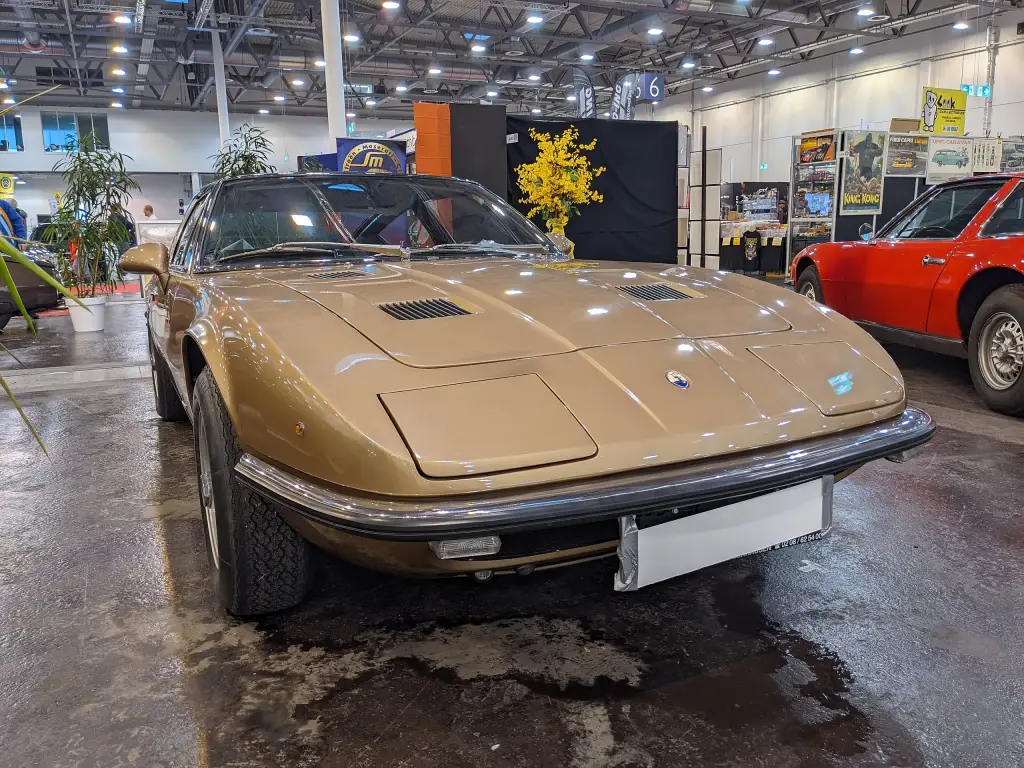
Vignale’s prototype was preferred and the production model was launched at the Geneva Motor Show the following March. The car was christened Indy in honour of Maserati’s two victories at the Indy 500. At its launch in 1969 the Indy was offered with a 4.2-litre V8; from 1970 a 4.7-litre Indy 4700 was offered alongside the 4200, and the same year brought interior updates including seats with retractable headrests and a new dashboard. In 1972 Maserati added the Indy 4900 to the range with the new 4.9-litre V8. Production ended in 1975 with 1,104 cars built, of which 440 were Indy 4200s, 364 were Indy 4700s and 300 were Indy 4900s.
Engineering
The Indy used unibody construction. Its suspension layout was shared with the Ghibli: double wishbones at the front with coaxial hydraulic dampers and coil springs and an anti-roll bar, and at the rear a live axle with semi-elliptic springs, a single longitudinal torque arm, hydraulic dampers and an anti-roll bar. Brakes were vented and servo-assisted discs on all four wheels. The engines were Maserati’s own all-aluminium, four-overhead-camshaft Tipo 107 V8 family, fed by four Weber 42 DCNF twin-choke carburettors; they had a wet sump and were therefore related to, but different from, the higher-output dry-sump Tipo 115 units of the flagship Ghibli.
Design and features
- Four-seat fastback: room for four in a Vignale body designed in-house.
- V8 range: 4.2-, 4.7- and 4.9-litre versions over the model’s life.
- Citroën-era first: the first Maserati produced under Citroën ownership.
- Ghibli chassis thinking: double wishbones at the front and a live axle at the rear.
- Indy name: a tribute to Maserati’s Indianapolis 500 victories.
Maserati Indy versions
- Indy 4200 (1969–1975): the original 4.2-litre car, 440 built.
- Indy 4700 (1970–1975): 4.7-litre engine and revised interior, 364 built.
- Indy 4900 (1972–1975): the 4.9-litre V8, 300 built.
The Indy replaced the Maserati Sebring and offered an alternative to the Maserati Ghibli; its V8 was related to the engine of the Bora. More cars are in the Maserati collection.
Sources
- Maserati Indy, English Wikipedia: history, versions, production, engineering