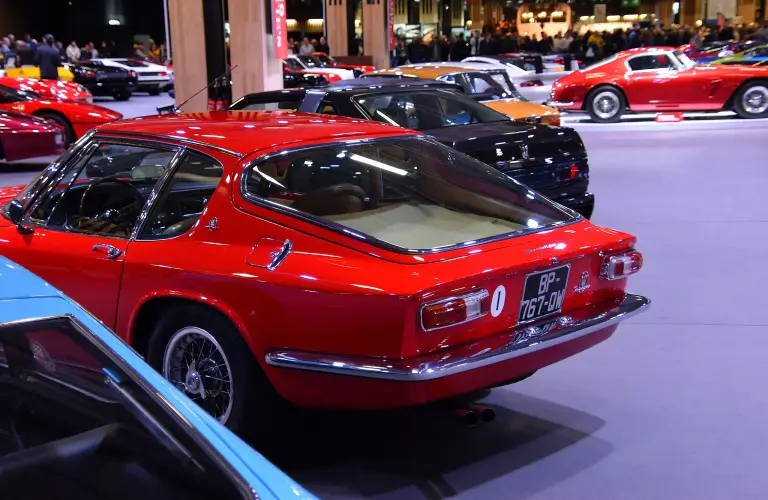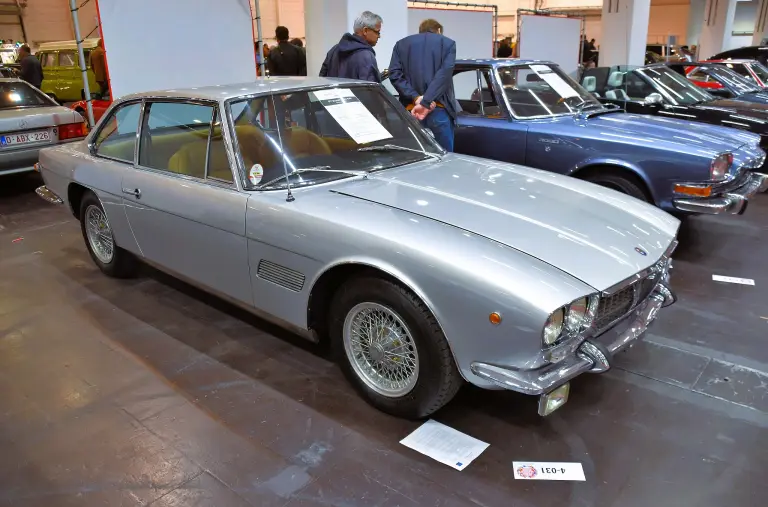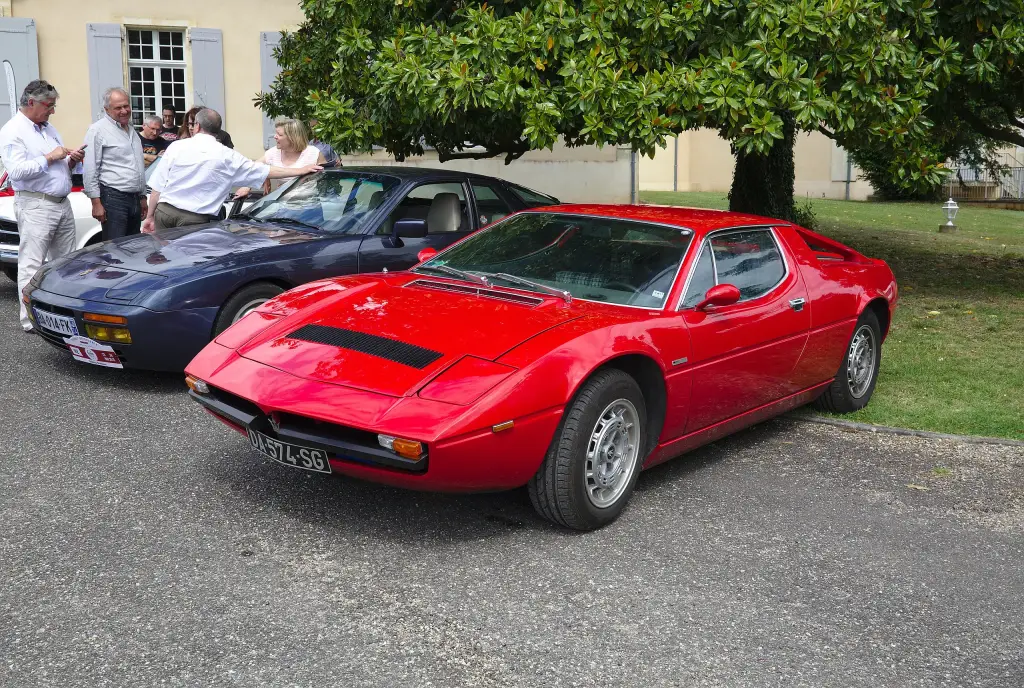
The Maserati Merak, internally Tipo AM122, is a mid-engined 2+2 sports car produced between 1972 and 1983. It was closely related to the Maserati Bora, sharing part of its structure and body panels, but used a three-litre V6 instead of the Bora’s 4.7-litre V8. The extra cabin space gained from the smaller powertrain allowed a second row of seats suitable for children or very small adults, making the Merak not just a cheaper alternative to the Bora but also a 2+2.
Maserati Merak at a glance
| Maker | Maserati, Modena |
|---|---|
| Project code | Tipo AM122; SS as AM122/A, 2000 GT as AM122/D |
| Production | 1972–1983 |
| Body | mid-engined 2+2 coupé, designed by Giorgetto Giugiaro |
| Engine | 2,965 cc 90-degree V6, 91.6 mm × 75 mm |
| Power | 190 PS at 6,000 rpm; 220 PS in the SS |
| Torque | 255 N·m at 4,000 rpm |
| Carburettors | three Weber 42 DCNF |
| Gearbox | five-speed Citroën transaxle |
| Suspension | unequal-length A-arms all round |
| Wheels | Campagnolo 7½J 15-inch, 185/70 front and 205/70 rear |
| Top speed | over 240 km/h |
Based on one source: the English Wikipedia article on the Merak.
History of the Maserati Merak
The Merak was introduced at the 1972 Paris Auto Show, more than a year after the Bora, and was named after Merak, a star in the constellation Ursa Major. It shares the front part of its bodyshell with the Bora up to the doors, but the front ends differ, mainly through the use of dual chrome bumpers on the Merak in place of the Bora’s twin trapezoidal grilles; the similarities end at the B-pillar.
Design
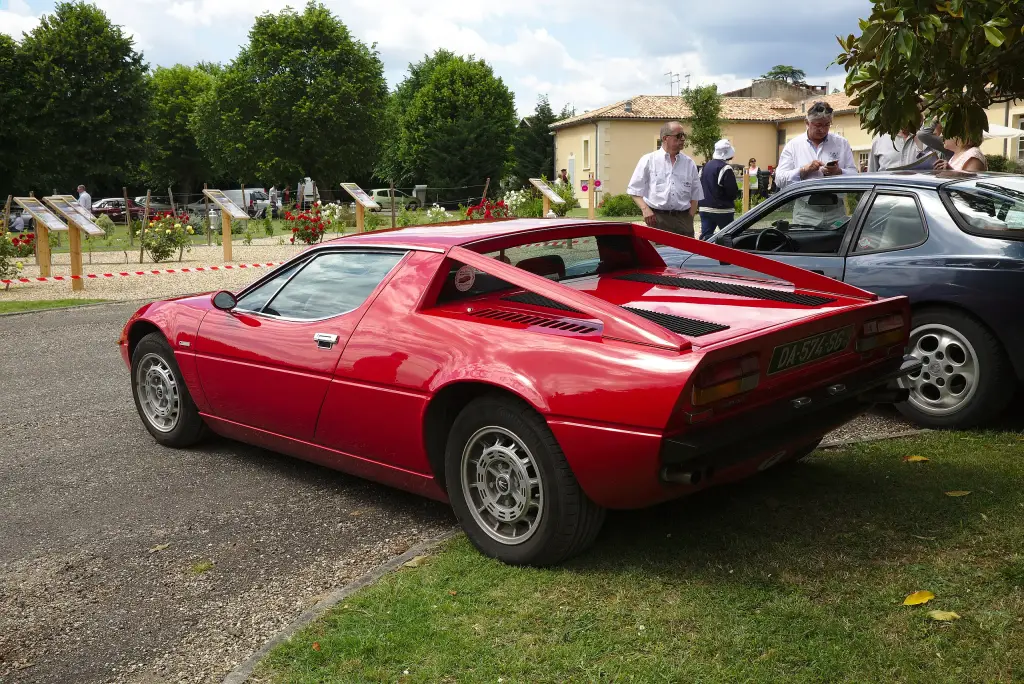
Giorgetto Giugiaro at Italdesign was commissioned to transform the Bora into the Merak. Unlike its bigger sister the Merak has no full glass fastback but a cabin ending abruptly with a vertical rear window and a flat horizontal engine cover pierced by four series of ventilation slats, with open flying buttresses visually extending the roofline to the tail. Its main competitors were the similarly Italian, mid-engined three-litre 2+2 Dino 308 GT4 and Lamborghini Urraco, but where those used transverse V8 engines the Merak had a more compact V6 mounted longitudinally.
Citroën engineering
Having been designed during Citroën’s ownership of Maserati from 1968 to 1975, the Merak used some Citroën hydropneumatic systems: the brakes were hydraulically assisted and operated, the pop-up headlights hydraulically actuated, and the clutch used the same hydropneumatic system as the brakes, though only some cars had servo assistance on the clutch. After 1976, when the French manufacturer gave up control, the Citroën-derived parts were gradually replaced by more conventional systems. When Alejandro de Tomaso bought Maserati in 1977 the Bora was discontinued after a production run of less than 600 cars, while the Merak remained on sale for six more years.
Engineering
The Merak used a steel monocoque with a rear tubular subframe carrying the powertrain and rear suspension. Suspension was unequal-length A-arms all round with coaxial coil springs and telescopic dampers, and the braking system used discs on both axles with the fronts vented; on early cars with Citroën hydraulics the rear brakes were inboard to reduce unsprung weight. Wheels were cast light-alloy Campagnolo 7½J 15-inch with Michelin XWX tyres of 185/70 at the front and 205/70 at the rear, and the compact spare was stored in the engine compartment above the transmission. The V6 descended from the 2.7-litre Tipo C.114 designed by Giulio Alfieri in 1967 for the Citroën SM; it was bored to 91.6 mm with the stroke unchanged at 75 mm for 2,965 cc, and had chain-driven double overhead camshafts, 12 valves and an unusual 90-degree angle between the banks because it was a Maserati V8 with one pair of cylinders removed. Lubrication used a wet sump and an oil cooler. The engine sat longitudinally behind the passenger compartment and drove through a single-plate dry clutch to a five-speed all-synchromesh Citroën transaxle and an open differential.
Merak, SS and 2000 GT
The original Merak’s three-litre engine was rated at 190 PS at 6,000 rpm and 255 N·m at 4,000 rpm, fed by three twin-choke Weber carburettors and with a compression ratio of 8.75:1; Maserati declared a top speed of over 240 km/h. Early left-hand-drive cars from 1972 to 1975 had the same dashboard as the Citroën SM, with oval instruments in a brushed metal fascia and a single-spoke steering wheel, and 630 cars were built in this configuration up to 1974; right-hand-drive cars of the period used the Bora dashboard and a three-spoke wheel. The lightweight and more powerful Merak SS was introduced at the Geneva Motor Show in March 1975 but did not enter production until the next year. It was 50 kg lighter and 30 PS more powerful at 220 PS thanks to three larger 44 DCNF 44 carburettors and a higher 9:1 compression ratio, and was recognisable by a black grille between the pop-up headlights; a Maserati-designed upper fascia with round instruments and a four-spoke wheel replaced the SM-derived interior, and later cars received the Bora’s driver-oriented dashboard. The US version of the SS returned to conventional hydraulics, eliminating the last of the Citroën high-pressure system, and 1,000 SS cars had been made by 1983. In November 1977 at the Turin Show De Tomaso presented the Merak 2000 GT, essentially a Merak with a smaller two-litre engine, built almost exclusively for Italy, where a new law penalised cars over 2,000 cc with 38 per cent VAT against the usual 19 per cent.
Design and features
- Bora bones: the front bodywork and structure of the Bora with a V6 engine.
- 2+2 layout: a second row of seats made possible by the compact V6.
- Giugiaro tail: vertical rear window, slatted engine cover and flying buttresses.
- Citroën hydraulics: hydraulic brakes, clutch and pop-up headlights on early cars.
- Long life: built for eleven years, six more than the Bora.
Maserati Merak versions
- Merak (1972–1983): the original 190 PS car with the SM-derived dashboard.
- Merak SS (1975–1983): 50 kg lighter and 220 PS, with a 9:1 compression ratio.
- Merak 2000 GT (1977–1983): two-litre version for the Italian market.
- US-specification cars: conventional hydraulics and a full-size spare.
The Merak was the 2+2 sister of the Maserati Bora and used Citroën systems like those of the Khamsin; its V6 later served as the basis for the Biturbo engine. More cars are in the Maserati collection.
Sources
- Maserati Merak, English Wikipedia: history, design, engineering, versions