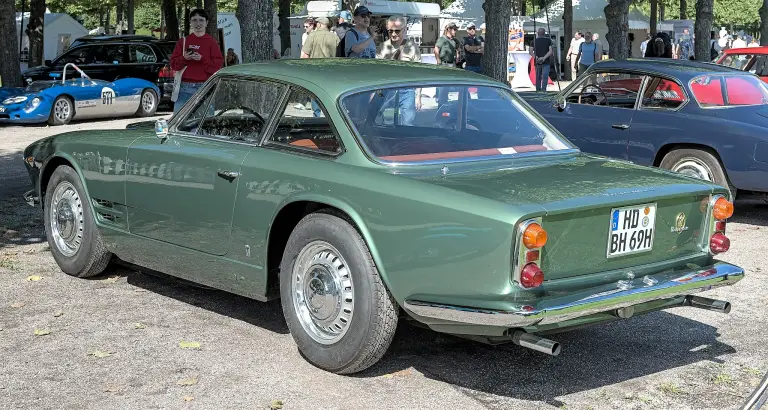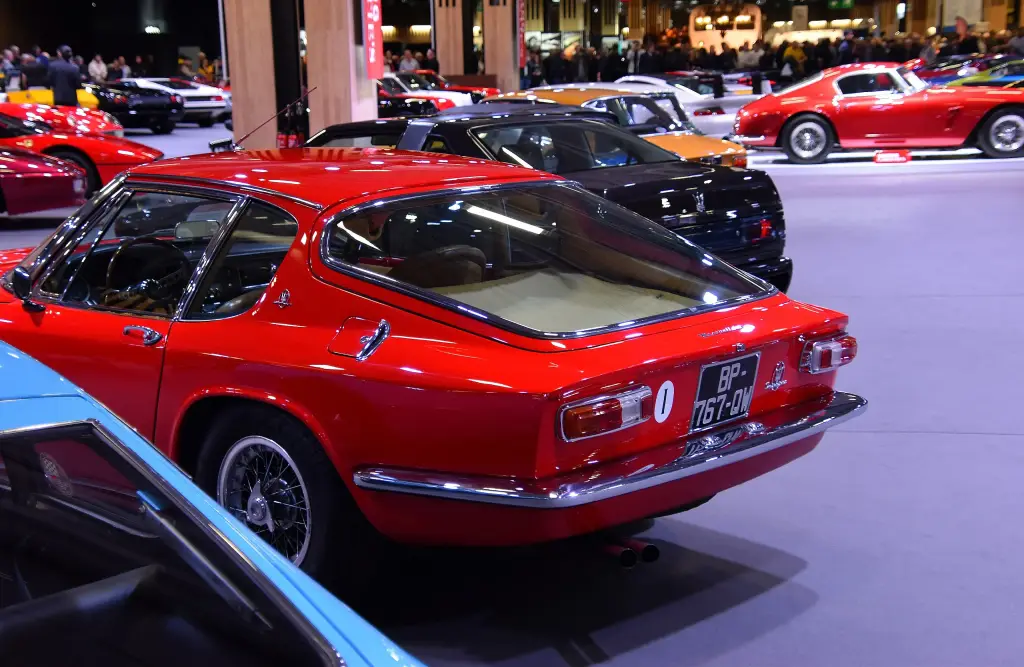
The Maserati Mistral, internally Tipo AM109, is a two-seat gran turismo produced between 1963 and 1970. The successor to the 3500 GT, it was styled by Frua and bodied by Maggiora of Turin, and 844 coupés and 124 Spyders were built. Named after a cold northerly wind of southern France, it was the first in a series of classic Maseratis to be given the name of a wind.
Maserati Mistral at a glance
| Maker | Maserati, Modena |
|---|---|
| Project code | Tipo AM109 |
| Production | 1963–1970 |
| Design | Pietro Frua, bodied by Maggiora of Turin |
| Body | two-seat coupé and Spyder; aluminium, steel from 1967 |
| 3500 engine | 3.5-litre six, 235 bhp at 5,500 rpm |
| 3700 engine | 3.7-litre six, 245 bhp at 5,500 rpm |
| 4000 engine | 4.0-litre six, 265 bhp at 5,200 rpm |
| Fuel system | Lucas indirect fuel injection |
| Gearbox | five-speed ZF |
| Brakes | solid discs on all four wheels |
| Built | 844 coupés and 124 Spyders |
Based on one source: the English Wikipedia article on the Mistral.
History of the Maserati Mistral
The Mistral is the last model from the Casa del Tridente to have the company’s twin-spark, double-overhead-camshaft straight six. Fitted to the Maserati 250F Grand Prix cars, this engine won eight Grands Prix between 1954 and 1960 and the Formula One world championship in 1957 with Juan Manuel Fangio. It had hemispherical combustion chambers fed by Lucas indirect fuel injection, a new development for Italian manufacturers. Maserati subsequently moved to V8 engines for later production cars to keep up with demand for more powerful machines.
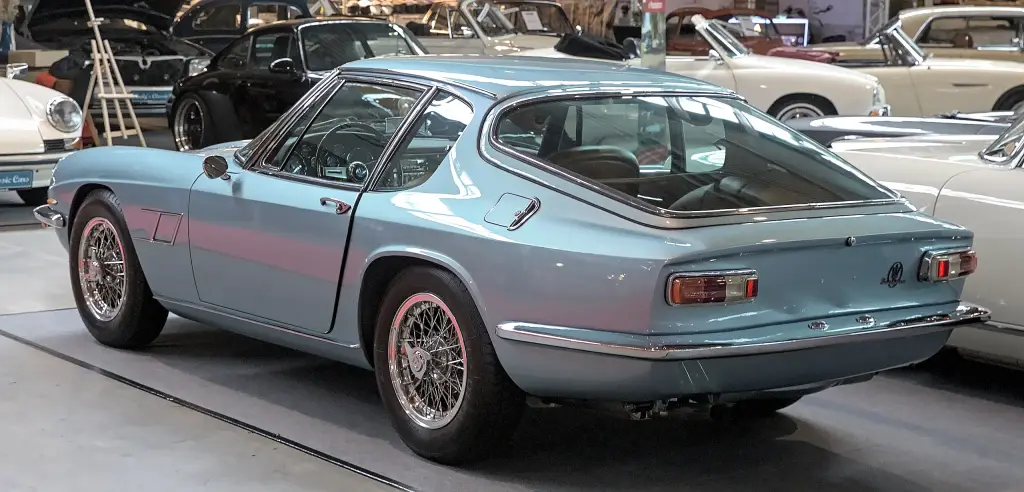
Engines
Three engines were fitted to the Mistral, displacing 3,500, 3,700 and 4,000 cc and developing 235 bhp at 5,500 rpm, 245 bhp at 5,500 rpm and 265 bhp at 5,200 rpm respectively. Only the earliest Mistrals had the 3,500 cc unit, and the most sought-after derivative is the 4,000 cc model. Unusually, the body was offered in both aluminium and, from 1967, steel, though it is not known exactly how many of each were built. The car had a standard five-speed ZF transmission and four-wheel solid disc brakes, with independent front suspension and a solid rear axle in the Maserati manner. Acceleration from 0 to 97 km/h took around or just under 7 seconds for both the 3.7- and 4.0-litre engines, with top speeds of approximately 225 to 233 km/h. Cars left the factory on Pirelli Cinturato 185VR16 CA67 tyres, later 205VR15 (CN72) tyres on Borrani wire wheels. Only the Spyder received the 3,500 engine, with just 27 made, along with 46 3.7-litre and 51 4.0-litre Spyders; 20 of the Spyders were right-hand drive.
Design
The body was designed by Pietro Frua and first shown in a preview at the Salone Internazionale dell’Automobile in Turin in November 1963. It is often confused with the very similar-looking but larger and more powerful Frua-designed AC 428. The Mistral overlapped in production with its successor, the Ghibli, from 1967 onwards.
Design and features
- Last six-cylinder GT: the twin-spark engine of the 250F, with Lucas fuel injection.
- Three capacities: 3.5, 3.7 and 4.0 litres, with the 4.0 the most desirable.
- Frua styling: a two-seat body built by Maggiora, in aluminium and later steel.
- Wind name: the first Maserati named after a wind.
- Rare Spyder: only 124 open cars, 20 of them right-hand drive.
Maserati Mistral versions
- Mistral 3500 (1963–1965): the earliest cars, only on the coupé and 27 Spyders.
- Mistral 3700: 245 bhp, with 46 Spyders.
- Mistral 4000 (1965–1970): 265 bhp, the most sought after, with 51 Spyders.
- Spyder (1964–1970): the open two-seater, 124 built.
The Mistral succeeded the Maserati 3500 GT and was replaced by the Maserati Ghibli; its six-cylinder engine came from the 250F. More cars are in the Maserati collection.
Sources
- Maserati Mistral, English Wikipedia: engine, versions, production, design