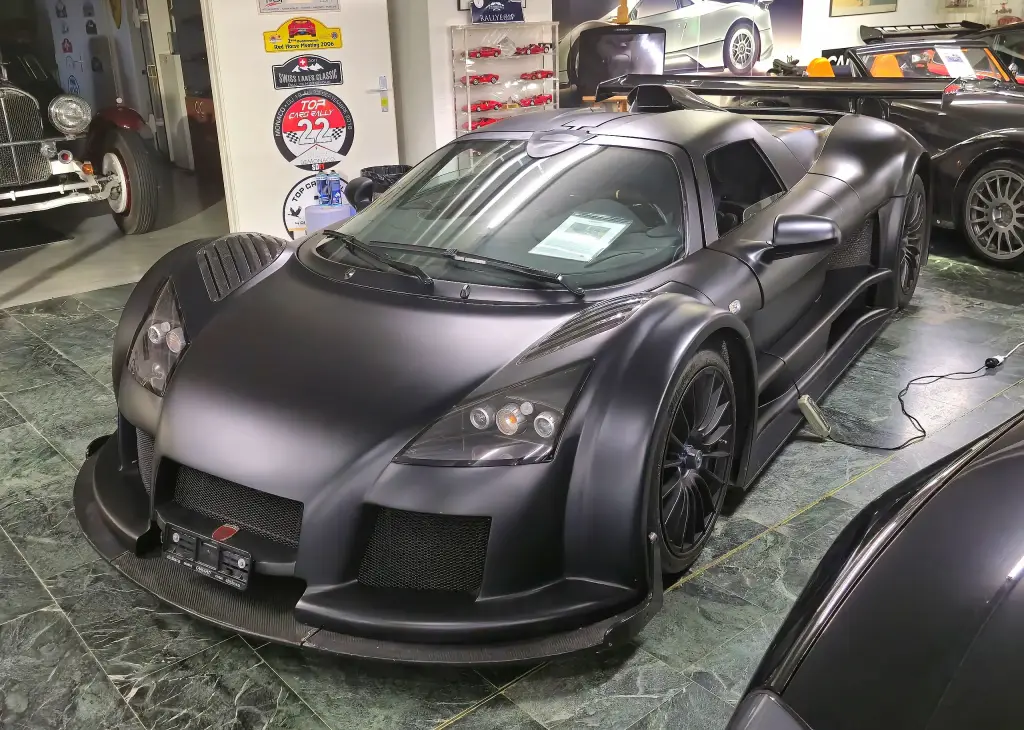

The Gumpert Apollo was the only series car of Gumpert Sportwagenmanufaktur GmbH, a small manufacturer in Altenburg, Germany. Roland Gumpert, formerly head of Audi’s motorsport department, had it designed as a Le Mans racing car that could also be driven on the road with a licence plate. It was built from 2005 until the company’s bankruptcy in 2013.
Gumpert Apollo at a glance
| Maker | Gumpert Sportwagenmanufaktur GmbH, Altenburg, Germany |
|---|---|
| Production | from October 2005 to 2013 |
| Project name | R1 |
| Design | Marco Vanetta |
| Body and chassis | tubular chromoly frame, fibreglass or optional carbon fibre panels |
| Layout | mid-engine, rear-wheel drive, two seats |
| Weight | 1,100–1,200 kg depending on options |
| Engine | 4,163 cc bi-turbo Audi V8, five valves per cylinder |
| Output | about 650, 700 or 800 PS (base, Sport, Race) |
| Top speed | 360.4 km/h with the 650 PS engine |
| 0–100 km/h | 3.1 seconds |
| Nürburgring lap | 7:11.57 (Sport Auto) |
| Built | 40–60 in total |
The English and German Wikipedia articles differ in places: the English page dates the start of production to October 2005 and says the first 1:4 model was made in 2001, while the German page gives 21 December 2005 for series production and 2002 for the scale model. This page follows the German dates where the two disagree.
History of the Gumpert Apollo
The project began as the R1 in 2002, after Roland Gumpert returned to Germany at the end of 2001 following more than three years in China, where he had run sales and marketing for an Audi–VW joint enterprise. The idea was a car that would be legal on the road yet ready for the racetrack, and it grew out of a request from the designer Roland Mayer, who wanted help building a prototype sports car. Audi approved Gumpert’s involvement on one condition: any car he developed had to be a series product, not a one-off prototype. The company was founded in 2004 as GMG Sportwagenmanufaktur Altenburg GmbH.
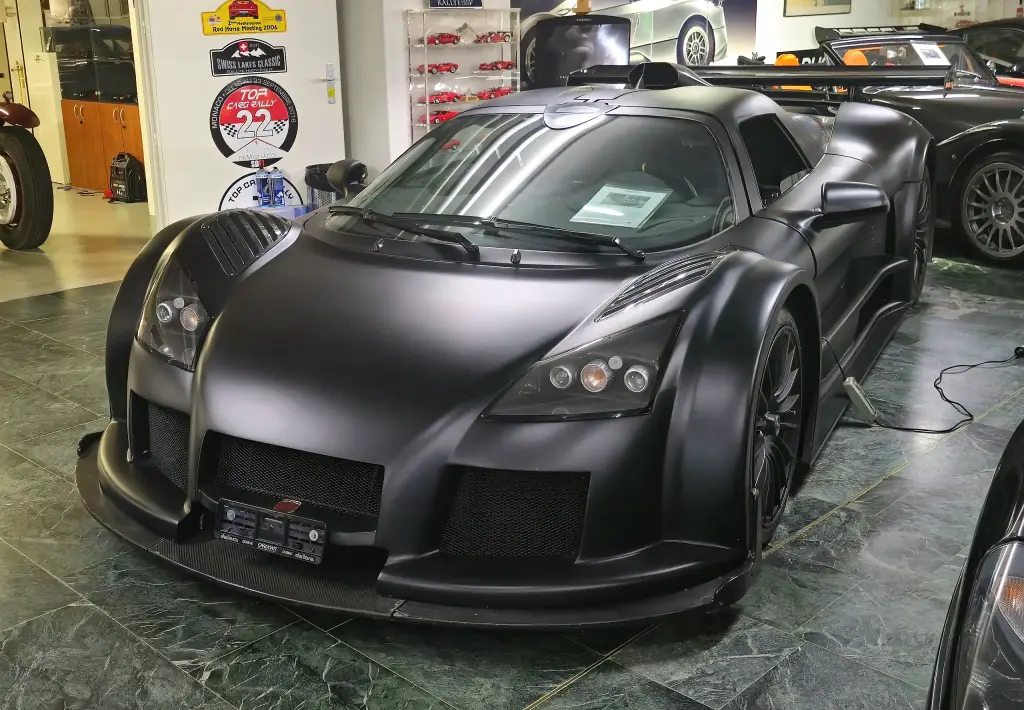

The first design was drawn by Marco Vanetta as a diploma project at the Hochschule München under Othmar Wickenheiser, and a 1:4 scale model was built in 2002. Development continued with the Technical University of Munich and the Ingolstadt University of Applied Sciences, which helped with construction work, computer simulations and wind tunnel tests. The result was the blueprint for the first full-size model, and two prototypes were then built in Ingolstadt. The first of them was damaged so badly during a promotional drive with a journalist that it had to be rebuilt; with the red prototype the Belgian racing driver Ruben Maes finished third on his debut in the Divinol Cup at the Hockenheimring in March 2005.
A pre-series car was shown in 2005, now with a monocoque, gullwing doors that opened to the middle of the roof and a smaller diffuser and front lip. Series production started in Altenburg on 21 December 2005 on a line laid out for about 60 cars a year. The Apollo was built largely by hand and could be specified to individual wishes; the first cars were deliberately spartan, without air conditioning or navigation, to save weight, and the price started at 198,000 euros without taxes, later rising to 301,600 euros as comfort equipment became standard.
Racing was part of the plan from the beginning. At the 24 Hours of Nürburgring in 2008 Heinz-Harald Frentzen, Dirk Müller, Marcel Engels and Dominik Schwager drove a hybrid Apollo with a 3.3-litre bi-turbo V8 of 382 kW (520 PS), an electric motor of about 100 kW and a traction battery from Gaia. Gearbox problems in the combustion part of the drivetrain left the car running on the electric motor alone; it reached the flag after two replacement gearboxes but was not classified.
The range grew through the model’s life. At the 2009 Geneva show Gumpert presented the Apollo Speed, which was aimed at acceleration and top speed rather than cornering: it sat 9 mm lower, had a revised front end, fixed wheel covers at the front and rotating ones at the rear, an adjustable rear wing, a covered underbody and its own tail lights. In 2010 the car received a light facelift with wider air intakes, LED daytime running lights, a four-tailpipe flap exhaust and a larger monocoque for more room inside; the 700 PS engine was also raised by 50 PS to 551 kW. In 2012 came the Apollo R, a pure racing car of up to 633 kW, and the Apollo enraged, limited to three cars and, at 574 kW, the most powerful street-legal Apollo ever built.
The manufacturer went bankrupt in August 2013 and production ended. The new owner announced at the beginning of 2014 that production would resume at another site, which did not happen, and the rights to the Apollo were eventually sold to an investor from Hong Kong. In the end only 40 to 60 cars were built, depending on the source.
Design and features
- Audi V8: a 4,163 cc bi-turbo unit with a closed-deck light metal crankcase, dry sump lubrication, five valves per cylinder, four overhead camshafts, VarioCam Direct variable valve timing on the intake side and sequential multipoint fuel injection.
- Chassis: a tubular chromoly frame with fibreglass body panels and carbon fibre as an option, which kept the weight between 1,100 and 1,200 kg.
- Record lap: on the eleventh series of Top Gear the Apollo lapped the test track in 1:17.1, a record that stood for two years until the Bugatti Veyron Super Sport beat it.
- Upside-down claim: Gumpert said the aerodynamic design would let the car drive upside-down in a tunnel above 306 km/h; the claim was never tested.
- Racetrack and road: the car was homologated for racing, including the FIA GT, as well as for the road.


Gumpert Apollo versions
- Base: about 650 PS (478 kW), 360.4 km/h, 0–100 km/h in 3.1 seconds and 0–200 km/h in 9.1 seconds.
- Sport (from 2007): about 700 PS (515 kW), placed between the base car and the racing version.
- Race: about 800 PS (588 kW), with an air lift system and a fire extinguishing system for the engine.
- Apollo Speed (2009): lower and more aerodynamic, built for top speed.
- Apollo R (2012): a pure racing car of up to 633 kW.
- Apollo enraged: a limited edition of three cars with 574 kW, the most powerful road-legal Apollo.
The Apollo is the only model of the marque on this site; more photographs and other rare sports cars are in the Gumpert collection.
Video: Gumpert Apollo | GRIP #46
Video by GRIP on YouTube.
Sources
- Gumpert Apollo, English Wikipedia: history, design, engine, records
- Gumpert Apollo, German Wikipedia: prototypes, production, variants, racing