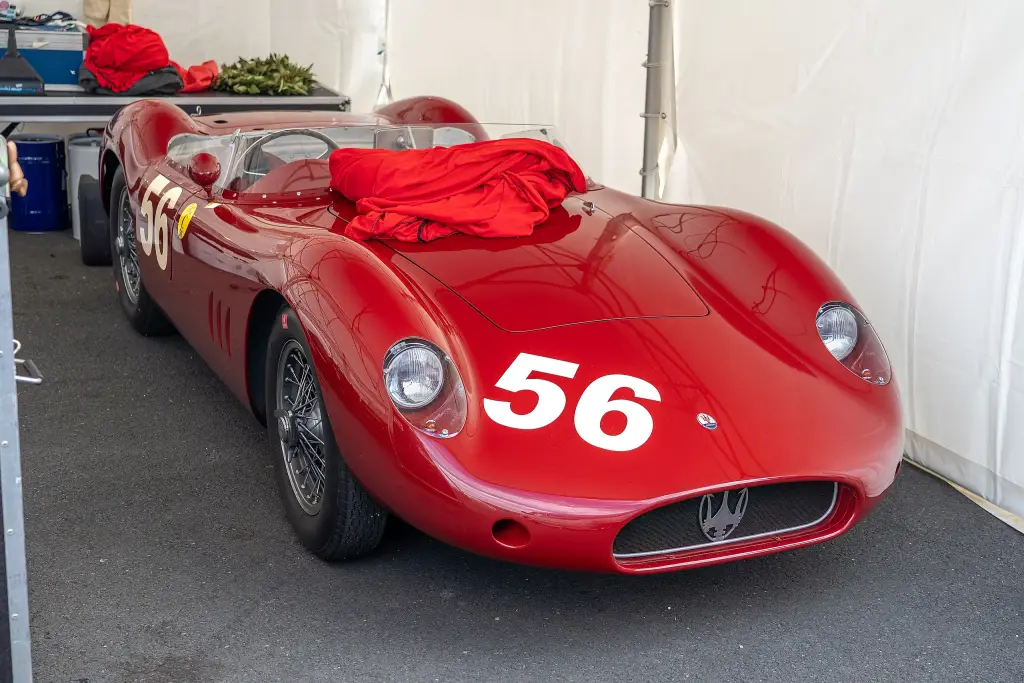
The Maserati 250S was a sports racing car built between 1954 and 1957 as an attempt to give the 200S more power. Only a few were produced, most of them converted from 200S and 200SI cars. Two distinct versions exist: a 1954 car with the six-cylinder engine of the 250F and a 1957 car with an enlarged four-cylinder unit.
Maserati 250S at a glance
| Maker | Maserati, Modena |
|---|---|
| Production | 1954–1957 |
| First version | 1954, one car on an A6GCS/53 chassis |
| First engine | 2,494 cc straight-six from the 250F, three Weber 42 DCO3 |
| Second version | 1957, four cars on 200SI chassis |
| Second engine | 2,489 cc inline-four, 96 mm × 86 mm, two Weber 45 DCO3 |
| Brakes | four-wheel hydraulic drums |
| Suspension | coil springs front, transverse leaf springs rear |
| Chassis | tubular trellis frame, aluminium body |
| Built | one 1954 car, four 1957 cars |
Based on one source: the English Wikipedia article on the 250S.
History of the Maserati 250S
The 250S was Maserati’s attempt to improve on the 200S by enlarging the two-litre four-cylinder engine to 2.5 litres, with the bore and stroke increased to 96 × 86 mm. A new crankshaft was designed as well, but the result was sobering: the engine delivered only 6 hp more than the two-litre unit. Chassis and engineering were carried over from the 200SI, which made the two cars almost indistinguishable from outside, and four 200SI chassis were converted this way.
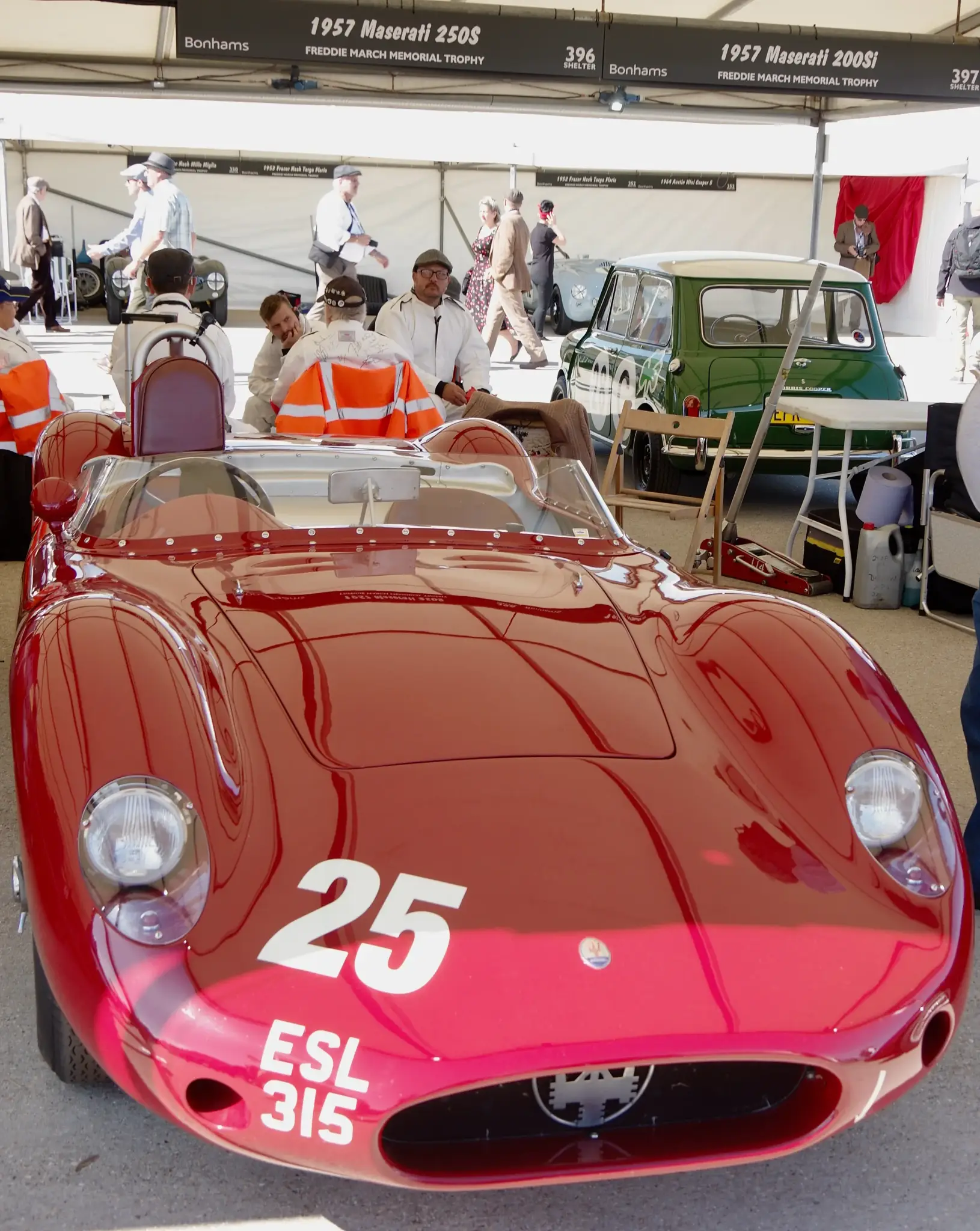
The 1954 car
The first version, also called the 2500 Sport, was a single car built on an A6GCS/53 chassis with the 2,500 cc six-cylinder engine of the 250F Formula One car, adapted to sports car rules. It raced a few times in the 1954 season, including the Mille Miglia and the Supercortemaggiore Grand Prix at Monza, without significant results, and was then set aside while Maserati developed the 300S. The engine was a 2,494 cc straight-six with an 84 mm bore and 75 mm stroke, twin overhead camshafts and three Weber 42 DCO3 carburettors. Brakes were hydraulic drums on all four wheels; the front suspension used coil springs with Houdaille dampers and an anti-roll bar, the rear transverse leaf springs with the same dampers and a bar.
The 1957 car
The project gained new life in 1956 when a car was assembled in Modena, again an A6 GCS but with a de Dion rear axle and the gearbox in the block with the differential. It competed at Agadir and Dakar without luck and was later used by Stirling Moss for testing before the Mille Miglia. The second 250S of 1957 was radically different: it used the 200SI chassis with the larger four-cylinder engine. Four examples were built to keep the agility of the two-litre car while offering more power against larger rivals. It debuted in practice for the 1000 km Buenos Aires with promising times but was judged not yet ready to race, and the internal competition of the 300S and Maserati’s withdrawal from works racing at the end of the season ended its development.
Racing
The 250S raced in Europe and the United States. Entries at the 1954 Le Mans 24 Hours and the Monza 1000 km are listed with contradictory engine capacities, so it is not certain which Maserati models were involved, and the same applies to the 1956 Agadir and Senegal Grands Prix. Races between 1957 and 1964 are documented: at the 1957 Sebring 12 Hours Roy Salvadori and Carroll Shelby started in a works 250S and were disqualified after 68 laps for illegal refuelling, the first finish came at the 1957 Nassau Trophy with Stephen Spitler 21st, and a year later Jim Hall took his first sports car win at Eagle Mountain. Between 1958 and 1959 the 250S also did well in SCCA national races in North America.
Design and features
- Longer-stroke four: 2,489 cc from a 96 × 86 mm bore and stroke, but only 6 hp more than the 2.0-litre.
- Two engines: the 250F straight-six in 1954 and the enlarged four in 1957.
- 200SI chassis: the 1957 cars were externally almost identical to the 200SI.
- De Dion rear axle: used on the 1956 test car in place of the live axle.
Maserati 250S versions
- 250S 1954 (2500 Sport): one car on an A6GCS/53 chassis with the 250F six.
- 250S 1956 test car: an A6 GCS with a de Dion rear axle and in-block gearbox.
- 250S 1957: four cars on 200SI chassis with the 2.5-litre four-cylinder engine.
- Engine kits: 250S engines supplied to customer teams to upgrade 200SI cars.
The 250S was developed from the Maserati 200S and used the engine of the Maserati 250F; it was overshadowed by the 300S. More cars are in the Maserati collection.
Sources
- Maserati 250S, English Wikipedia: development, versions, racing record