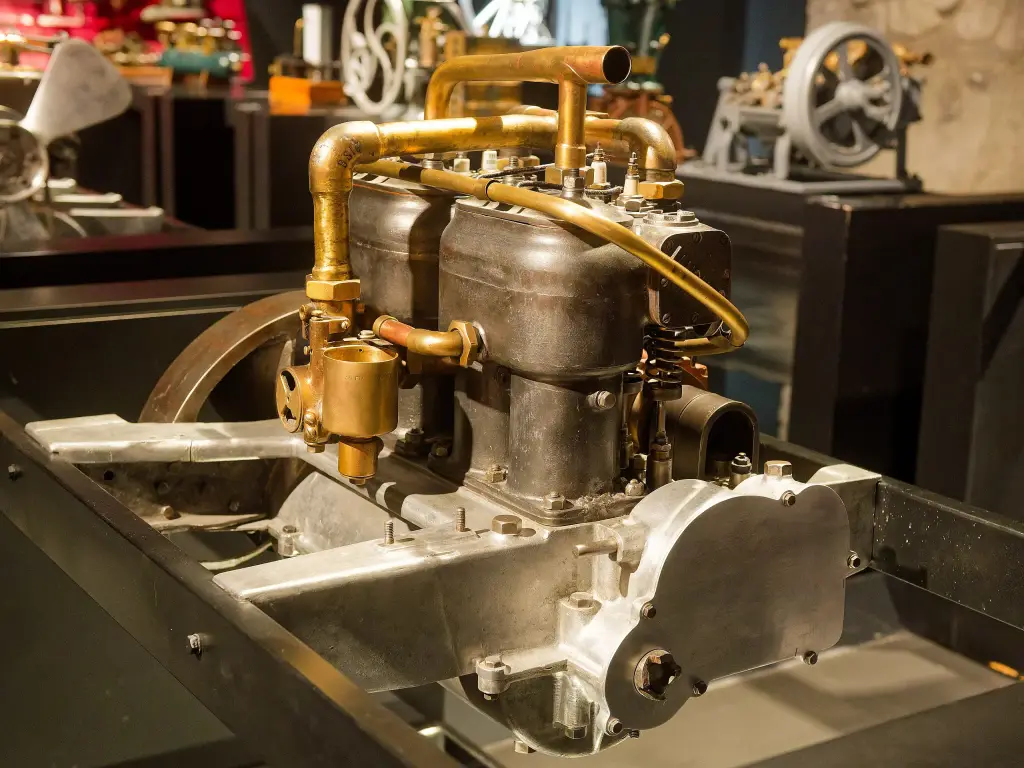
The Lancia Alfa 12 HP, originally known by its workshop code Tipo 51, was the first car made by Lancia. Road testing began in September 1907 and production in 1908, when the chassis was shown at the Turin Motor Show. The name Alfa came later, when Lancia began using the letters of the Greek alphabet for its models.
Lancia Alfa at a glance
| Maker | Lancia, Turin |
|---|---|
| Production | 1908 |
| Also known as | Lancia 12 HP, Tipo 51 |
| Engine | 2,544 cc side-valve four, two cast-iron blocks |
| Bore and stroke | 90 x 100 mm |
| Power | 28 CV at 1,500 rpm |
| Top speed | about 90 km/h |
| Transmission | four speeds plus reverse, cardan shaft, rear drive |
| Chassis | steel, 2,820 mm wheelbase, 710 kg |
| Steering | right-hand drive, worm and wheel |
| Sold | more than 100 |
| Racing versions | five or six, with a shorter wheelbase |
History of the Lancia Alfa
Lancia’s first car
Vincenzo Lancia founded his company in 1906 and put his first design on the road in the autumn of 1907. The car was unconventional for its time: a low, light chassis with a cardan-shaft transmission instead of the usual chains, and a four-cylinder engine running at what was then a high 1,800 rpm. The chassis was displayed at the eighth Turin Motor Show between 18 January and 2 February 1908 under the name 12 HP.
The Greek names
The workshop designation was Tipo 51. The car became the Alfa in 1919, when Giovanni Lancia, Vincenzo’s brother and a student of classical languages, suggested that the models be distinguished by the letters of the Greek alphabet, starting with the first car. The naming habit stayed with the company through the Beta, Gamma, Delta and Theta.
Engine and chassis
The engine was a 2,544 cc side-valve four built in two cast-iron blocks of two cylinders each, with a fixed cylinder head, an aluminium crankcase, a camshaft in the crankcase driven by gears and a crankshaft on three bearings. The compression ratio was 4.8:1, ignition came from a high-tension Bosch magneto with fixed advance and the vertical two-stage Lancia carburettor was warmed by radiator water. A four-speed gearbox plus reverse sent drive to the rear wheels through a multi-disc clutch running in oil. Front suspension was a solid axle on semi-elliptic springs, the rear a solid axle on three-quarter elliptic springs; the foot brake worked on the transmission and the hand brake on the rear wheels. The wheels were wooden artillery type with 810 x 90 tyres, and the chassis weighed 710 kg.
A commercial success
More than a hundred cars were sold, some of them exported to the United Kingdom and the United States. Five or six racing versions were also made, with a shorter wheelbase of 2,740 mm instead of 2,820 mm and modified springs. In 1908 a bare chassis cost 10,000 lire, a double phaeton 12,000, a coupé de luxe 13,500, a landaulet 13,750 and a limousine 14,000; the chassis numbers 1 to 137 also covered the 18/24 HP Dialfa and the racing cars.
Design and features
- Cardan shaft drive: modern for 1908, when many rivals still used chains.
- High-revving engine: 28 CV at 1,500 rpm and more than 1,800 rpm available, unusual at the time.
- Four speeds: a four-speed gearbox plus reverse with a light alloy casing.
- Coachbuilt bodies: buyers could order a phaeton, coupé, landaulet or limousine on the same chassis.
Lancia Alfa versions
- 12 HP standard: the production car of 1908.
- Racing version: five or six cars with a shortened wheelbase and modified springs.
- Coachbuilt bodies: double phaeton, coupé de luxe, landaulet and limousine.
The Alfa was the first of the Greek-letter Lancias, followed by the Lancia Theta and, decades later, cars such as the Lancia Augusta. More cars are in the Lancia collection.
Sources
- Lancia Alfa, English Wikipedia: dates, engine, production
- Lancia Alfa, Italian Wikipedia: technical data, prices, racing versions