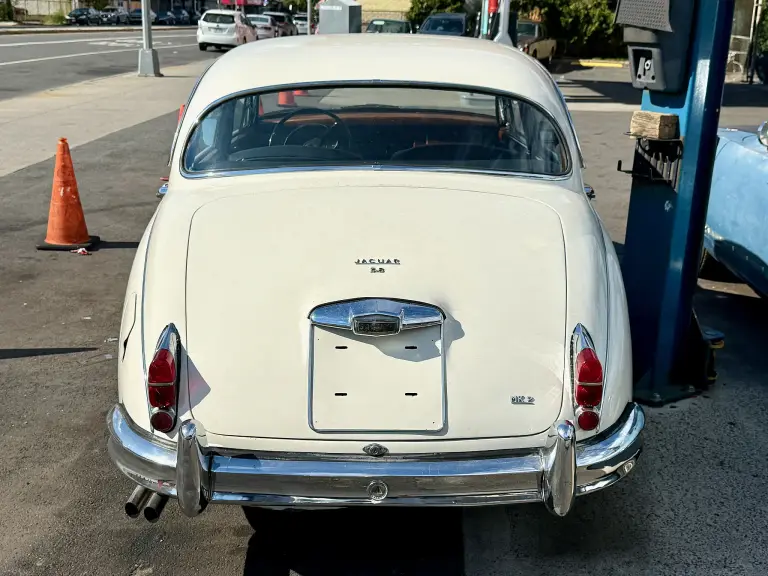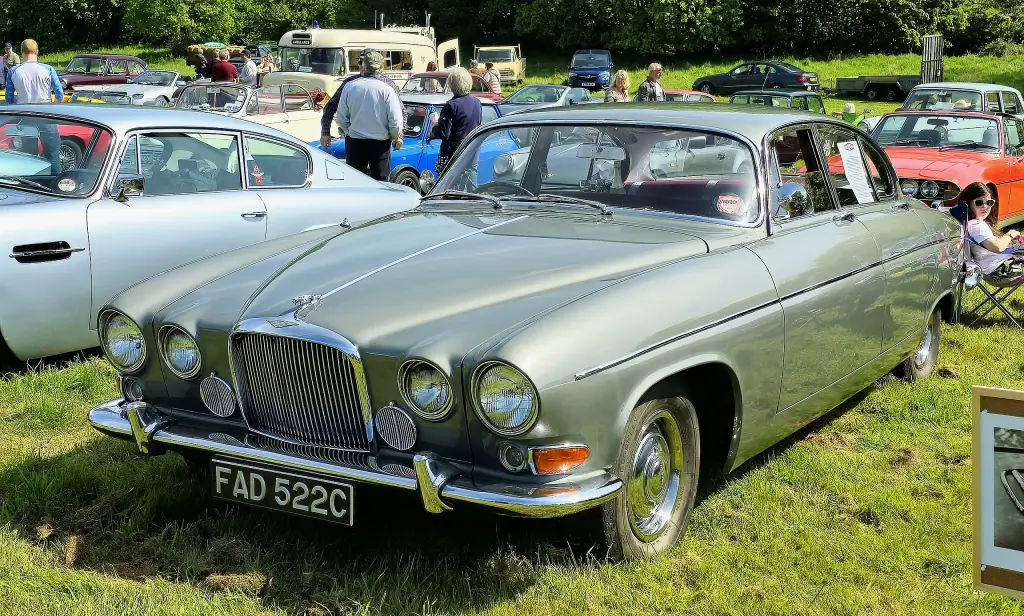
The Jaguar Mark X, later renamed the Jaguar 420G, is a large luxury saloon built by Jaguar Cars between 1961 and 1970. It succeeded the Mark IX at the top of the range but broke with its predecessors in both styling and technology, adopting a unitary body, four-wheel disc brakes and Jaguar’s independent rear suspension.
Jaguar Mark X at a glance
| Production | 1961–1970 |
|---|---|
| Also named | Jaguar 420G from 1966 |
| Introduced | October 1961 |
| Body | unitary shell, codenamed Zenith |
| Engines | 3.8-litre XK, 4.2-litre from 1964 |
| Power | 250 or 265 bhp from the 3.8, 265 bhp from the 4.2 |
| Carburettors | triple SU |
| Rear suspension | independent, inboard brakes |
| Wheels | 14 inch |
| Top speed | about 120 mph |
| 4.2-litre cars built | 5,137 |
History of the Jaguar Mark X
A new look
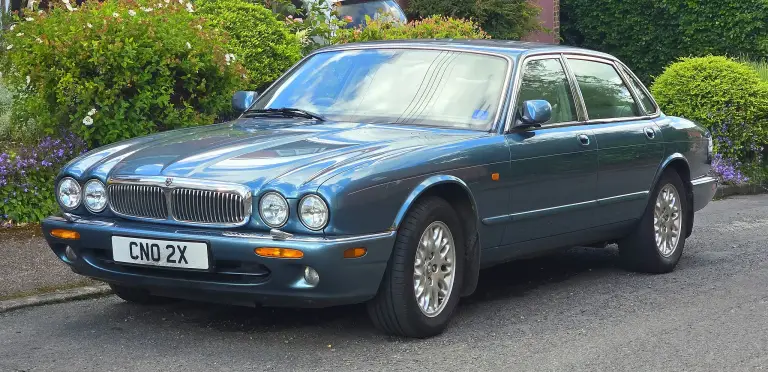
In 1961 the Mark X introduced an upright, slightly forward-leaning nose for Jaguar saloons, with four headlamps set into rounded front wings and a vaned grille. That front-end style, derived from the Daimler DK400, reappeared on successive Jaguars up to the X-Type and the third-generation XJ in 2009, shaping the marque’s saloon look for nearly half a century. Instead of body-on-frame construction the Mark X used a unitary shell codenamed Zenith, the largest such body in Britain at the time; its floorpan lived on in elongated form under the Daimler DS420 limousine until 1992. The interior was the last Jaguar to use wood as abundantly as standard, from the dashboard and window trim to book-matched fold-out rear picnic tables.
Engineering
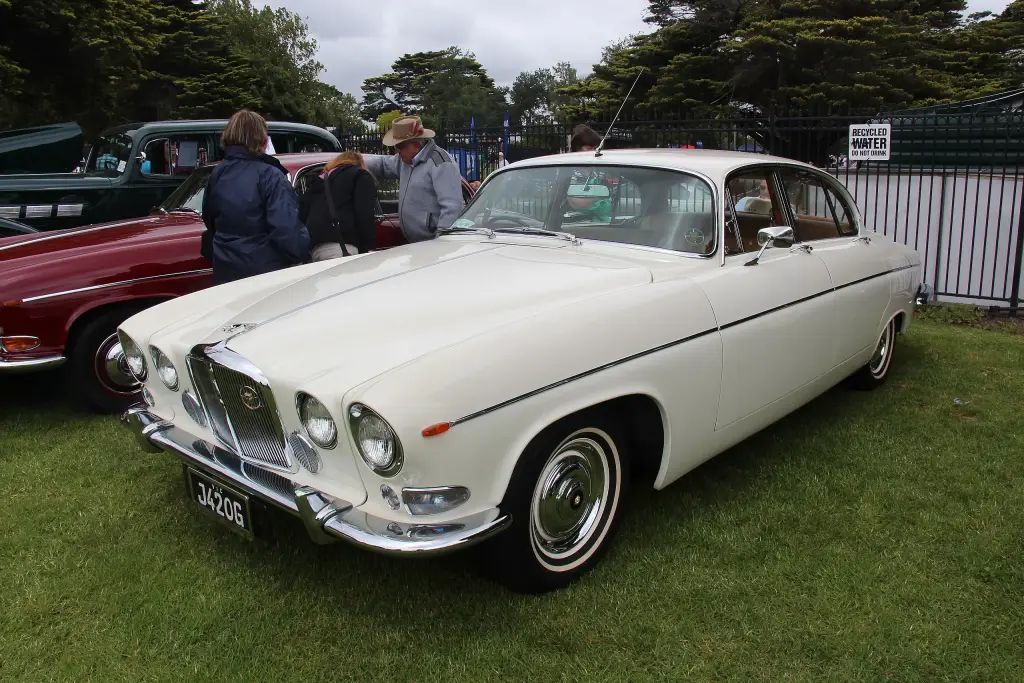
The Mark X was the first Jaguar saloon with independent rear suspension, designed by William Heynes, using a wider-track version of the E-Type’s layout with inboard brakes; the same basic system served Jaguar until X308 production ended in 2003. Front suspension was by double wishbones with coil springs and telescopic dampers, and the car rode on 14-inch wheels. Power came from the E-Type’s 3781 cc XK six, with 250 or 265 bhp depending on compression ratio; the 4,235 cc engine took over at the 1964 London Motor Show, though the 3.8 could still be ordered until October 1965. Transmission was manual, manual with overdrive or automatic, and the 4.2 brought an all-synchromesh four-speed gearbox and a Borg-Warner Type 8 automatic in place of the DG. Power-assisted four-wheel disc brakes and power steering were standard, the later cars using Marles Varamatic variable-ratio steering.
Sales and the 420G
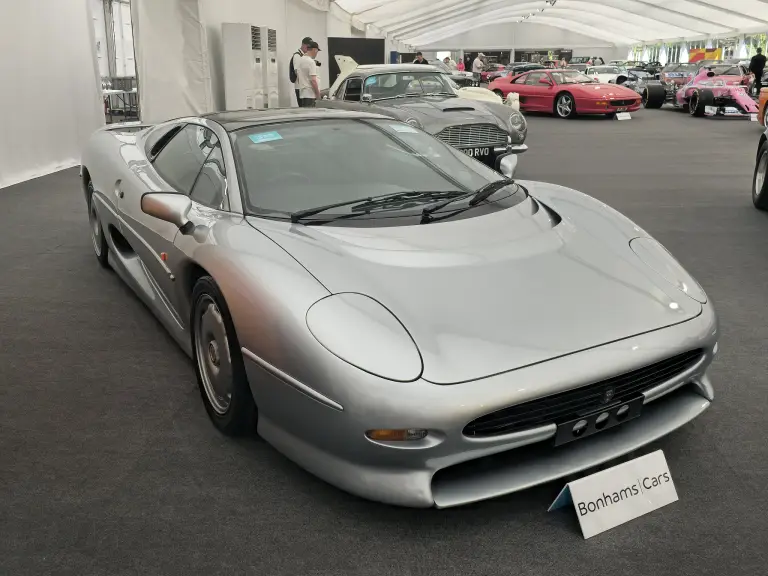
Despite acclaim in Britain and America and Jaguar’s hope of appealing to heads of state, diplomats and film stars, above all in the United States, the Mark X never met its sales targets. From 1961 until the XJ220 of 1992 it was one of the widest production Jaguars ever built; asked in 1972 whether the car had grown too large, William Lyons agreed that it definitely had, and called the more compact XJ6 the ideal size. The 420G of 1966 was the renamed and slightly revised version. The 4.2-litre Mark X is the rarest today, with only 5,137 built and few survivors known.
Design and features
- Unitary body: the largest in Britain when it appeared, codenamed Zenith.
- Independent rear suspension: a first for a Jaguar saloon, with inboard brakes.
- Quad headlamps: the nose that defined Jaguar saloons until 2009.
- E-Type power: 3.8 then 4.2-litre XK engines with triple SU carburettors.
- Wood and picnic tables: the last Jaguar with woodwork this lavish as standard.
Jaguar Mark X versions
- Mark X 3.8 (1961–1965): 250 or 265 bhp, 14-inch wheels.
- Mark X 4.2 (1964–1966): larger engine, all-synchromesh gearbox, 5,137 built.
- 420G (1966–1970): the renamed model with detail changes.
- Daimler DS420: a limousine built on an elongated version of the Mark X floorpan until 1992.
The Mark X replaced the Jaguar Mark IX and its ideas fed into the Jaguar XJ6 and the Jaguar E-Type. More cars are in the Jaguar collection.
Sources
- Jaguar Mark X, English Wikipedia: body, engineering, sales