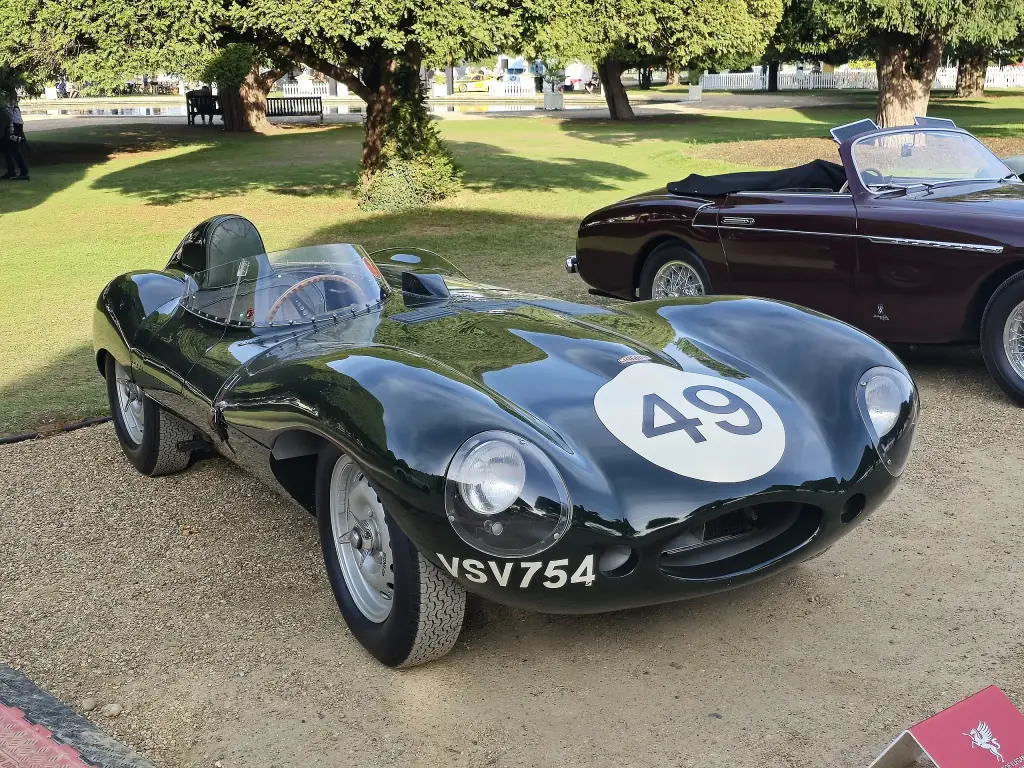
The Jaguar D-Type is a sports racing car produced by Jaguar Cars between 1954 and 1957. Designed specifically to win the Le Mans 24-hour race, it shared the straight-six XK engine and much of its mechanical layout with the C-Type, but its structure was radically different, with an innovative monocoque and aerodynamic work that borrowed from aviation.
Jaguar D-Type at a glance
| Production | 1954–1957 |
|---|---|
| Purpose | Le Mans 24 Hours |
| Engine | XK straight-six; 3.4 litres, 3.8 from 1957, 3.0 from 1958 |
| Construction | aluminium monocoque cockpit tub |
| Designer | Malcolm Sayer (body), William Heynes (engineering) |
| Brakes | disc brakes all round |
| Aerodynamics | long nose and tail fin, from 1955 |
| Le Mans wins | 1955, 1956 and 1957 |
| Built | about 71, some sources say 75 |
| Road version | XKSS |
History of the Jaguar D-Type
Design
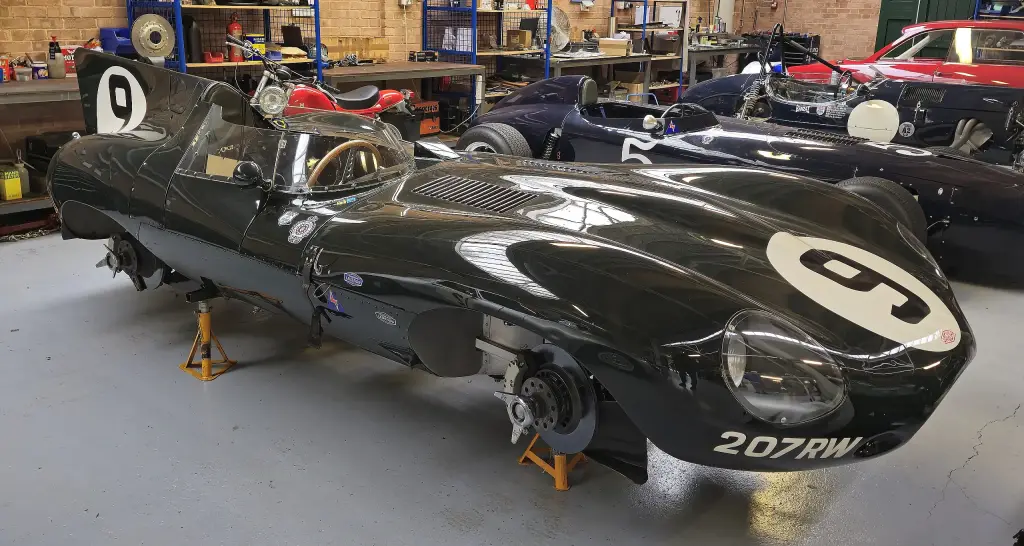
The D-Type applied aeronautical technology that was revolutionary at the time. The cockpit “tub” was of monocoque construction in aluminium alloy; its elliptical shape and small cross-section gave torsional rigidity and reduced drag. An aluminium tubing subframe attached to the front bulkhead carried the engine, steering and front suspension, while the rear suspension and final drive were mounted to the rear bulkhead. Fuel was carried in the tail in a deformable Marston Aviation bag tank rather than a conventional one.
Aerodynamics
The body was the work of Malcolm Sayer, who had joined Jaguar from the Bristol Aeroplane Company. To reduce the frontal area, dry sump lubrication was developed and the engine was canted at 8½ degrees from the vertical, which required the offset bonnet bulge; Philip Porter suggests the real reason was to make room for the ram pipes of the three twin-choke Weber carburettors. A fin behind the driver added stability on the long Mulsanne Straight, and for 1955 the factory cars received a longer nose that added 7½ inches to the length and further raised top speed, with the headrest fairing and fin combined into one unit.
Racing
In 1954 the D-Types were slowed by fuel starvation from the filters, and the Duncan Hamilton and Tony Rolt car finished less than a lap behind the winning Ferrari, though its 172.8 mph on the Mulsanne Straight showed the aerodynamic advantage over the 4.9-litre Ferrari’s 160.1 mph. In 1955, with long-nose bodywork and larger valves, the race was overshadowed by the accident that killed Pierre Levegh and more than 80 spectators; Mercedes withdrew, Jaguar continued and Mike Hawthorn and Ivor Bueb won. In 1956 the race was won by a D-Type entered by the Edinburgh team Ecurie Ecosse with Ron Flockhart and Ninian Sanderson. Although Jaguar withdrew from racing at the end of 1956, 1957 was the car’s best year: 3.8-litre D-Types took five of the top six places at Le Mans.
Design and features
- Monocoque tub: an aluminium cockpit shell carrying the suspension loads.
- Aviation fuel tank: a deformable Marston bag in the tail.
- Long nose and fin: 1955 aerodynamics developed for the Mulsanne Straight.
- Disc brakes: carried over from the C-Type, all round.
- XK engine: developed from 3.4 to 3.8 litres and later reduced to 3.0.
Jaguar D-Type versions
- 1954 short-nose: the original body with the standard fin.
- 1955 long-nose: longer body, larger valves, combined headrest and fin.
- 1957 3.8-litre: the most successful season, five of the top six at Le Mans.
- 1958 3.0-litre: reduced capacity to meet the Le Mans sports-car limit.
- XKSS: road-legal conversions of unfinished cars; nine were destroyed in a 1957 factory fire.
The D-Type followed the Jaguar C-Type and its body ideas fed into the Jaguar E-Type. More cars are in the Jaguar collection.
Sources
- Jaguar D-Type, English Wikipedia: design, aerodynamics, racing history