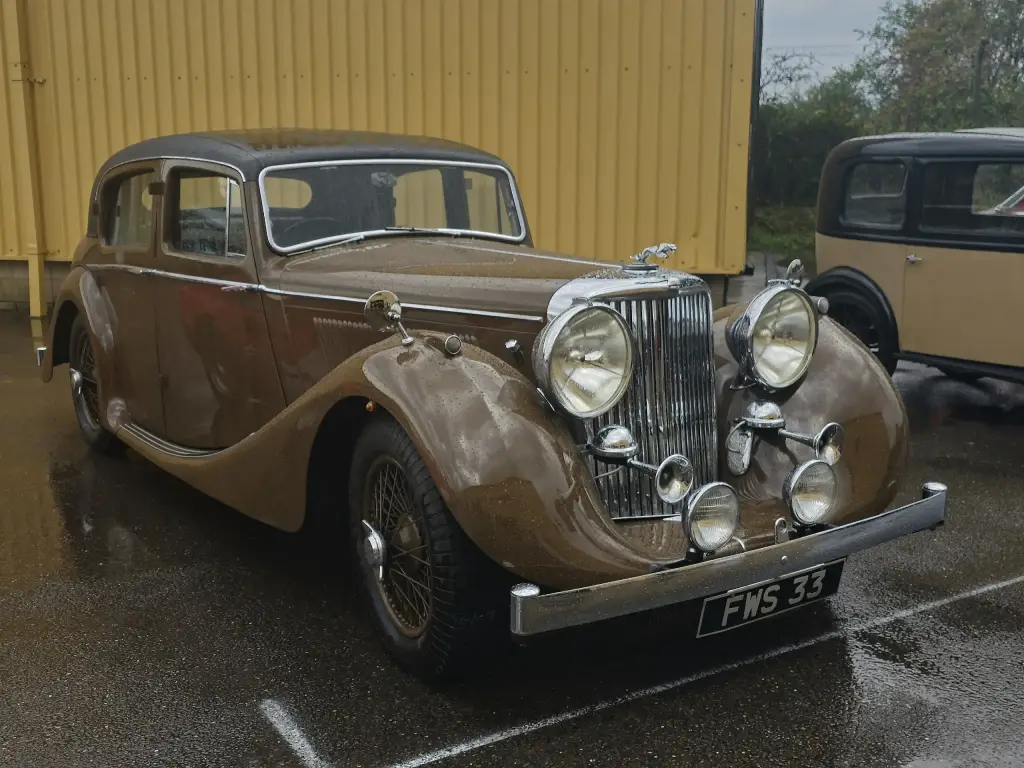
The Jaguar Mark IV is a range of cars built by Jaguar Cars from 1945 to 1949 and marketed as the Jaguar 1½ litre, Jaguar 2½ litre and Jaguar 3½ litre. The Mark IV name was applied retrospectively to tell these cars apart from the succeeding Mark V range.
Jaguar Mark IV at a glance
| Production | 1945–1949 |
|---|---|
| Names | Jaguar 1½, 2½ and 3½ litre |
| Chassis | separate frame |
| Suspension | semi-elliptic leaf springs, rigid axles front and rear |
| 1½ Litre engine | 1608 cc Standard side-valve, 1776 cc overhead-valve from 1938 |
| 2½ Litre engine | six-cylinder, 105 bhp |
| 3½ Litre engine | six-cylinder, 125 bhp |
| Brakes | mechanically operated Girling |
| Bodies | saloon; drophead coupé available on some models |
| Company renaming | SS Cars Ltd became Jaguar Cars Ltd in March 1945 |
History of the Jaguar Mark IV
Back into production
The Mark IV brought back the SS Jaguar 1½, 2½ and 3½ litre models that SS Cars had built from 1936 to 1940. Before the war the Jaguar name was used across the SS Cars range: the saloons were SS Jaguar 1½, 2½ or 3½ litre, and the two-seater sports cars the SS Jaguar 100. In March 1945 SS Cars Ltd was renamed Jaguar Cars Ltd. All Mark IVs were built on a separate chassis frame with semi-elliptic leaf springs on rigid axles front and rear.
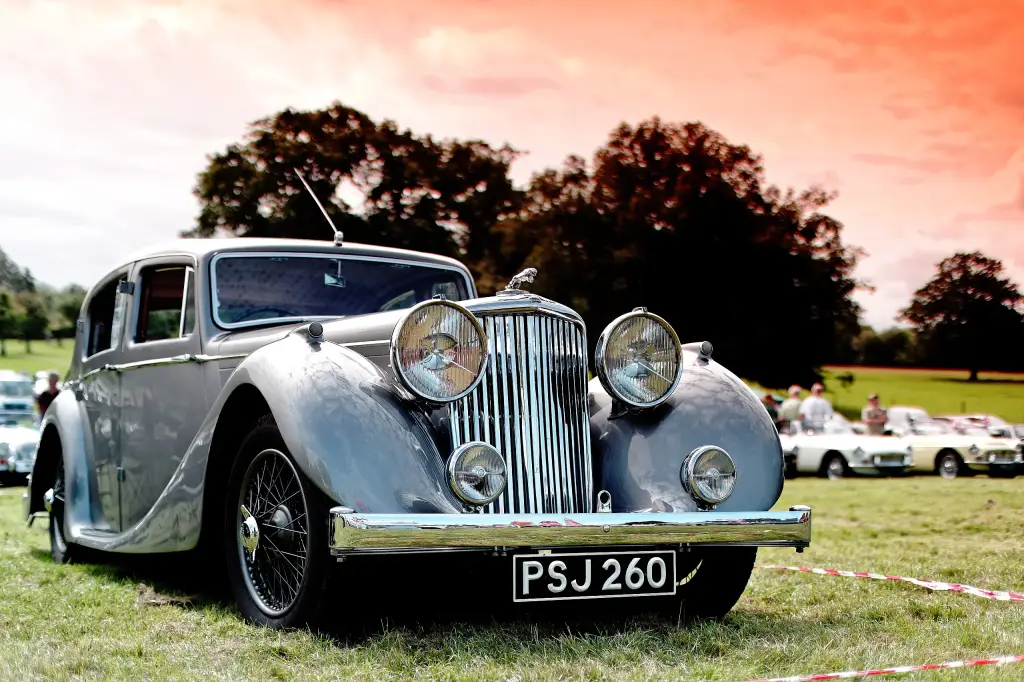
The 1½ Litre
The smallest model first used a 1608 cc side-valve Standard engine, replaced from 1938 by a 1776 cc overhead-valve unit, still from Standard, which also supplied the four-speed manual transmission. Before the war the car came as a saloon or drophead coupé; after the war only the closed body was made. Body construction was steel on wood until 1938, when it changed to all steel. Performance was not a strong point but 70 mph was possible, and the cabin was as roomy and well appointed as its longer-engined brothers; a report of the time called the four-cylinder car the sweetest running of the range, with a big car cruising gait in the sixties. Girling mechanically operated brakes were fitted.
The six-cylinders
The 2½ Litre engine also came from Standard but was redesigned with overhead valves; Harry Weslake advised on the cylinder head, lifting output to 105 bhp. The chassis was 119 inches, growing to 120 inches in 1938 to make room for the six, with passenger space unchanged. The 3½ Litre of 1938 used the same body and chassis with a 125 bhp engine, giving better performance at the cost of economy; its rear axle ratio was 4.25:1 against 4.5:1 on the 2½ Litre. Some drophead models of the six-cylinder cars were made after the war.
Design and features
- Separate chassis: leaf-sprung rigid axles front and rear, as before the war.
- Three engines: four-cylinder 1½ Litre and six-cylinder 2½ and 3½ Litre units.
- Standard Motor components: engines and gearboxes sourced from Standard, then reworked.
- Weslake cylinder head: the 2½ Litre’s head was developed with Harry Weslake.
- Post-war continuity: the last Jaguars to carry pre-war coachwork into the late 1940s.
Jaguar Mark IV versions
- 1½ Litre: 1776 cc overhead-valve four, saloon only after the war.
- 2½ Litre: 105 bhp six, saloon and some drophead coupés.
- 3½ Litre (1938 on): 125 bhp six, the fastest of the range.
The Mark IV was replaced by the Jaguar Mark V, and its two-seater sporting relative was the SS Jaguar 100. More cars are in the Jaguar collection.
Sources
- Jaguar Mark IV, English Wikipedia: history, engines, chassis