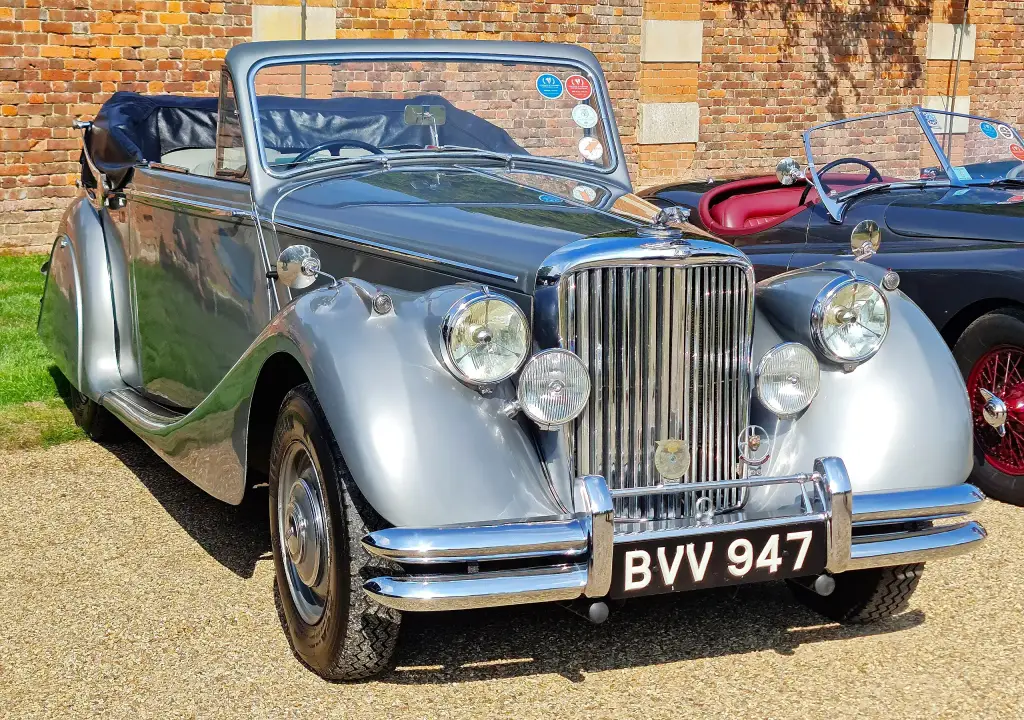
The Jaguar Mark V is a luxury car built by Jaguar Cars in Coventry from 1948 to 1951, as a four-door saloon and a two-door drophead coupé, both seating five adults. It was Jaguar’s first car with independent front suspension and hydraulic brakes, and the last to use the pushrod engines.
Jaguar Mark V at a glance
| Production | 1948–1951 |
|---|---|
| Launched | 27 October 1948, London Motor Show |
| Bodies | four-door saloon, two-door drophead coupé |
| Engines | 2664 cc and 3485 cc pushrod straight-six |
| Power | 102 bhp and 125 bhp |
| Chassis | new box-section frame with cross bracing |
| Front suspension | double wishbones and torsion bars |
| Brakes | hydraulic |
| Wheels | 16-inch steel disc, rear spats standard |
| Gearbox | four-speed manual, no automatic |
| Note | first Jaguar designed for both right- and left-hand drive |
History of the Jaguar Mark V
Launch
The Mark V was shown to distributors and the press on 30 September 1948 and launched on 27 October 1948 at the London Motor Show, sharing a stand with the XK120, whose announcement came at the same time. The XK120, not quite ready for production, was the star of the show, yet the Mark V vastly outsold it, at roughly 5,000 cars a year against 2,000 for the sports car. Three cars were built in late 1948 and saloon production was well under way at the Swallow Road works in Foleshill by March 1949, though the drophead coupé was delayed for some months; the last cars were built in mid-1951.
Under the skin
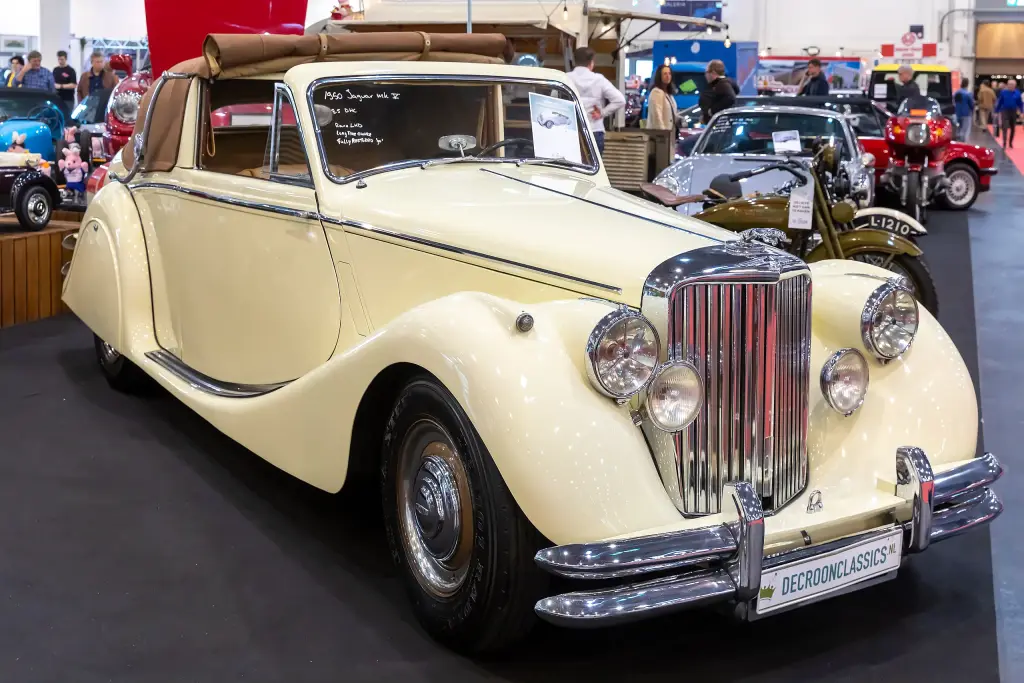
The Mark V kept the 1946–48 driveline: the overhead-valve pushrod 2½ and 3½ litre engines, built by Jaguar since 1946 after the company bought the design from Standard before the war, and a four-speed single-helical gearbox made by Jaguar and the Moss Gear Company. The 1½-litre Standard engine of earlier models was not offered, and there was no automatic transmission. Claimed output was 102 bhp for the 2664 cc engine and 125 bhp for the more popular 3485 cc version. The chassis frame was new, with deep box sections and cross bracing for stiffness; the independent front suspension used double wishbones and torsion bars, an arrangement Jaguar kept for many later cars. The chassis had weldments and brackets for both left- and right-hand drive pedal linkages, and it swept over the rear axle rather than running underslung, giving more wheel travel and comfort.
Style and equipment
The styling followed pre-war SS Jaguar lines with an upright chrome grille, and the leaping Jaguar radiator cap mascot was optional. The Autocar called the car rich yet unostentatious, halfway in outline between the old and the new. Wheels were 16-inch steel discs, much smaller than the Mark IV’s 18-inch items, and rear-wheel spats were standard; the saloon had a distinctive tuck-in curve at the base of the rear quarter window. British and most export cars used 7.7-inch Lucas PF770 headlamps with semaphore indicators, while the American market got sealed headlamps and flashing indicators. Twelve single paint colours were offered with seven upholstery colours, but no factory two-tone scheme or whitewall tyres. The Motor tested a 3½ litre in 1949 at 90.7 mph and 0–60 mph in 20.4 seconds, and Autocar praised light steering and a comfortable, stable ride. Its replacement, the Mark VII, kept the same ten-foot wheelbase but had a longer, more streamlined body.
Design and features
- Independent front suspension: double wishbones and torsion bars, a first for Jaguar.
- Hydraulic brakes: adopted later than most rivals but necessary with the new suspension.
- New chassis: deep box sections and cross bracing for greater stiffness.
- Left- and right-hand drive: the first Jaguar designed for both from the start.
- Pushrod engines: the last Jaguars to use them before the XK unit took over.
Jaguar Mark V versions
- 2½ Litre saloon and DHC: 2664 cc, 102 bhp.
- 3½ Litre saloon and DHC: 3485 cc, 125 bhp, the more popular choice.
- American specification: sealed headlamps and flashing indicators.
The Mark V followed the Jaguar Mark IV and was replaced by the Jaguar Mark VII. More cars are in the Jaguar collection.
Sources
- Jaguar Mark V, English Wikipedia: history, chassis, equipment, performance