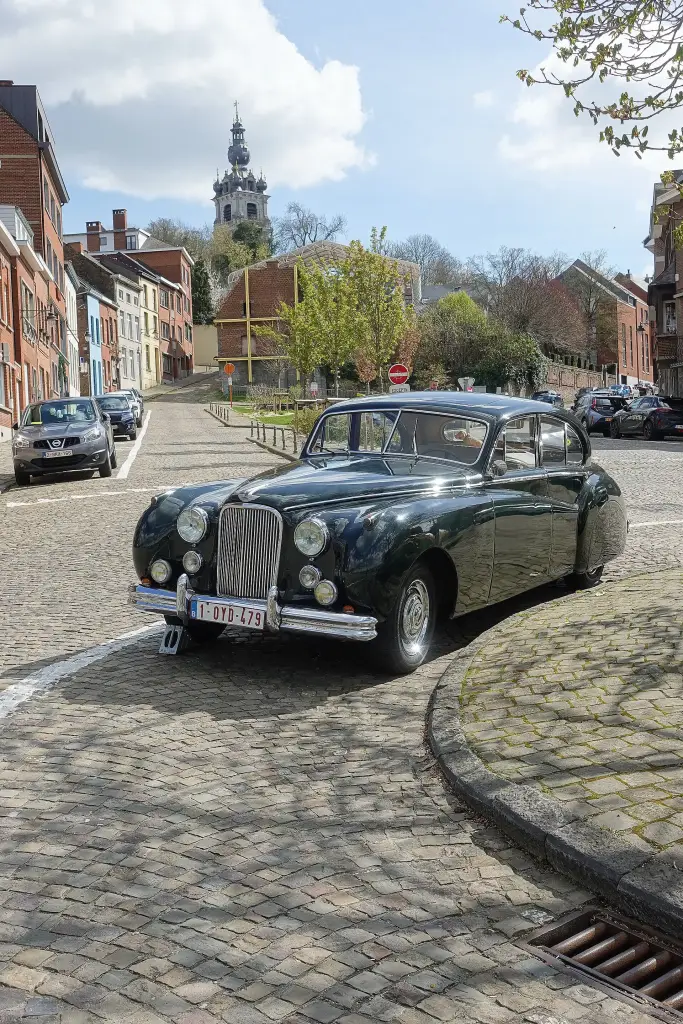
The Jaguar Mark VII is a four-door luxury car produced in Coventry from 1950 to 1956. Launched at the 1950 British International Motor Show as the successor to the Mark V, it took the Mark VII name because a Bentley Mark VI was already on the market. In its original form it could exceed 100 mph, and in 1952 it became the first Jaguar available with an optional automatic transmission.
Jaguar Mark VII at a glance
| Production | 1950–1956 |
|---|---|
| Launched | 1950 British International Motor Show |
| Chassis | from the Mark V, 10-foot wheelbase |
| Engine | 3442 cc DOHC straight-six XK |
| Power | 160 bhp, 190 bhp in the Mark VII M |
| Top speed | over 100 mph; 104 mph claimed for the M |
| Gearbox | four-speed manual, automatic from 1952 |
| Built | 20,908 Mark VII, 10,061 Mark VII M |
| Racing | five straight Daily Express Trophy wins |
| Rallying | Monte Carlo Rally win in 1956 |
History of the Jaguar Mark VII
The original Mark VII
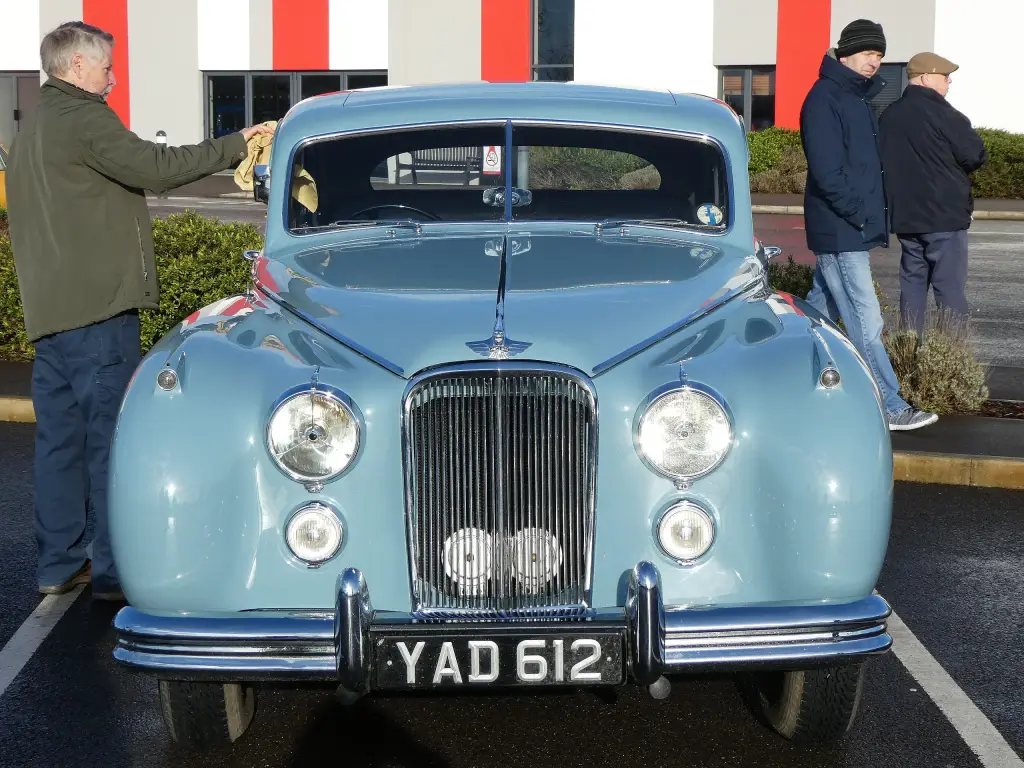
The chassis came from the Mark V and the wheelbase stayed at ten feet. The new body looked more streamlined, with integrated headlights and mudguards, a two-piece windscreen and a longer rear overhang; as on the Mark V, the rear wheels were partly covered by removable spats. Where the Mark V had a pre-war pushrod engine from Standard, the Mark VII used the new XK engine: the 3442 cc twin-cam six first seen in the 1948 XK120, here with 160 bhp and a claimed top speed above 100 mph.
Into production
Jaguar expected most customers overseas, because British car tax then penalised buyers of larger-engined cars. The car went into production just as post-war austerity began to ease, and its reception in Britain and America in 1951 prompted Jaguar to move production to the larger Browns Lane plant, a wartime shadow factory. Published performance was quoted at the standard 8:1 compression ratio, which did not suit Britain’s low-octane Pool petrol, so a 7:1 engine was optional; magazines tested the higher-compression cars on the Ostend–Brussels autoroute, where 80-octane fuel was sold. The Motor recorded 101 mph and 0–60 mph in 13.7 seconds in 1952, at a test price of £1,693. By the time the model was upgraded to M specification in 1954, 20,908 had been built.
The Mark VII M
The Mark VII M arrived at the 1954 British International Motor Show with high-lift camshafts raising output to 190 bhp and a claimed 104 mph. The four-speed manual gained constant mesh and closer ratios, and the Borg-Warner automatic, previously export-only, became optional in Britain. Larger torsion bars went to the front suspension, flasher indicators replaced semaphore arms, and the front gained circular horn grilles below the headlamps instead of integrated auxiliary lamps, with both bumpers wrapping further round the body. New tail lamps had built-in reflectors and indicators, the headlamps got Le Mans type diffuser glasses, and the seats became full length with Dunlopillo. With the Suez Crisis of 1956 and the threat of fuel rationing, Jaguar turned to smaller saloons, and the M sold 10,061 in two years before the Mark VIII replaced it.
Design and features
- XK engine: the 3.4-litre twin-cam six from the XK120, at last in a Jaguar saloon.
- Over 100 mph: exceptional for a large luxury saloon in 1950.
- Automatic option: the first Jaguar to offer one, from 1952.
- Race and rally success: five Daily Express Trophy wins and the 1956 Monte Carlo Rally.
- Mark VII M: 190 bhp, closer ratios and better brakes and lamps.
Jaguar Mark VII versions
- Mark VII (1950–1954): 160 bhp, 20,908 built.
- Mark VII M (1954–1956): 190 bhp, 10,061 built.
- Lightweight Mark VII M (1954): one racing car with magnesium panels and a D-Type engine, never raced in period.
The Mark VII followed the Jaguar Mark V and led to the Jaguar Mark IX. More cars are in the Jaguar collection.
Sources
- Jaguar Mark VII, English Wikipedia: history, Mark VII M, racing