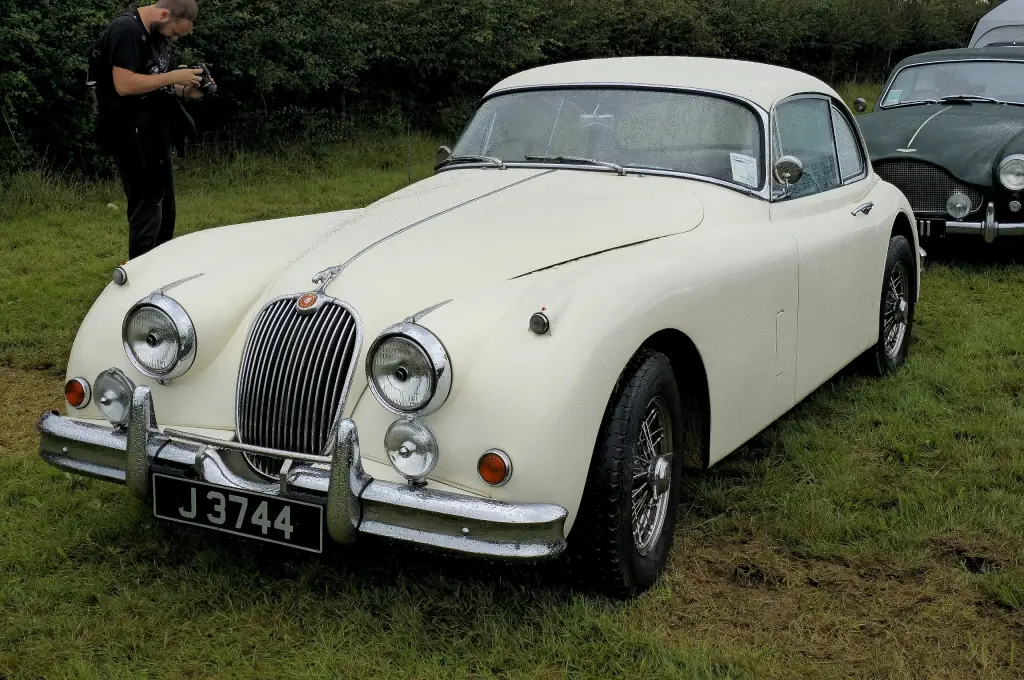
The Jaguar XK150 is a sports car produced by Jaguar between 1957 and 1961 as the successor to the XK140. It was announced in Britain in May 1957 with a family resemblance to the XK120 and XK140 but radically revised, most visibly by a one-piece windscreen replacing the split screen.
Jaguar XK150 at a glance
| Production | 1957–1961 |
|---|---|
| Announced | May 1957 in Britain |
| Engine | 3.4-litre XK six, 3.8 from 1960 |
| Power | 180 bhp standard, 210 bhp SE, 250 bhp S, 265 bhp with 3.8 |
| Brakes | disc brakes, optional on the SE from 1958 |
| Steering | rack and pinion, manual only |
| Windscreen | one piece instead of split |
| Bodies | fixed head coupé, drophead coupé, open two-seater from 1958 |
| Built | 9,382 |
| Replaced by | Jaguar E-Type, March 1961 |
History of the Jaguar XK150
New look, new engine
The one-piece windscreen was the clearest change, and the wing line was carried higher and more streamlined along the doors. The widened bonnet opened down to the wings, and on the coupés the windscreen frame moved forward four inches for easier access. The dashboard was trimmed in leather with walnut optional, thin doors gave more interior space, and a small red light reminded the driver that the front parking lights on top of the wings were on. Suspension and chassis were very similar to the XK140 with manual-only rack and pinion steering, while a new B-type cylinder head raised the 3.4-litre engine to 180 bhp.
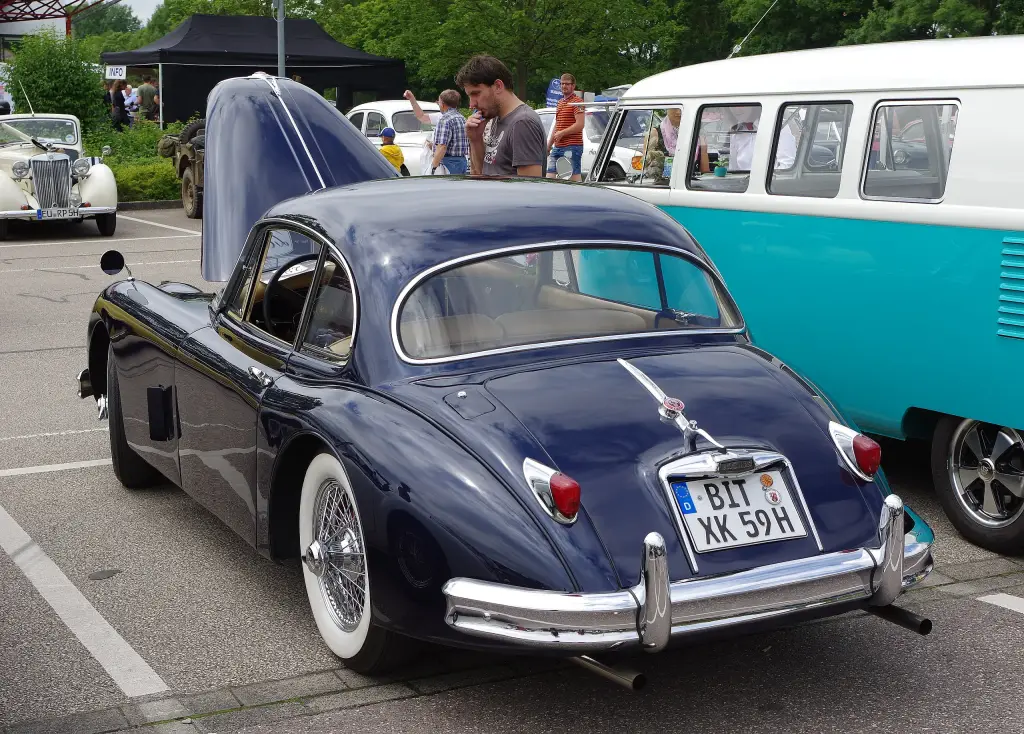
Special Equipment and S
The first closed and convertible XK150s were slower than their predecessors, and after a twelve-month delay caused by the February 1957 factory fire the gap was closed in spring 1958 with the SE models, which had disc brakes and a more powerful engine. Twin 1.75-inch SU HD6 carburettors and a modified B-type head with larger exhaust valves gave 210 bhp. The open two-seater could also be had with the S engine: three 2-inch SU HD8 carburettors and a straight-port cylinder head for a claimed 250 bhp. In 1960 the 3.8-litre engine from the Mark IX became available, tuned to up to 265 bhp in S models and good for 135 mph and about 7 seconds to 60 mph. Four-wheel Dunlop disc brakes appeared as an option.
The end of the line
A 250 bhp 3.4-litre XK150S fixed head coupé tested by The Motor in 1959 reached 132 mph and 60 mph in 7.8 seconds, making it the fastest closed car the magazine had fully tested to that point. Production ended in October 1960 with 9,382 cars: 2,265 open two-seaters, 4,445 fixed head coupés and 2,672 drophead coupés. Bertone bodied three bare chassis as prototype fixed head coupés, reportedly intended as the replacement for the XK150 and wearing an XKE badge, before Jaguar chose the E-Type instead. The E-Type was announced in mid-March 1961.
Design and features
- One-piece windscreen: the biggest visual change from the XK140.
- Disc brakes: available from 1958, the first time on an XK.
- Engine choice: 180, 210, 250 or 265 bhp depending on specification.
- Open two-seater: added in 1958 with wind-up windows and high sills.
- Bertone prototypes: three chassis bodied in Turin as possible successors.
Jaguar XK150 versions
- XK150 standard: 3.4-litre engine with the B-type head, 180 bhp.
- XK150 SE: 210 bhp with larger SU carburettors and disc brakes.
- XK150 S: three SU HD8s and a straight-port head, 250 bhp, 265 with the 3.8.
- Open two-seater (1958): wind-up windows with a simple folding roof.
- Bertone coupés: three chassis with Italian coachwork.
The XK150 followed the Jaguar XK140 and was replaced by the Jaguar E-Type, while its 3.8-litre engine also went into the Jaguar Mark IX. More cars are in the Jaguar collection.
Sources
- Jaguar XK150, English Wikipedia: history, engines, production, performance