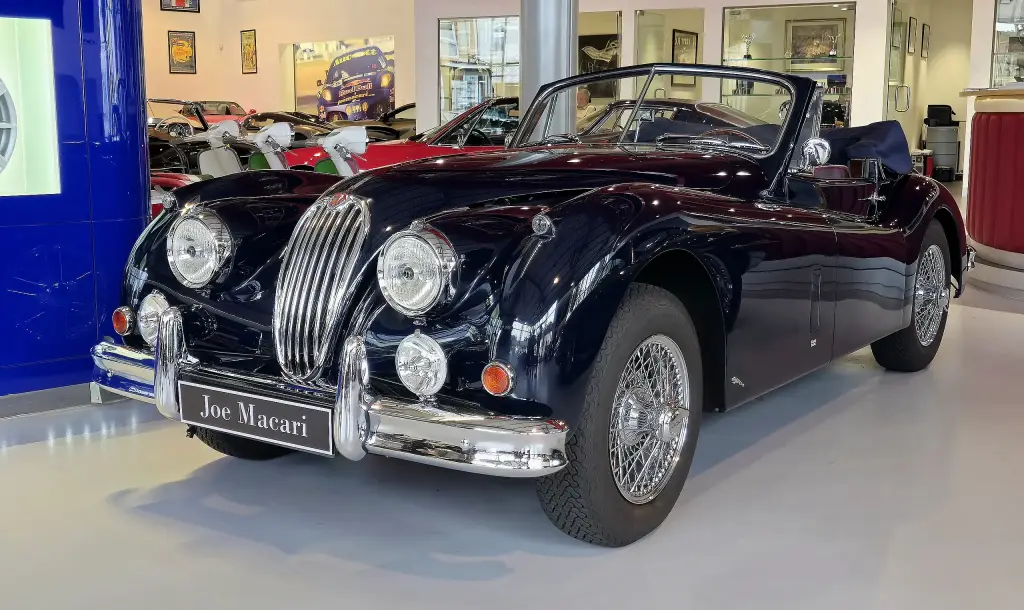
The Jaguar XK140 is a sports car manufactured by Jaguar between 1954 and 1957 as the successor to the XK120. It brought more interior space, improved brakes, rack and pinion steering, increased suspension travel and telescopic shock absorbers in place of the older lever arm design.
Jaguar XK140 at a glance
| Production | 1954–1957 |
|---|---|
| Introduced | late 1954, sold as a 1955 model |
| Engine | 3.4-litre twin-cam XK straight-six |
| Power | 190 bhp gross standard, 210 bhp with the C-Type head |
| Steering | rack and pinion |
| Dampers | telescopic instead of lever arm |
| Legroom | 3 inches more than the XK120 |
| Bodies | open two-seater, drophead coupé, fixed head coupé |
| Automatic | offered from 1956, a first for a Jaguar sports car |
| Top speed | 120–125 mph in SE form |
History of the Jaguar XK140
What changed outside
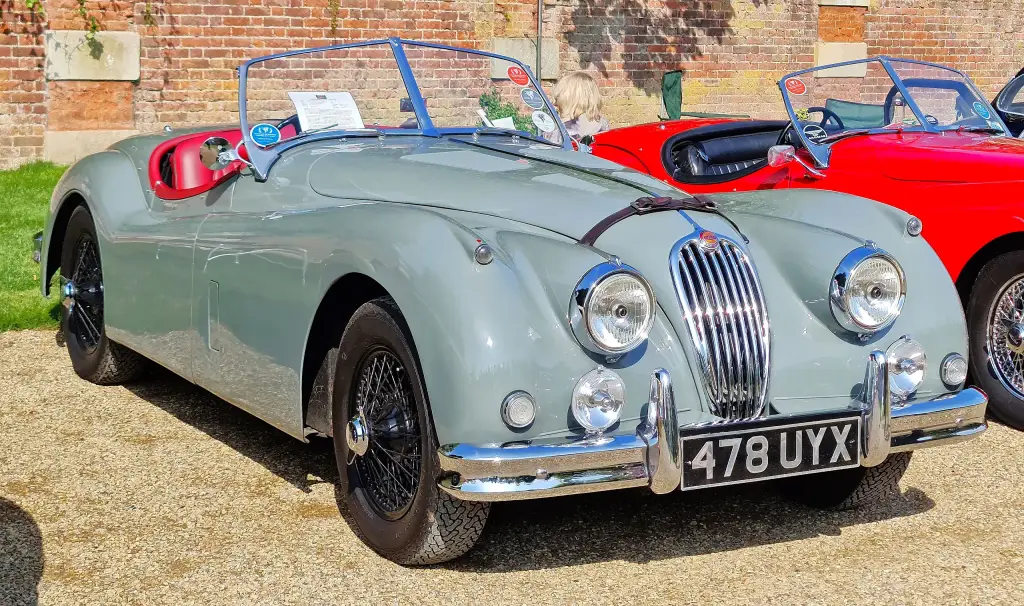
The XK140 was introduced in late 1954 and sold as a 1955 model. Exterior changes from the XK120 included more substantial front and rear bumpers with overriders and flashing turn signals operated by a switch on the dash above the front bumper. The grille stayed the same size but became a one-piece cast unit with fewer, broader vertical bars, and the Jaguar badge moved into the grille surround. A chrome strip ran along the centre of the bonnet and boot lid, and an emblem on the boot read Winner Le Mans 1951–3.
Inside and under the skin
The interior was made more comfortable for taller drivers by moving the engine, firewall and dash forward to give three inches more legroom. The fixed head coupé carried two 6-volt batteries, one in each front wing, while the drophead and open cars had a single 12-volt battery in the passenger-side wing. The 3.4-litre XK engine came with the Special Equipment modifications from the XK120 as standard, raising output by 10 bhp to 190 bhp gross at 5,500 rpm; the optional C-Type cylinder head gave 210 bhp at 5,750 rpm. With that head, 2-inch sand-cast H8 carburettors, heavier torsion bars and twin exhausts the car was called the XK140 SE in Britain and the XK140 MC in North America. In 1956 the XK140 became the first Jaguar sports car offered with automatic transmission.
Bodies and performance
The open two-seater had a light canvas top folding out of sight behind the seats, leather and leatherette trim, removable side curtains on alloy doors and a tonneau cover; the door tops and scuttle were cut back two inches from the XK120 and the angle of the door front changed from 45 to 90 degrees for easier access. The drophead coupé had a bulkier lined top that lowered onto the body, a fixed integral windscreen, wind-up windows, a small rear seat and walnut veneer. The fixed head coupé shared that trim and rear seat, with a longer roof, forward windscreen, shorter front wings and longer doors than the XK120 version. A stock XK140 SE reached 120–125 mph; Road & Track recorded 120.3 mph and 0–60 mph in 8.4 seconds in June 1955. Zagato built one coupé on an XK140 for Guido Modiano and showed it at the 1957 Paris Motor Show, and Ghia built a Michelotti-designed coupé in 1955, reportedly three cars in all.
Design and features
- More space: three inches of extra legroom over the XK120.
- Rack and pinion steering: sharper than the old recirculating ball system.
- Telescopic dampers: improved suspension travel and control.
- 190 bhp as standard: and 210 bhp with the C-Type cylinder head.
- Automatic option: the first Jaguar sports car to offer one, in 1956.
Jaguar XK140 versions
- Open two-seater: sidescreens, folding top and tonneau cover.
- Drophead coupé: lined top, wind-up windows and a small rear seat.
- Fixed head coupé: longer roof, longer doors and a rear seat.
- XK140 SE / MC: C-Type head, H8 carburettors, twin exhausts, 210 bhp.
- Coachbuilt: one Zagato coupé and a Michelotti design by Ghia.
The XK140 followed the Jaguar XK120 and was replaced by the Jaguar XK150. More cars are in the Jaguar collection.
Sources
- Jaguar XK140, English Wikipedia: changes, engines, bodies, performance