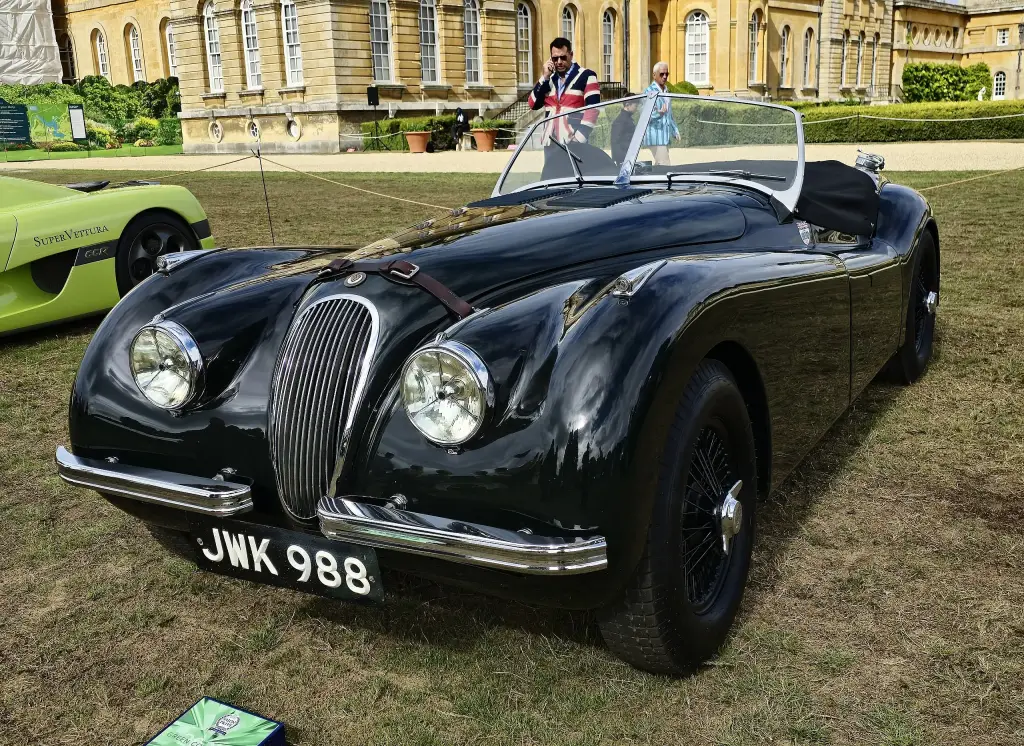
The Jaguar XK120 is a sports car built by Jaguar between 1948 and 1954 and Jaguar’s first sports car since SS 100 production ended in 1939. It was launched in open two-seater form at the 1948 London Motor Show as a testbed and show car for the new XK engine designed by chief engineer William Heynes; the sensation it caused persuaded William Lyons to put it into production.
Jaguar XK120 at a glance
| Production | 1948–1954 |
|---|---|
| Shown | London Motor Show, 1948 |
| Engine | 3.4-litre twin-cam straight-six XK |
| Power | 160 bhp at 8:1 compression |
| Top speed | 120 mph, giving the model its name |
| Bodies | open two-seater, fixed head coupé from 1951, drophead coupé from 1953 |
| First 242 cars | aluminium bodies on ash framing |
| Chassis | steel, largely copied from the Mark V |
| Suspension | torsion bar independent front, leaf springs rear |
| Brakes | 12-inch drums all round |
History of the Jaguar XK120
Construction
The first 242 cars had wood-framed open two-seater bodies with aluminium panels, built by hand between late 1948 and early 1950; from the 1950 model year the cars were mass-produced with pressed-steel bodies, keeping aluminium doors, bonnet and boot lid. The steel chassis was mostly copied from the Jaguar Mark V, using many of the same parts. The 3.4-litre twin-cam XK engine was advanced for a mass-produced unit, with an aluminium cylinder head, hemispherical combustion chambers, inclined valves and twin side-draft SU carburettors, giving 160 bhp at the standard 8:1 compression ratio. Most early cars were exported, while a 7:1 low-compression version was reserved for Britain, where post-war austerity restricted buyers to 70-octane Pool petrol.
Speed records
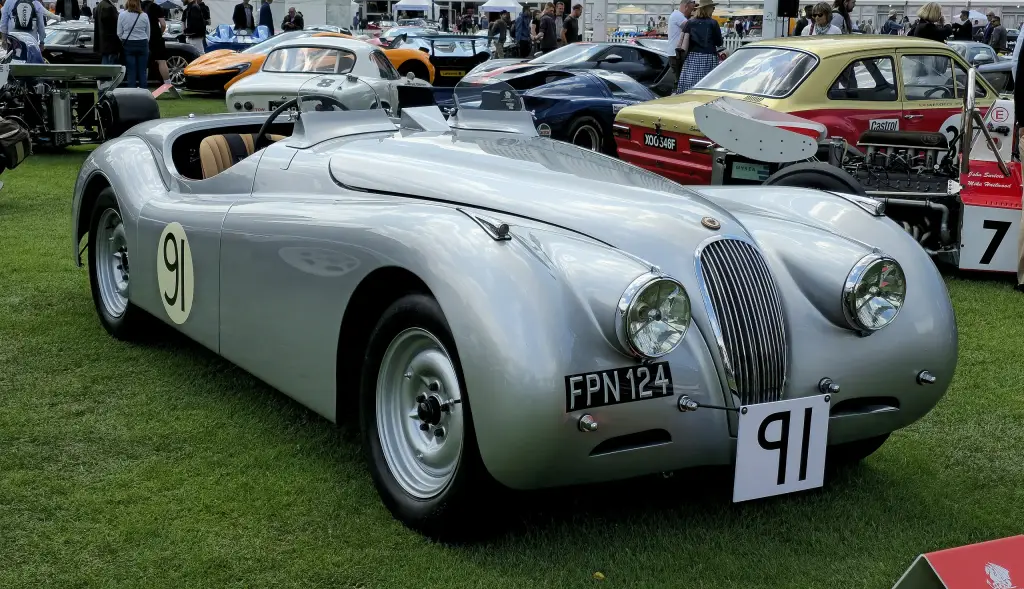
The “120” in the name referred to the aluminium car’s 120 mph top speed, which made it the world’s fastest production car at its launch. On 30 May 1949, on the empty Ostend–Jabbeke motorway in Belgium, a prototype timed by Royal Automobile Club of Belgium officials averaged 132.6 mph in runs in opposite directions with a small aero screen in place of the windscreen and the alternative top gear ratio, and 135 mph with a passenger-side tonneau cover fitted. In 1950 and 1951 open XK120s averaged over 100 mph for 24 hours and over 130 mph for an hour at the banked Linas-Montlhéry autodrome in France, and in 1952 a fixed-head coupé took numerous speed and distance records by averaging 100 mph for a week. The first production car, chassis 670003, was delivered to Clark Gable in 1949.
Bodies and equipment
The XK120 came in three two-seater body styles: the open two-seater, or roadster, known in America as the OTS; a fixed head coupé from 1951; and a drophead coupé from 1953. The open car offered little weather protection, with a folding canvas top and detachable sidescreens stowed behind the seats and doors opened by an interior pull-cord rather than external handles. The drophead coupé had a padded lined top, roll-up windows and a two-piece flat-glass windscreen set in a steel frame integral with the body. Both closed cars had wood-veneered dashboards and door caps, and all models had removable rear wheel spats unless wire wheels were specified. All XK120s used Heynes-designed torsion bar independent front suspension, semi-elliptic leaf springs at the rear, recirculating ball steering and 12-inch drum brakes that were prone to fade, though some cars had finned Alfin drums to help. A smaller-engined XK100 with a 2-litre four-cylinder engine, intended for the UK, was cancelled before production.
Design and features
- XK engine: a twin-cam six with hemispherical chambers, later enlarged to 3.8 and 4.2 litres.
- 120 mph: the fastest production car in the world at launch.
- Record breaker: 135 mph at Jabbeke and 100 mph for a week in 1952.
- Three bodies: OTS, fixed head coupé and drophead coupé.
- Light and simple: a Mark V-based chassis with torsion bar front suspension.
Jaguar XK120 versions
- Open two-seater (OTS): the original roadster, with sidescreens and a folding top.
- Fixed head coupé (1951): closed body with wood veneer inside.
- Drophead coupé (1953): lined folding top and wind-up windows.
- Special Equipment: early cars with wire wheels and other upgrades, marked by an S in the chassis number.
The XK120 grew into the Jaguar XK140 and Jaguar XK150, and its engine went into the Jaguar Mark VII. More cars are in the Jaguar collection.
Sources
- Jaguar XK120, English Wikipedia: construction, records, bodies, equipment