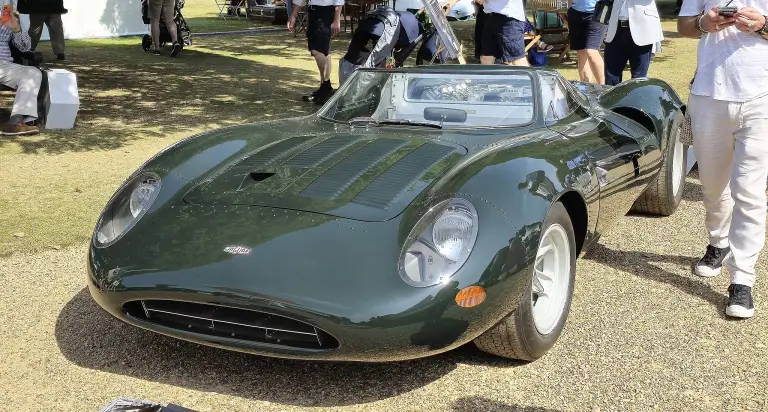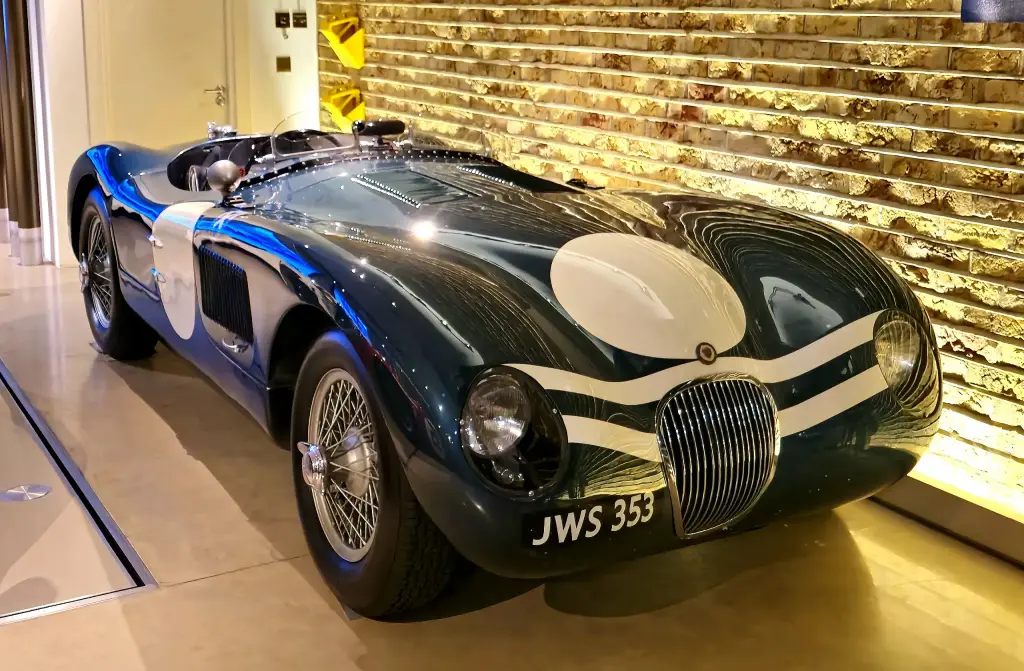
The Jaguar C-Type, officially called the Jaguar XK120-C, is a racing sports car built by Jaguar and sold from 1951 to 1953. The “C” stands for competition: the car combined the running gear of the road-going XK120 with a lightweight tubular frame and an aerodynamic aluminium body, and it won the Le Mans 24 Hours at its first attempt.
Jaguar C-Type at a glance
| Also called | Jaguar XK120-C |
|---|---|
| Production | 1951–1953 |
| Built | 53, of which 43 sold to private owners |
| Engine | 3.4-litre twin-cam straight-six |
| Power | about 205 bhp at first, 220 bhp in 1953 |
| Frame | lightweight multi-tubular, triangulated |
| Body | aluminium, barchetta style |
| Brakes | drum at first, disc brakes from mid-1953 |
| Carburettors | SU, then three Weber DCO3 from 1953 |
| Le Mans wins | 1951 and 1953 |
| Chassis numbers | XKC001 to XK054 |
History of the Jaguar C-Type
Origins
The C-Type was designed around proven parts. Its 3.4-litre twin-cam straight-six came from the XK120 and was originally tuned to around 205 bhp; the lightweight, multi-tubular, triangulated frame was designed by Jaguar chief engineer William Heynes, and Heynes, Bob Knight and later Malcolm Sayer developed the aerodynamic aluminium body. In barchetta style, it was stripped of road-going items such as carpets, weather equipment and exterior door handles. According to the Jaguar Heritage Registry, the cars were produced between May 1952, starting with XKC001, and August 1953 with XK054.
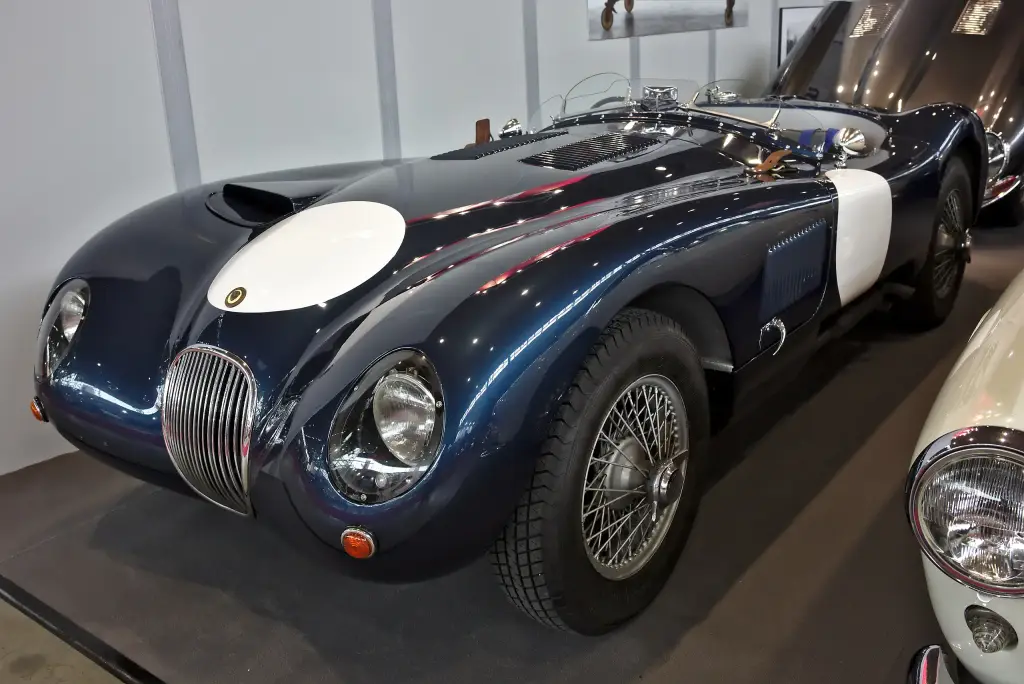
Le Mans 1951 and 1952
Jaguar entered three cars in 1951 and won at the first attempt, with Peter Walker and Peter Whitehead; the other two factory entries retired with lack of oil pressure. For 1952 Jaguar modified the body to increase top speed after reports about the speed of the Mercedes-Benz 300SLs, but the rearrangement of the cooling system made the cars vulnerable to overheating and all three retired. Testing by Norman Dewis at MIRA afterwards showed the trouble lay mainly in the cooling system: the water pump pulley was undersized so it spun too fast and caused cavitation, the header tank sat far from the radiator and the tubing was too small at 7/8 inch.
Le Mans 1953 and after
In 1953 the body was made in thinner, lighter aluminium and the SU carburettors gave way to three 40 mm Weber DCO3 units, helping to raise power to 220 bhp. Further weight was saved with a rubber bag fuel tank, lighter electrical equipment and thinner gauge steel for some chassis tubes. Duncan Hamilton and Tony Rolt won at an average of 105.85 mph, the first time Le Mans had been won at over 100 mph. Disc brakes were still novel in 1953, and Jaguar’s win helped set off a scramble to fit them to production cars. In 1954, the C-Type’s final year at Le Mans, an Ecurie Francorchamps car finished fourth.
Design and features
- Tubular frame: a light triangulated chassis designed by William Heynes.
- Aluminium body: aerodynamic barchetta coachwork by Heynes, Knight and Sayer.
- Disc brakes: fitted from mid-1953, ahead of most of the industry.
- Weber carburettors: three twin-choke DCO3s on the 1953 cars.
- Race record: two Le Mans wins and a fourth place in its final year.
Jaguar C-Type versions
- 1951 specification: SU carburettors, drum brakes, about 205 bhp.
- 1952 lightweight: revised aerodynamics for higher top speed.
- 1953 specification: thinner aluminium, triple Webers, disc brakes, 220 bhp.
- Works lightweights: three built, of which XKC052 was the second.
The C-Type grew out of the Jaguar XK120 and led directly to the D-Type. More cars are in the Jaguar collection.
Sources
- Jaguar C-Type, English Wikipedia: specification, racing history, values