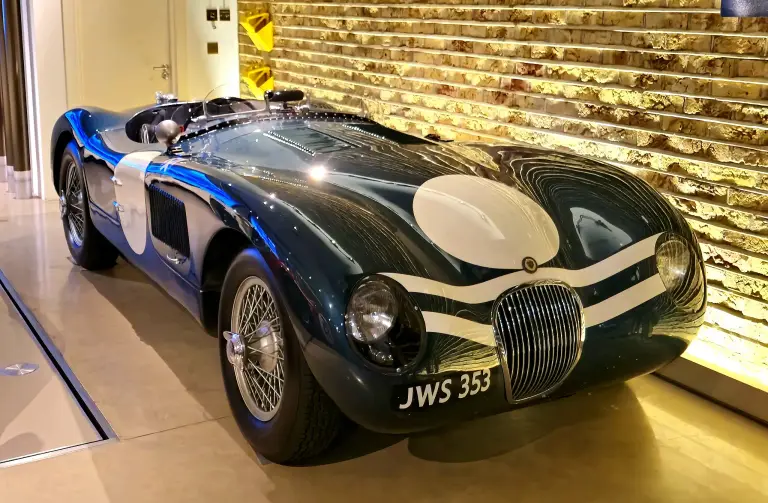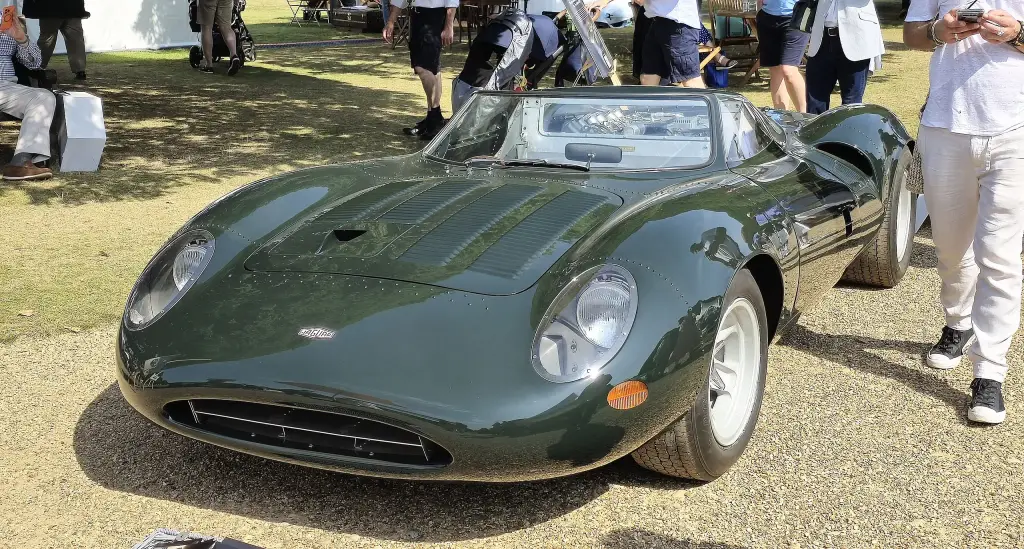
The Jaguar XJ13 is a prototype racing car developed by Jaguar Engineering Director William Heynes to compete at Le Mans in the mid-1960s. It never raced, and only one was built.
Jaguar XJ13 at a glance
| Built | 1966 |
|---|---|
| Purpose | Le Mans prototype |
| Designers | William Heynes, Claude Bailey (engine), Malcolm Sayer (body) |
| Engine | 5.0-litre V12, mid-mounted |
| Power | 502 bhp at 7,600 rpm |
| Layout | engine as a stressed chassis member |
| Gearbox | five-speed ZF transaxle |
| Front suspension | wishbones with coil springs and dampers |
| Cars built | one |
| Raced | never |
| Crash | MIRA, 21 January 1971 |
History of the Jaguar XJ13
The V12
Jaguar had considered a double overhead camshaft V12 as far back as 1950, first for racing and then in a single-cam road-going form, unlike the XK, which was designed as a production engine and later pressed into racing. The engine was essentially two XK six-cylinders on a common crankshaft with an aluminium block, though the inlet porting, valve angles and combustion chamber shape differed. It first ran in July 1964.
Building the prototype
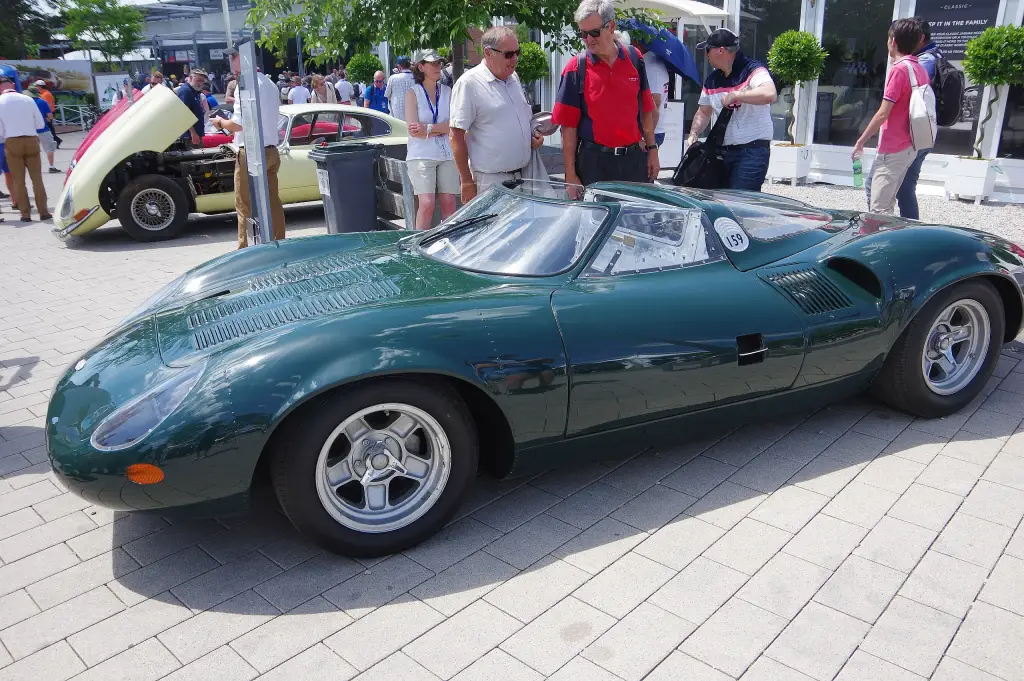
A mid-engined prototype had been mooted by Heynes in 1960, but construction only began in 1965 and the first car ran by March 1966. Malcolm Sayer, who had shaped the C-Type and D-Type, designed the aluminium body using techniques borrowed from the aircraft industry. Heynes entrusted the build to Derick White, Ted Brookes, Mike Kimberley and Bob Blake in the Browns Lane experimental department’s competition shop. Ex-Jaguar apprentice David Hobbs became the main test driver and set an unofficial UK closed-circuit lap record with the car that stood for 32 years. The XJ13 carried its 5.0-litre V12 behind the driver as a stressed chassis member, with a five-speed ZF transaxle. Front suspension used wishbones with coil springs and dampers, unlike the E-Type’s torsion bars, while the rear kept E-Type-style driveshafts as upper links.
Why it never raced
The project was never a priority for management and became less so after the 1966 merger with BMC. By then Ford’s 7.0-litre GT40 Mk II had won Le Mans, and the XJ13 was considered obsolete before it was finished; from 1968 prototype engines were limited to 3.0 litres anyway. Testing at MIRA and Silverstone confirmed that considerable development would have been needed to make the car competitive, and the prototype went into storage.
The MIRA crash
In 1971 Jaguar wanted a shot of the XJ13 at speed for the launch film of the V12 E-Type. On 21 January 1971 test driver Norman Dewis ran the car at MIRA on a damaged tyre, against instructions, and crashed heavily. Dewis was unhurt but the car was nearly destroyed. It was later rebuilt by Abbey Panels using some of the original body jigs, at a cost of £1,000 to Jaguar; in Jaguar’s own words, the car seen today is not an exact reproduction of the original. It made its public debut in July 1973 when Lofty England drove it at Silverstone during the British Grand Prix meeting, and it is now displayed at the British Motor Museum at Gaydon.
Design and features
- Mid-engined V12: a 5.0-litre twelve of 502 bhp at 7,600 rpm.
- Stressed engine: the V12 formed part of the chassis structure.
- Sayer body: aluminium coachwork shaped with aircraft techniques.
- Never raced: obsolete before completion, kept as a prototype.
- Rebuilt after the crash: restored by Abbey Panels after the 1971 MIRA accident.
Jaguar XJ13 versions
- 1966 prototype: the only car built, later damaged at MIRA and rebuilt.
- Replicas: faithful recreations have been built using original data and, in one case, an original prototype engine.
The XJ13 followed Jaguar’s Le Mans cars such as the Jaguar D-Type, and its V12 ideas led to the Jaguar XJ220. More cars are in the Jaguar collection.
Sources
- Jaguar XJ13, English Wikipedia: development, engineering, crash, rebuild