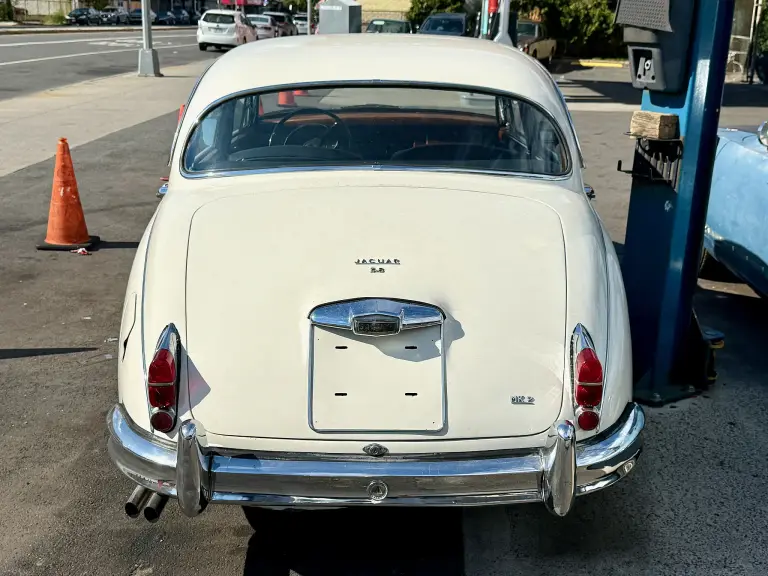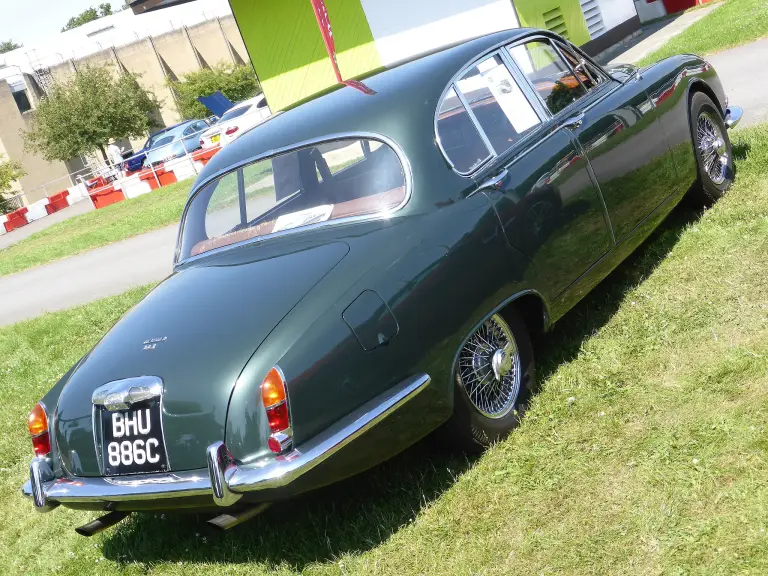
The Jaguar Mark 1 is a British luxury saloon produced by Jaguar between 1955 and 1959. Company documents of the time called it the Jaguar 2.4 Litre and Jaguar 3.4 Litre; the Mark 1 name came later, after the 2.4-litre Mark 2 replaced it in October 1959. It was Jaguar’s first small saloon since the 1½ and 2½ Litre cars ended in 1949, and it easily outsold the larger, more expensive Jaguars.
Jaguar Mark 1 at a glance
| Production | 1955–1959 |
|---|---|
| Names | Jaguar 2.4 Litre and 3.4 Litre |
| Announced | 2.4 Litre on 28 September 1955 |
| 3.4 Litre | announced in the US on 26 February 1957 |
| Construction | unitary body and chassis |
| Front suspension | double wishbones, coil springs, anti-roll bar |
| Rear axle | live axle with inverted semi-elliptic springs |
| Brakes | drum, disc brakes optional from late 1957 |
| Gearbox | manual with overdrive, three-speed automatic from 1957 |
| Built | 19,992 of the 2.4 and 17,405 of the 3.4 |
History of the Jaguar Mark 1
Origins
Jaguar moved to Daimler’s Browns Lane plant in 1951, which gave it enough capacity to enter the middle-weight executive saloon market then held in Britain by the Humber, the Standard Vanguard and the Rover P4. The 2.4 Litre was announced on 28 September 1955 and the 3.4 Litre, aimed at the American market, followed in February 1957; it was not at first freely available at home. Although the car shared a family look with the larger Mark VII, it was the first Jaguar with unitary construction of body and chassis.
Chassis and equipment
The independent front suspension used double wishbones, coil springs, telescopic dampers and an anti-roll bar in a separate subframe mounted on rubber bushes, a layout later used on other Jaguar saloons including early XJs. The live rear axle used a simplified version of the D-Type suspension, with inverted semi-elliptic springs cantilevered into the main body frame and a Panhard rod for transverse location; the rear track was about 4.5 inches narrower than the front, a feature that helped high-speed stability. At launch the car had 11.125-inch drum brakes, with disc brakes on all four wheels offered as an option from the end of 1957. Standard and special equipment versions were sold; the standard car lacked a tachometer, heater, windscreen washers, fog lights and cigarette lighter, but both had leather upholstery and polished walnut trim.
Engines and sales
The 2.4 Litre used a short-stroke version of the XK120’s twin-cam six, rated at 112 bhp net at the 1955 launch. From February 1957 the 3.4-litre 210 bhp engine already used in the Mark VIII became available, largely at the urging of US dealers; it brought a larger grille for better cooling, a stronger rear axle and cut-away rear wheel spats to clear wire-wheel hubs, and the 2.4 also received the larger grille. A three-speed Borg-Warner automatic became available in September 1957. The Motor recorded 101.5 mph and 0–60 mph in 14.4 seconds for a 2.4 with overdrive, and 119.8 mph and 11.2 seconds for a 3.4 automatic; Autocar timed a 3.4 manual with overdrive at 9.1 seconds to 60 mph. Mark 1 3.4 Litre saloons were raced and rallied by drivers including Stirling Moss, Mike Hawthorn and Roy Salvadori.
Design and features
- Unitary construction: the first Jaguar to combine body and chassis in one shell.
- D-Type rear suspension: inverted semi-elliptic springs and a Panhard rod.
- Two engines: the 2.4-litre XK unit and, from 1957, the 210 bhp 3.4.
- Optional disc brakes: available on all four wheels from late 1957.
- Compact luxury: leather and walnut in a car smaller than the Mark VII.
Jaguar Mark 1 versions
- 2.4 Litre (1955–1959): 112 bhp, 19,992 built.
- 3.4 Litre (1957–1959): 210 bhp, larger grille, 17,405 built.
- Standard and special equipment: two trim levels from launch.
- Automatic: three-speed Borg-Warner from September 1957.
The Mark 1 was replaced by the Jaguar Mark 2 and sat below the Jaguar Mark VII in the range. More cars are in the Jaguar collection.
Sources
- Jaguar Mark 1, English Wikipedia: history, chassis, engines, production