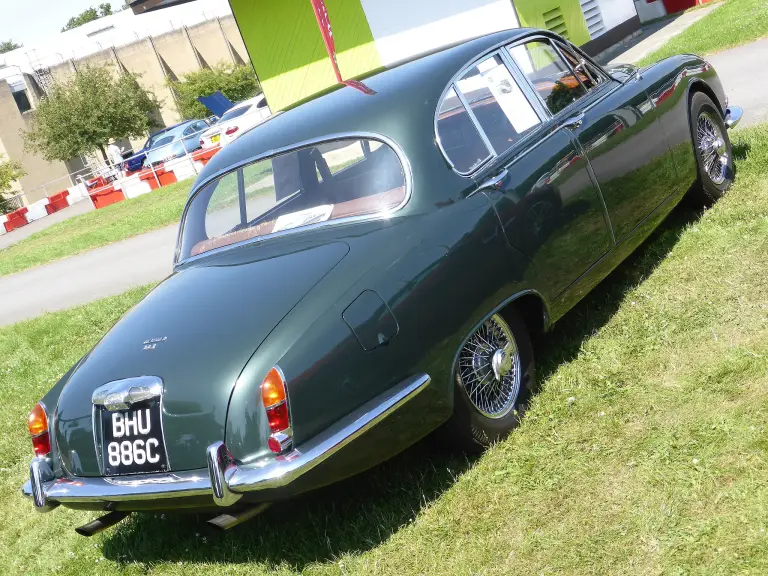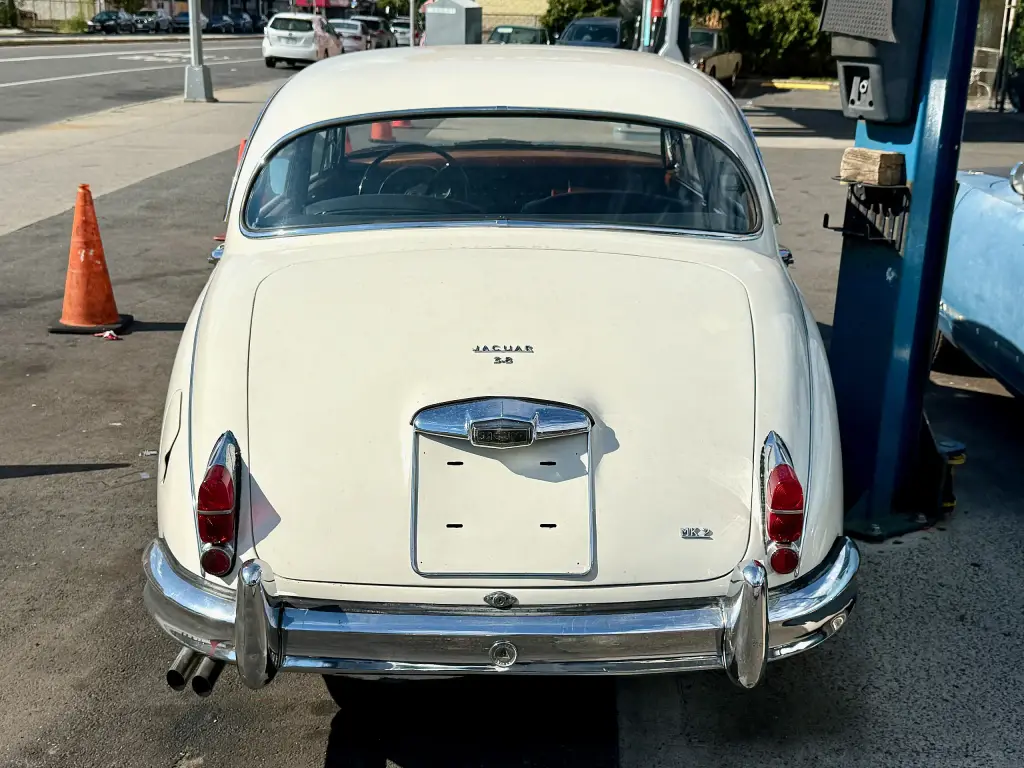
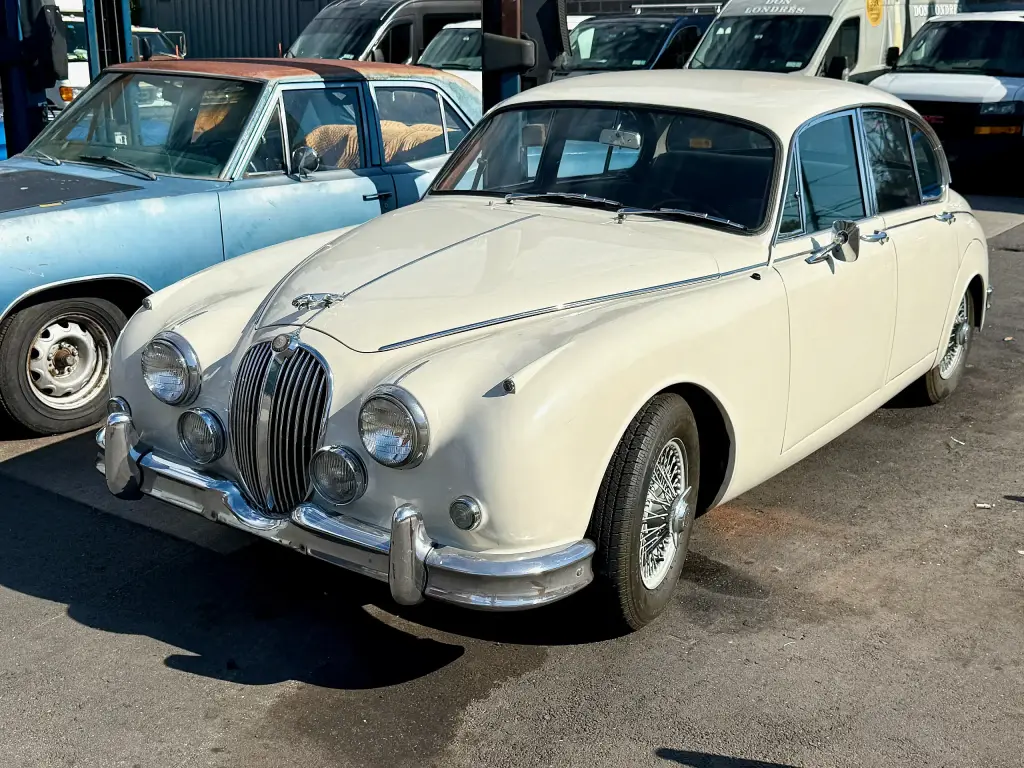
The Jaguar Mark 2 is a mid-sized luxury sports saloon built from late 1959 to 1967 in Coventry. Its predecessors, the 2.4 and 3.4 Litre cars of 1955–1959, became known as the Mark 1. The Mark 2 was a fast and capable saloon in the spirit of Sir William Lyons’ advertising slogan, Grace… Space… Pace, and it was sold with all three versions of the XK engine.
Jaguar Mark 2 at a glance
| Production | late 1959 – 1967 |
|---|---|
| Built at | Coventry, England |
| Engines | 2.4, 3.4 and 3.8-litre XK six |
| Power | 120, 210 and 220 bhp (gross figures) |
| Carburettors | twin Solex on the 2.4, twin SU HD6 on the 3.4 and 3.8 |
| Brakes | disc brakes all round, standard |
| Gearbox | manual, overdrive or automatic |
| Rear axle | live axle; limited-slip differential on the 3.8 |
| Built | 83,976 between 1959 and 1967 |
| 240 and 340 | 7,246 built between 1967 and 1969 |
History of the Jaguar Mark 2
A new body above the waistline
The Mark 2 was re-engineered above the waistline, with vision improved by an 18% increase in cabin glass area. Slender front pillars allowed a wider windscreen and the rear window almost wrapped around to the enlarged side windows, which now had the familiar Jaguar D-shape above the back door and fully chromed frames. The radiator grille was changed and larger side, tail and fog lamps were repositioned. Inside there was a new heating system ducted to the rear compartment and an improved instrument layout that stayed standard until the XJ Series II of 1973.
Mechanical changes
The front suspension geometry was rearranged to raise the roll centre and the rear track was widened. Four-wheel disc brakes became standard, and power steering, overdrive or automatic transmission could be specified at extra cost. The 3.8-litre car came with a limited-slip differential. The Mark 2 was more than 100 kg heavier than the 2.4 and 3.4 cars it replaced, and it kept a live rear axle.
Engines
The range used the XK six in 2,483, 3,442 and 3,781 cc forms. The 3.8 shared its block, crank, connecting rods and pistons with the 3.8 E-Type but had a different inlet manifold and carburation, two SUs instead of three, and therefore 30 bhp less; the Mark 2 cylinder head had curved ports where the E-Type had straight ones. Jaguar kept quoting gross bhp for the American market, where the figures mattered: the 3.8 developed about 190 bhp by modern DIN standards.
240 and 340
Around September 1967 the 3.8 was dropped and the 2.4 and 3.4 were rebadged as the 240 and 340 as gap-fillers until the XJ6 arrived in September 1968. The 340 ended then, but remaining parts were used up in budget 240s until April 1969, selling at £1,364, only £20 more than the first 2.4 in 1956. The 240 gained a straight-port head, twin HS6 SUs and a new inlet manifold, raising output from 120 to 133 bhp; the automatic became a Borg-Warner 35 and Marles Varamatic power steering was offered on the 340. Leather gave way to Ambla and tufted carpet, fog lamps became optional, the rear body was slightly reshaped and servicing intervals grew from 2,000 to 3,000 miles. For the first time the 2.4 could exceed 100 mph.
Design and features
- Three XK engines: 2.4, 3.4 and 3.8 litres, the last with 220 bhp gross.
- Disc brakes as standard: a strong point for a fast saloon of 1959.
- Compact luxury: leather, walnut and a rear heating duct in a car smaller than the Mark IX.
- Racing pedigree: the same recipe that made the Mark 1 a favourite in touring car races.
- 240 and 340: budget derivatives that carried the design into 1969.
Jaguar Mark 2 versions
- 2.4 Litre: 120 bhp, twin Solex carburettors, 25,173 built.
- 3.4 Litre: 210 bhp, twin SU HD6, 28,666 built.
- 3.8 Litre: 220 bhp, limited-slip differential, 30,141 built.
- 240 (1967–1969): 133 bhp, 4,446 built.
- 340 (1967–1968): the 3.4 under a new name, 2,788 built.
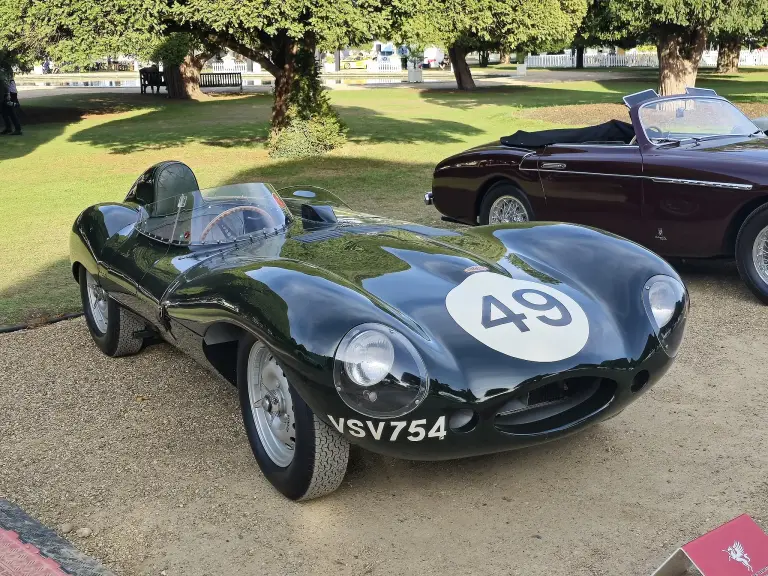
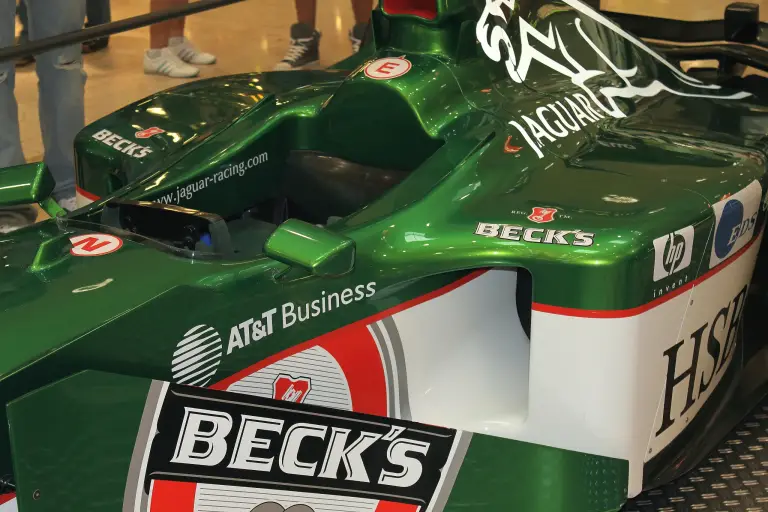
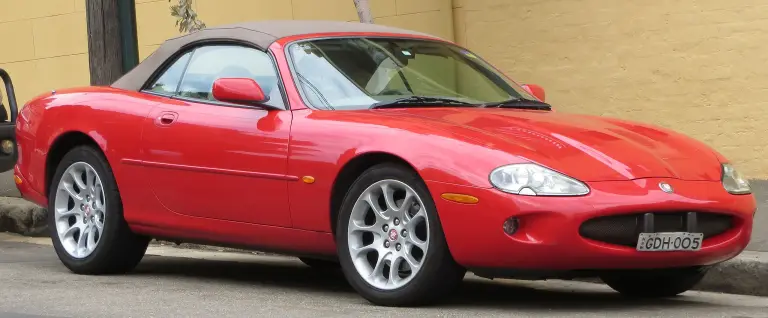
The Mark 2 replaced the Jaguar Mark 1 and was eventually replaced by the Jaguar XJ6. More cars are in the Jaguar collection.
Sources
- Jaguar Mark 2, English Wikipedia: engines, body, 240 and 340, production