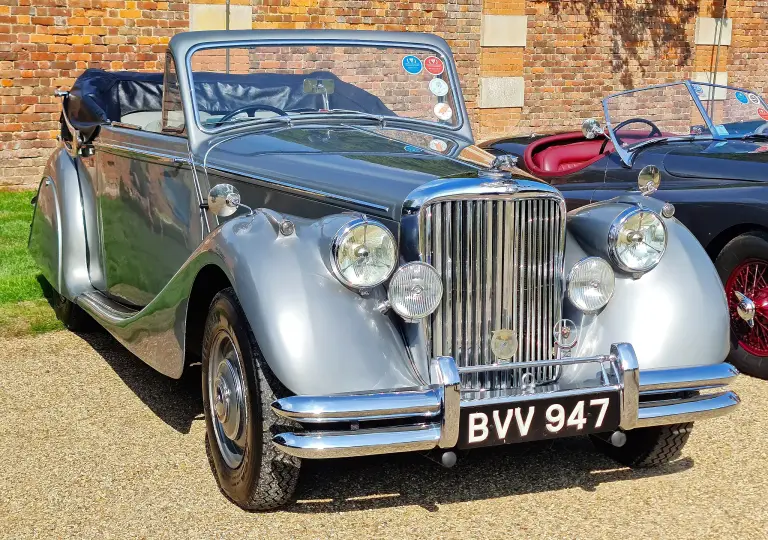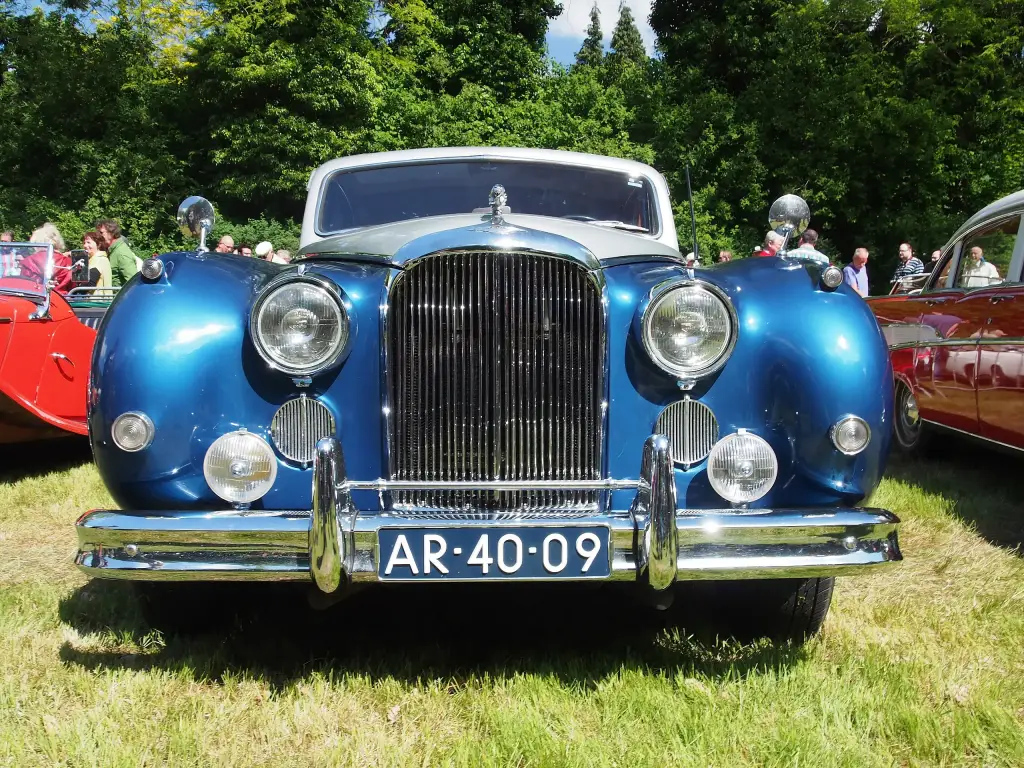
The Jaguar Mark IX is a four-door luxury saloon announced on 8 October 1958 and built from 1958 to 1961. It was generally similar to the Mark VIII it replaced but brought a larger, more powerful 3.8-litre engine, four-wheel disc brakes and power-assisted recirculating ball steering.
Jaguar Mark IX at a glance
| Announced | 8 October 1958 |
|---|---|
| Production | 1958–1961 |
| Engine | 3.8-litre DOHC straight-six XK |
| Power | 220 bhp |
| Carburettors | twin HD6 SU, auxiliary choke carburettor |
| Brakes | servo-assisted Dunlop discs, all four wheels |
| Steering | recirculating ball, power assisted, 3.5 turns lock to lock |
| Gearbox | four-speed manual, overdrive or Borg-Warner automatic |
| Suspension | torsion bar independent front, leaf-sprung live rear axle |
| Built | 10,009 |
| Replaced by | Jaguar Mark X in 1961 |
History of the Jaguar Mark IX
What changed
The early Mark IX cars looked identical to the Mark VIII apart from a chrome Mk IX badge on the boot lid; later versions gained a larger tail-lamp assembly with an amber section, similar to the Mark 2. The enlarged-bore 3.8-litre engine produced 220 bhp against the Mark VIII’s 3.4-litre 190 bhp, keeping the B-type cylinder head but with a chamber added at the bottom of the combustion chamber to take the bigger bore. Twin 1.75-inch HD6 SU carburettors were fitted, with a small electromagnetically controlled auxiliary carburettor between them acting as a choke; it proved troublesome and many cars were converted to manual switching. Compression was 8:1 as standard, with 9:1 for performance and 7:1 for markets such as Africa where petrol quality was sometimes a problem.
Chassis and equipment
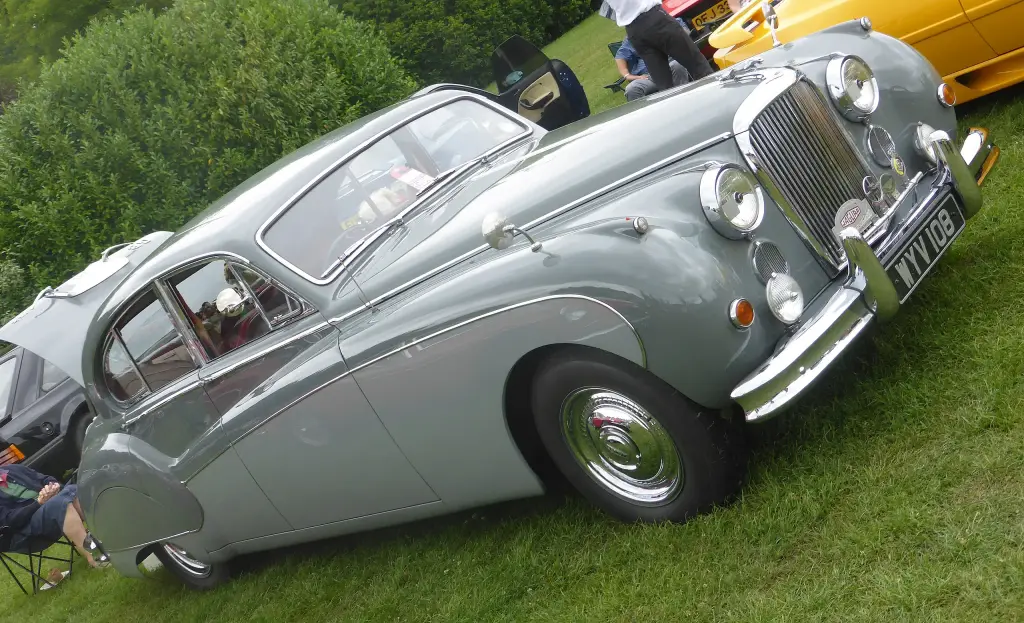
The Mark IX was the first production Jaguar with four-wheel servo-assisted Dunlop disc brakes and recirculating ball power steering as standard. The brakes had a vacuum reserve tank so that braking remained if the engine stalled, and automatic cars had a hill-holding anti-creep valve that kept brake pressure at rest to stop the car rolling back. The Hobourn-Eaton steering pump, running at 600–650 psi, was driven from the back of the generator and allowed gearing of 3.5 turns lock to lock against 4.5 on the Mark VII and VIII. Torsion bar independent front suspension and the leaf-sprung live rear axle were carried over from the Mark VIII, and the sunshine roof became standard in the UK. The interior used leather, burled walnut and deep pile carpet.
On the road and in service
The Motor tested an automatic car in 1958 at 114.4 mph and 0–60 mph in 11.3 seconds, with a test price of £2,162 including tax. The Mark IX was popular as a state car: when Charles de Gaulle visited Canada in 1960 the motorcade cars were Mark IX Jaguars, and the Nigerian government bought forty in green and white state colours. At £1,995 with a manual gearbox, £2,063 with overdrive and £2,163 with automatic, it cost less than half the price of similar competitors. It was replaced in 1961 by the lower, more modern Mark X, and remains a familiar sight in classic racing at meetings such as Goodwood.
Design and features
- First with disc brakes: servo-assisted Dunlop discs on all four wheels as standard.
- Power steering: recirculating ball with a Hobourn-Eaton pump.
- 3.8-litre engine: 220 bhp, with an unusual electromagnetic choke carburettor.
- Anti-creep: automatic cars held brake pressure on hills.
- State car: used for official motorcades and government fleets.
Jaguar Mark IX versions
- Early Mark IX: externally identical to the Mark VIII apart from the badge.
- Later Mark IX: larger tail lamps with an amber indicator section.
- Transmissions: four-speed manual, manual with overdrive, or three-speed Borg-Warner automatic.
The Mark IX followed the Jaguar Mark VII and was replaced by the Jaguar Mark X. More cars are in the Jaguar collection.
Sources
- Jaguar Mark IX, English Wikipedia: features, performance, sales