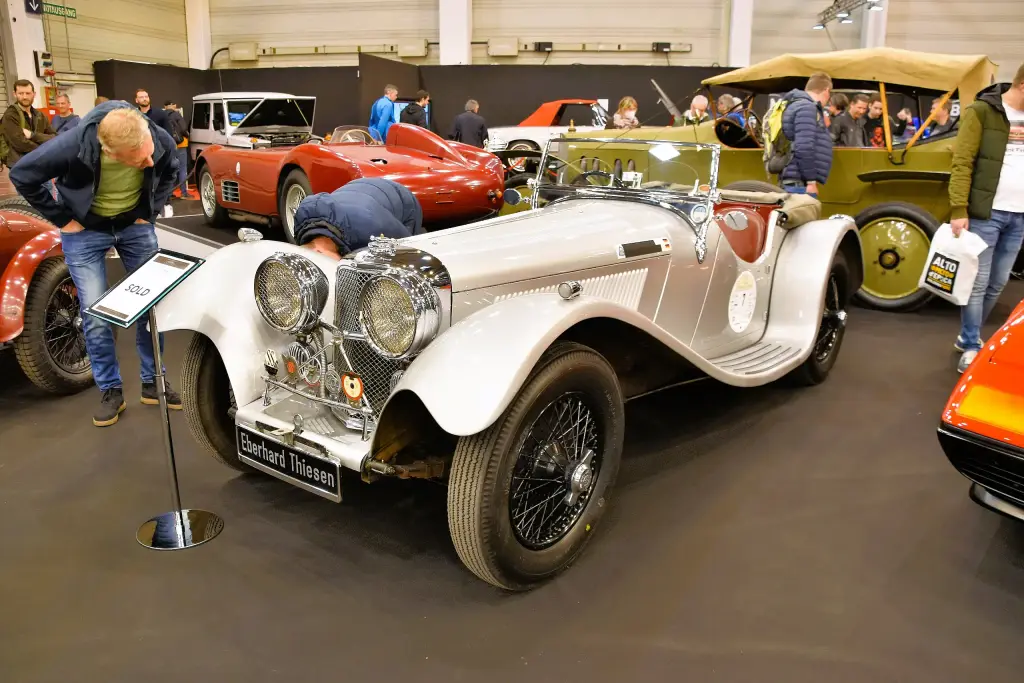
The SS Jaguar 100 is a British two-seat sports car built between 1936 and 1939 by SS Cars Ltd of Coventry. The manufacturer’s name kept a link to Swallow Sidecar, the firm Walmsley and Lyons founded in 1922 to build motorcycle sidecars; in March 1945 the shareholders agreed to rename the company Jaguar Cars Limited. The “100” stood for the car’s theoretical 100 mph maximum speed.
SS Jaguar 100 at a glance
| Production | 1936–1939 |
|---|---|
| Builder | SS Cars Ltd, Coventry |
| Wheelbase | 8 feet 8 inches |
| Chassis | shortened 2½-litre saloon chassis |
| Engine | 2½-litre pushrod six, 3½-litre from 1938 |
| Power | 100 bhp, 125 bhp in the 3½ |
| Carburettors | twin SU, bolted directly to the head |
| Gearbox | four-speed with synchromesh on the top three ratios |
| Brakes | Girling |
| Weight | just over 23 cwt, about 1,150 kg |
| Built | 198 of 2½ litres, 116 of 3½ litres |
| Top speed | 95 mph tested with the 2½, 100 mph with the 3½ |
History of the SS Jaguar 100
Construction
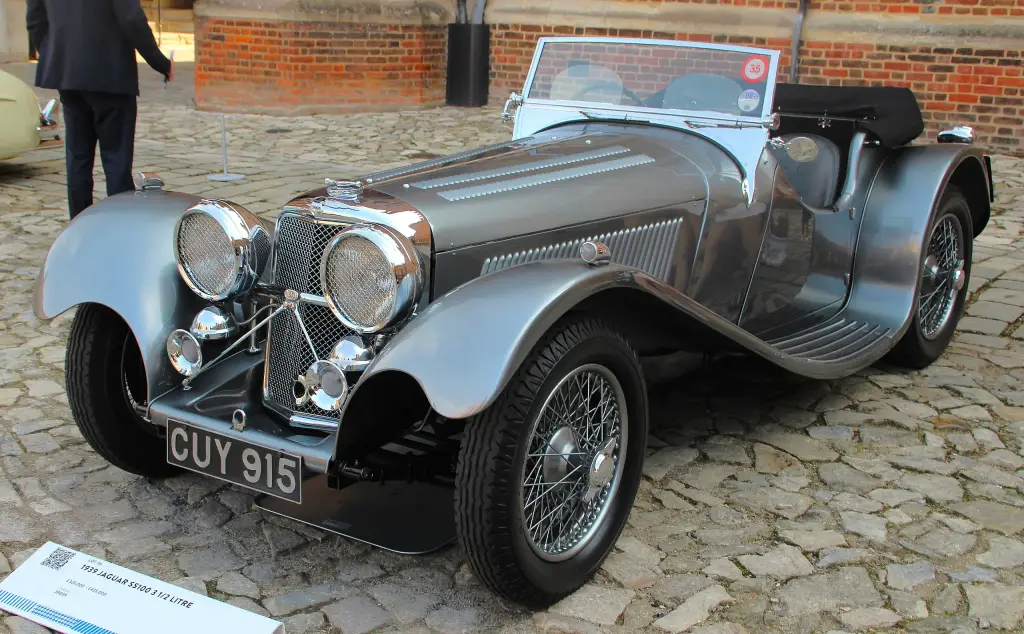
The chassis had an 8 foot 8 inch wheelbase and was essentially a shortened version of the one designed for the 2½-litre saloon, a car built in much greater numbers and first seen in the SS 90 of 1935. Cars left the factory on 5.50 or 5.25 by 18 inch tyres on 18-inch wire wheels. Suspension was by half-elliptical springs all round with rigid axles. The engine was a development of the old 2½-litre Standard pushrod unit, converted from side valve to overhead valve with a new cylinder head designed by William Heynes and Harry Weslake; output rose from 70 to 100 bhp. In 1938 the engine grew to 3½ litres and 125 bhp. The complete car weighed just over 23 cwt.
On the road
Autocar tested the 2½-litre car in 1937 and, with the windscreen lowered, recorded 95 mph and 0–60 mph in 13.5 seconds. The 3½-litre reached 100 mph, with a best of 101 mph over the quarter mile, and cut the 0–60 mph time to 10.4 seconds. In 1937 the 2½-litre cost £395; in 1938 the 3½-litre cost £445, and the single fixed head coupé was listed at £595. A few cars were supplied as chassis only to outside coachbuilders.
Rarity and the leaper
Only 198 2½-litre and 116 3½-litre SS100s were made, and while most stayed in Britain, 49 were exported. Good cars now fetch well over £300,000: a near-concours example made £199,500 at Bonhams’ 2007 Goodwood sale, and a restored 1937 3½ litre roadster sold for £666,270 at Pebble Beach in 2010. The SS100 was the first car to carry the Jaguar leaper mascot; Sir William Lyons reportedly described the first version, fitted in mid-1936, as looking like a cat shot off a fence, and the more stylised leaper on the 1937 publicity car CKV 250 became the company’s trademark. CKV 250 itself was ordered as a gift for King Mihai I of Romania, who drove it until he left the country.
Design and features
- 100 mph name: the model number came from its theoretical top speed.
- Heynes and Weslake head: the pushrod six converted to overhead valves for 100 bhp.
- Light and simple: rigid axles, leaf springs and a shortened saloon chassis.
- The first leaper: the Jaguar mascot made its debut on this car.
- Rare: 314 built in total, 49 of them exported.
SS Jaguar 100 versions
- 2½ Litre (1936–1939): 100 bhp, 198 built.
- 3½ Litre (1938–1939): 125 bhp, 116 built.
- Fixed head coupé: one built, listed at £595.
- Replicas: Birchfield, Steadman, Suffolk and Finch have all built recreations since the 1960s.
The SS100 was the sporting flagship of the range that became the Jaguar Mark IV saloons, and it was the ancestor of the Jaguar XK120. More cars are in the Jaguar collection.
Sources
- SS Jaguar 100, English Wikipedia: construction, performance, values, leaper