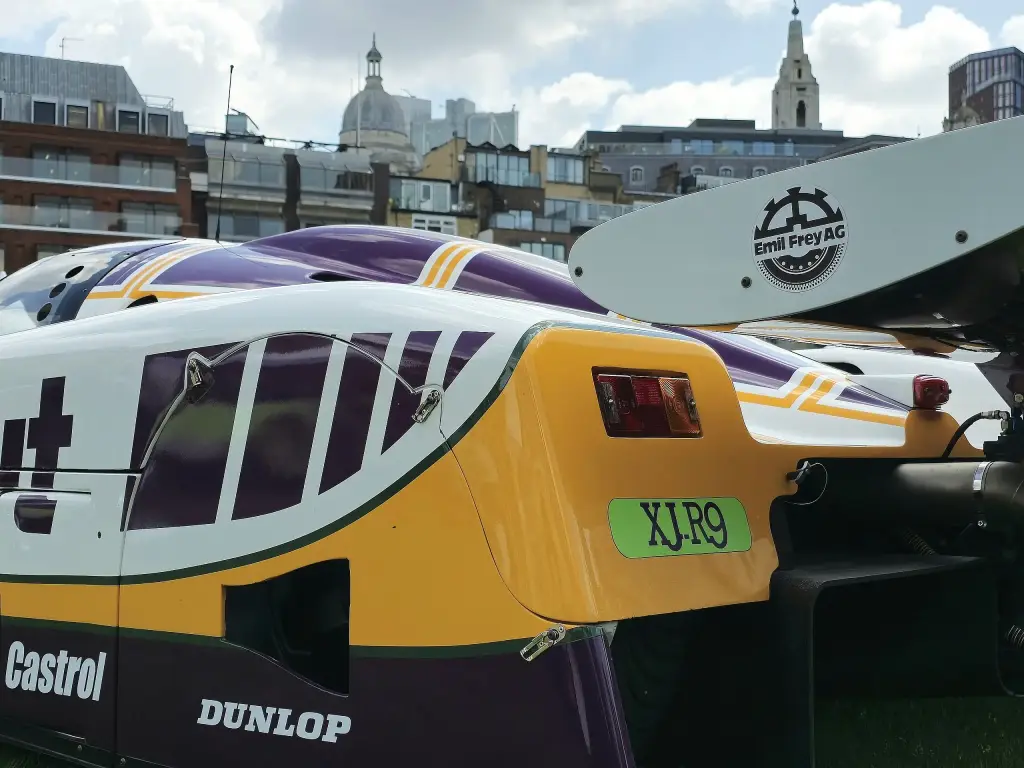
The Jaguar XJR-9 is a sports-prototype race car built by Jaguar for both FIA Group C and IMSA Camel GTP racing. In 1988 it won the 24 Hours of Le Mans, having already taken an overall victory on its debut at the 24 Hours of Daytona.
Jaguar XJR-9 at a glance
| Introduced | 1988 |
|---|---|
| Designed by | Tony Southgate |
| Built by | Tom Walkinshaw Racing |
| Engine | 7.0-litre V12, based on the 5.3-litre XJS unit |
| Power | 750 hp at 7,200 rpm |
| Torque | 828 N·m at 5,500 rpm |
| Chassis | carbon fibre and Kevlar monocoque |
| Gearbox | March/TWR five-speed manual |
| Brakes | TWR ventilated discs |
| Top speed | 245 mph |
| Le Mans variant | XJR-9LM, low drag for the Mulsanne Straight |
| 1988 results | six wins in the World Sports Prototype Championship |
History of the Jaguar XJR-9
Development
The XJR-9 was an evolution of the XJR-8, designed by Tony Southgate, built by Tom Walkinshaw Racing and powered by a Jaguar 7.0-litre V12 derived from the 5.3-litre production engine used in the XJS. The engine was a 60-degree single-overhead-camshaft 24-valve unit with Zytek fuel injection, running a 12:1 compression ratio and producing 750 hp at 7,200 rpm and 828 N·m at 5,500 rpm. The car used a carbon fibre and Kevlar monocoque with push-rod activated front suspension and magnesium uprights at the rear. A derivative, the XJR-9LM, was developed specifically for Le Mans, where the long Mulsanne Straight demanded a low-drag aerodynamic package.
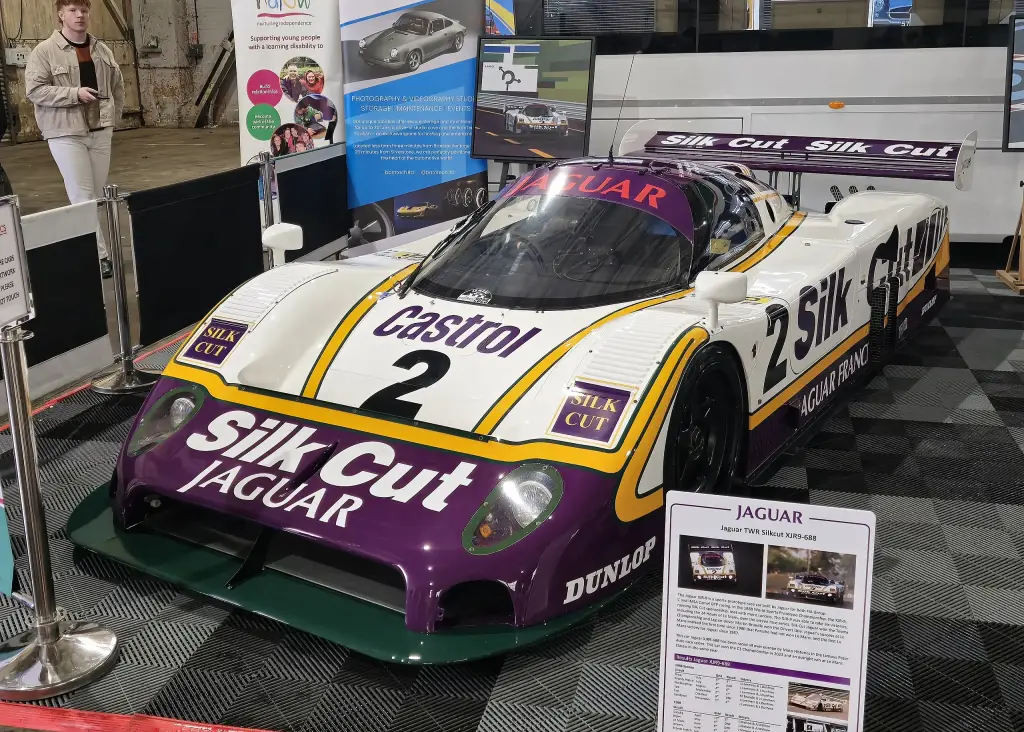
1988
In the United States, the Castrol-sponsored XJR-9s debuted at the 24 Hours of Daytona and won outright, though the rest of the IMSA Camel GTP season brought just one more win, in the final race, leaving the team third in the constructors’ championship. The World Sports Prototype Championship, run in Silk Cut colours, went far better: the XJR-9 took six victories from eleven races, including the 24 Hours of Le Mans. Silk Cut Jaguar won the teams’ championship and Martin Brundle took the drivers’ title. The Le Mans win was the first since 1980 that Porsche had not won, and Jaguar’s first there since 1957.
Afterwards
For 1989 the XJR-9 was entered in both IMSA and the world championship, but it was now dated: in IMSA it was repeatedly beaten by Nissan, and Jaguar introduced the XJR-10 mid-season, finishing second in the championship. In the world championship Jaguar won no races and finished fourth, with the XJR-11 arriving mid-season to replace the XJR-9. Within months of the 1988 Le Mans victory TWR used the XJR-9 chassis to develop the R9R prototype, which by 1990 had become the XJR-15 sports car. In 2010 an XJR-9 won the Le Mans Legend race.
Design and features
- 7.0-litre V12: developed from the production XJS engine, 750 hp.
- Carbon and Kevlar monocoque: built by TWR for Group C and IMSA.
- 1988 Le Mans win: Jaguar’s first since 1957.
- XJR-9LM: a low-drag version for the Mulsanne Straight.
- Basis for the XJR-15: its chassis became a road-going sports car.
Jaguar XJR-9 versions
- XJR-9 (1988): the standard Group C and IMSA car.
- XJR-9LM: low-drag bodywork for Le Mans.
- Silk Cut and Castrol cars: the two sponsor liveries of the works team.
The XJR-9 led to the Jaguar XJR-10 and Jaguar XJR-14, and its chassis became the Jaguar XJR-15. More cars are in the Jaguar collection.
Sources
- Jaguar XJR-9, English Wikipedia: development, 1988 season, specifications