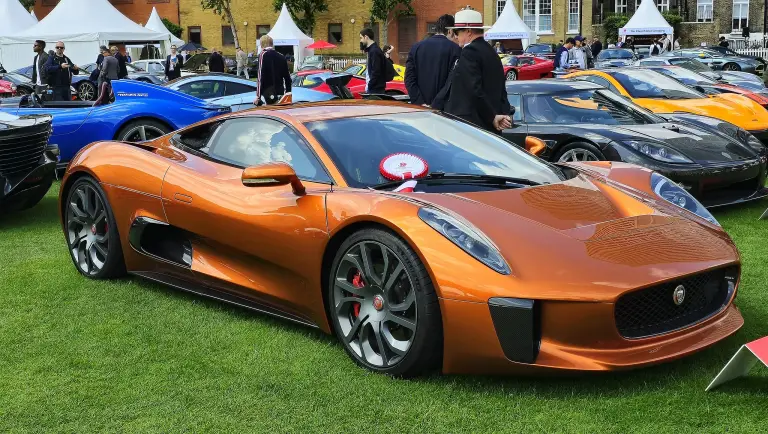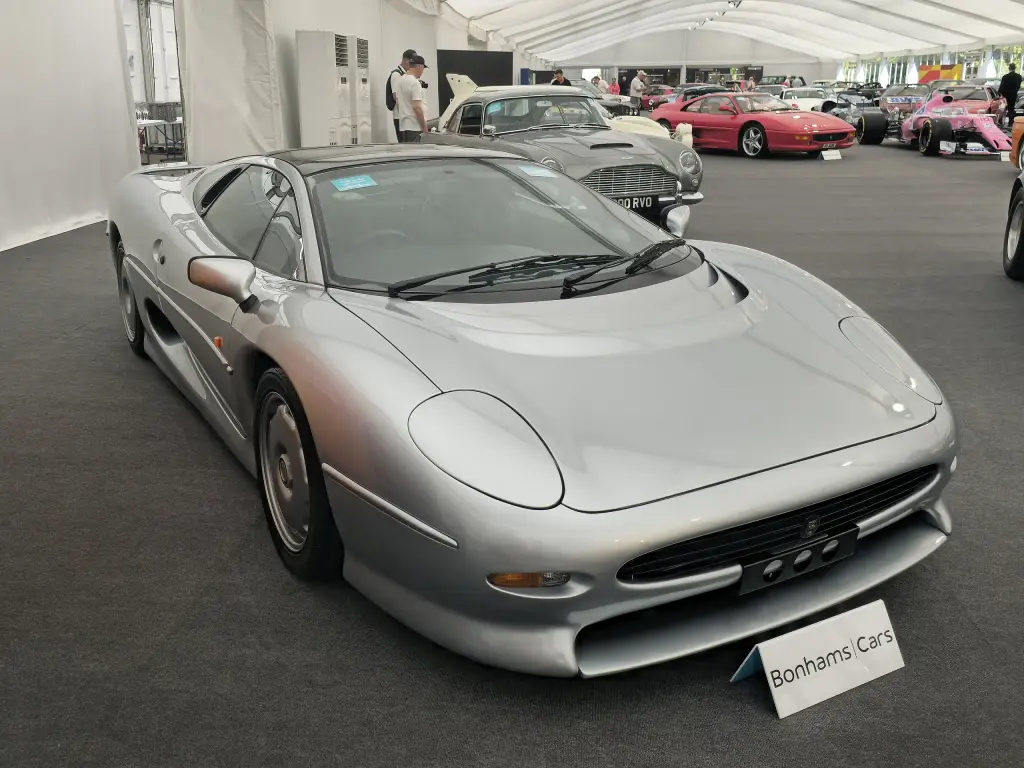
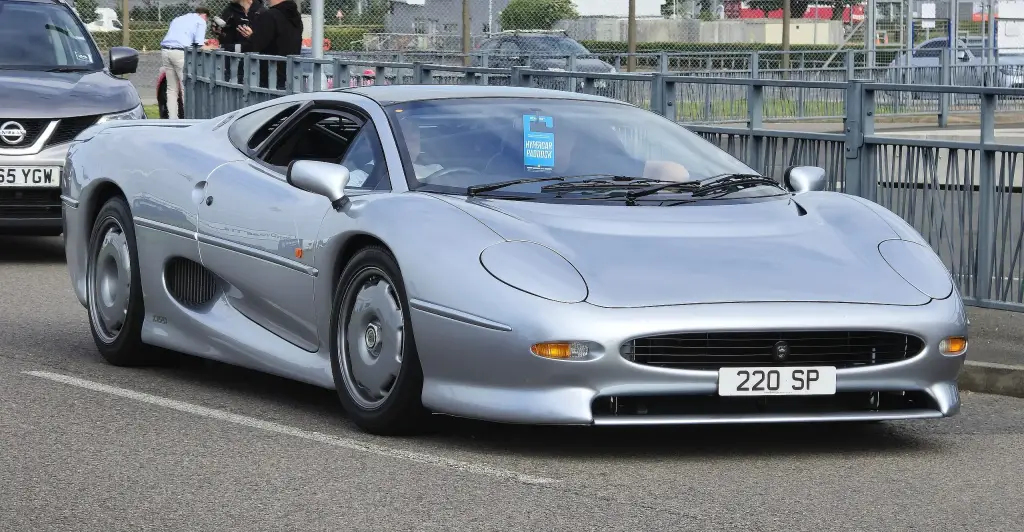
The Jaguar XJ220 is a two-seat supercar produced by Jaguar from 1992 until 1994 in collaboration with the racing engineering company Tom Walkinshaw Racing. With the catalytic converter removed it recorded 217 mph at Jaguar’s Nardo test track in Italy, making it the fastest production car from 1992 to 1993.
Jaguar XJ220 at a glance
| Production | 1992–1994 |
|---|---|
| Partner | Tom Walkinshaw Racing |
| Concept shown | 1988 British International Motor Show, Birmingham |
| Engine | turbocharged V6 instead of the concept’s V12 |
| Top speed | 217 mph (349 km/h) at Nardo |
| Nürburgring lap | 7:46.36 for a 1991 prototype |
| Price in 1992 | £470,000 |
| Built | 275 |
| Deposits taken | about 281 at £50,000 each |
| Name | from the concept’s 220 mph target |
History of the Jaguar XJ220
From the race track
Tom Walkinshaw encouraged Jaguar to enter the XJS in the 1981 European Touring Car Championship, and the partnership won the title in 1983. Jaguar supported Group 44 Racing’s XJR-5 in IMSA from 1983, then joined Walkinshaw in the FIA Group C World Sportscar Championship with the XJR-6, and the XJR-9 went on to win the 1988 Le Mans 24 Hours and the World Sportscar Championship. The V12’s poor fuel consumption, combined with new refuelling rules, forced its replacement in the XJR-10 and XJR-11 by a compact turbocharged unit bought from Austin Rover, originally designed for the MG Metro 6R4.
The Saturday Club
Jaguar’s engineering director Jim Randle felt the racing cars had drifted too far from the road product, so he began a project to win Le Mans in house, as the C-Type and D-Type had done. Over Christmas 1987 he built a quarter-scale cardboard model of a potential Group B racer; two mock-ups followed, and the design by Keith Helfet, which took elements of the XJ41 project and Malcolm Sayer’s work on the XJ13, was chosen as more obviously Jaguar. With no official support Randle assembled twelve volunteers who worked evenings and weekends and became known as the Saturday Club. The FIA Group B rules steered the concept towards a mid-engined, four-wheel-drive layout with a Jaguar V12.
Concept and production
The concept car was unveiled at the 1988 British International Motor Show in Birmingham, and its reception persuaded Jaguar to build it. The name followed the XK120 in quoting top speed in miles per hour: the target was 220 mph. About 281 deposits of £50,000 each were taken for deliveries planned in 1992. Engineering and emissions requirements changed the specification, most importantly replacing the V12 with a turbocharged V6, and the early 1990s recession hit demand for supercars, so many buyers did not take up their options. In the end 275 cars were built at £470,000 each in 1992, one of the most expensive cars of the time.
Design and features
- 217 mph: the fastest production car in the world in 1992 and 1993.
- Turbocharged V6: a change from the concept car’s V12.
- Nürburgring record: a 1991 prototype lapped in 7:46.36, quicker than any production car before it.
- Group B origins: conceived by Jaguar engineers as a Le Mans racer in road-going form.
- Rare and costly: 275 built at £470,000 each.
Jaguar XJ220 versions
- Concept (1988): mid-engined, four-wheel drive, Jaguar V12.
- Production XJ220 (1992–1994): rear-drive with a turbocharged V6, 275 built.
- XJ220 S: a lightened, more powerful derivative built in small numbers.
The XJ220 grew out of Jaguar’s Group C racing programme with cars such as the Jaguar XJR-9, and its V12 ideas went back to the Jaguar XJ13. More cars are in the Jaguar collection.
Sources
- Jaguar XJ220, English Wikipedia: origins, concept, production, performance