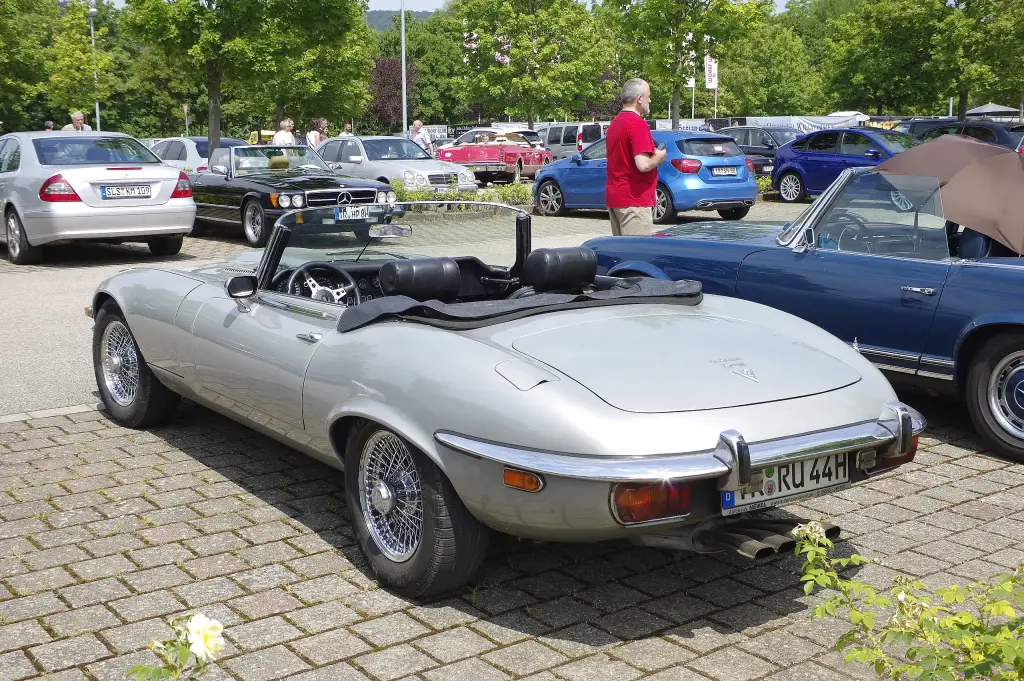
The Jaguar E-Type, sold as the Jaguar XK-E in North America, is a British front-engined sports car manufactured by Jaguar Cars from 1961 to 1974. Its sleek appearance, advanced technology, high performance and competitive price made it an icon; the claimed 150 mph top speed, sub-seven-second 0–60 mph time and all-round disc brakes helped push the rest of the industry forward.
Jaguar E-Type at a glance
| Production | 1961–1974 |
|---|---|
| Also called | Jaguar XK-E (North America) |
| Layout | front engine, rear-wheel drive |
| Bodies | fixed-head coupé, open two-seater, 2+2 coupé from 1966 |
| Engine | 3.8-litre straight-six, 4.2 from 1965, V12 in Series 3 |
| Construction | unitary body with a front subframe |
| Suspension | independent front and rear |
| Brakes | disc, mounted inboard at the rear |
| Steering | rack and pinion |
| Weight | from 1,315 kg |
| Top speed | 150 mph claimed |
| Series | 1, 2 and 3 |
History of the Jaguar E-Type
Origins
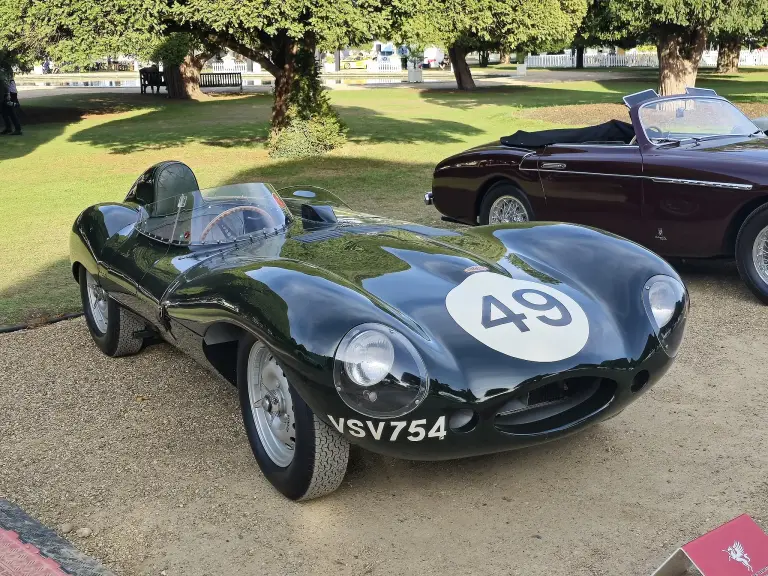
The E-Type was based on Jaguar’s D-Type racing car, which had won Le Mans three years in a row from 1955. It used a novel principle for the early 1960s: a front subframe carrying the engine, front suspension and front bodywork bolted directly to the body tub, so no ladder frame chassis was needed and the first cars weighed only 1,315 kg. It debuted on 15 March 1961. Enzo Ferrari is rumoured to have called it the most beautiful car ever made, though the remark has never been fully confirmed; in 2004 Sports Car International placed the E-Type first among the top sports cars of the 1960s, and in 2008 it came first in The Daily Telegraph’s list of the world’s 100 most beautiful cars.
Series 1
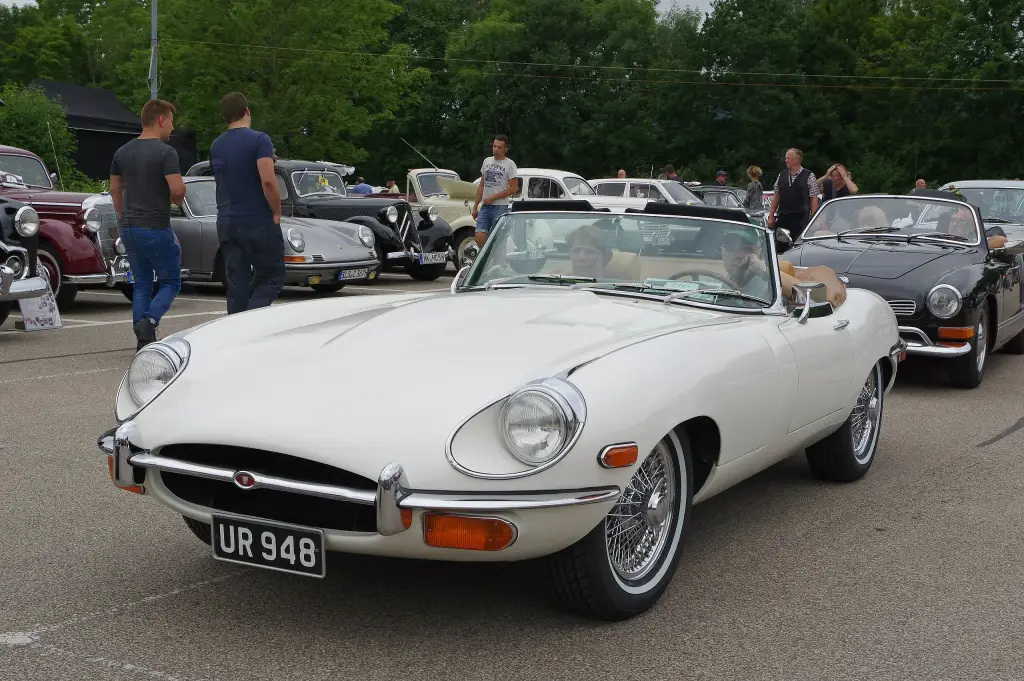
The car was introduced as a two-seater coupé and a two-seater convertible, with a 2+2 coupé on a longer wheelbase added in 1966. The earliest Series 1 cars of 1961–1964 had 3.8-litre engines and partial synchromesh transmissions; the 1965–1967 cars grew to 4.2 litres with about 10% more torque, and gained reclining seats, an alternator instead of a dynamo, a negative-earth electrical system and a more reliable brake servo. The first 500 cars had flat floors and external bonnet latches. Some late Series 1 cars lost their headlight covers, still counted by Jaguar as Series 1 cars.
Series 1.5 to 3
The 1968 cars kept the Series 1 design but, to meet US emission rules, traded triple SU carburettors for twin Zenith-Stromberg units, cutting claimed power from 265 to 246 hp and torque from 283 to 263 lb·ft. Later updates were officially designated Series 2 and Series 3. Among the rarest Series 1 variants were the competition Lightweight, planned as 18 cars though only a dozen were reportedly built, and the one-off Low Drag Coupé.
Design and features
- Unitary construction: a bolted front subframe instead of a separate chassis.
- Inboard rear brakes: reduced unsprung weight and improved packaging.
- Rack-and-pinion steering: rare in its class in 1961.
- Performance: a claimed 150 mph and 0–60 mph in under seven seconds.
- Lightweight and Low Drag: limited competition versions for racing.
Jaguar E-Type versions
- 3.8-litre Series 1 (1961–1964): the original coupé and open two-seater.
- 4.2-litre Series 1 (1965–1967): more torque, better equipment, 2+2 added.
- Series 1.5 (1968): twin Zenith-Stromberg carburettors for US emissions.
- Series 2 and Series 3: later updates, the last with the V12 engine.
- Lightweight (1963): a competition version, about a dozen built.
- Low Drag Coupé: a one-off technical exercise.
The E-Type grew out of the Jaguar D-Type and was later echoed by the Jaguar F-Type. More cars are in the Jaguar collection.
Sources
- Jaguar E-Type, English Wikipedia: design, series, variants, values