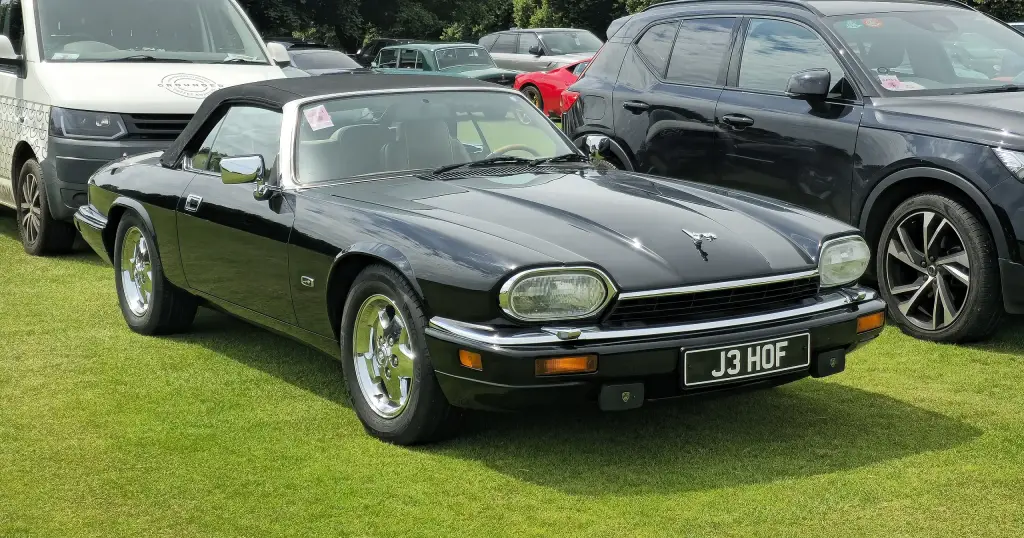
The Jaguar XJ-S, later called the XJS, is a luxury grand tourer made by Jaguar Cars from 1975 to 1996 in coupé, fixed-profile and full convertible bodies. There were three distinct iterations and a total production of 115,413 units over 20 years and 7 months, making it Jaguar’s longest-running model.
Jaguar XJS at a glance
| Production | 1975–1996 |
|---|---|
| Introduced | 10 September 1975 |
| Project code | XJ27 |
| Bodies | coupé, XJ-SC fixed-profile, full convertible |
| Engine | 5.3-litre V12, 3.6-litre AJ6 six from 1983 |
| V12 power | 295 hp with the HE engine from 1981 |
| Performance | 0–60 mph in 7.6 seconds, 143 mph |
| Gearboxes | Borg-Warner Model 12, TH400, Getrag five-speed, ZF four-speed |
| Built | 115,413 |
| Later name | XJS, without the hyphen, from the Ford era |
History of the Jaguar XJS
Pre-HE (1975–1981)
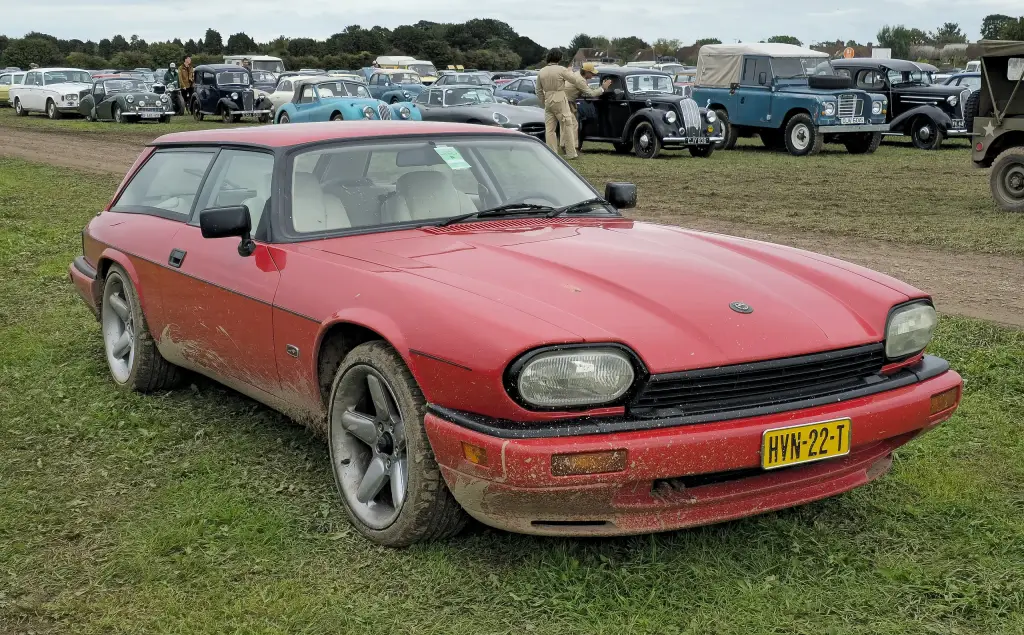
Design and development began in the late 1960s under the code XJ27, with an initial shape by Malcolm Sayer, who died in 1970 before it was finished; the in-house team led by Doug Thorpe completed it. Chief engineer William Heynes had developed the car on the platform of the current XJ saloon. The design was radical, with long overhangs and flying buttresses sweeping down the rear of the roofline, a styling feature that improved aerodynamics rather than a leftover from a mid-engined layout. Power came from the Jaguar V12 with manual or automatic transmission, though the manual was soon dropped as the units were left over from V12 E-Type production. The car reached 60 mph in 7.6 seconds and 143 mph. Early cars used a Borg-Warner Model 12 automatic, replaced in 1977 by General Motors’ Turbo-Hydramatic 400. European and Canadian cars had two moulded headlights, while American cars kept four round sealed-beam lamps until 1992.
Difficult beginnings
Jaguar launched the XJ-S after a fuel crisis, when the market for a 5.3-litre V12 grand tourer was small. It was a radical departure from the E-Type, moving from sports car to GT and losing the convertible roof. German authorities feared the buttresses would restrict rearward vision and refused type approval, so German buyers had to obtain road approval for each car individually. Sales stayed low and production stopped for half of 1981 to clear unsold stock; Leyland had decided to drop the car but gave it another chance with a facelift and engine revisions.
HE (1981–1991)
From July 1981 the car became the XJ-S HE with the new High-Efficiency V12 for much better fuel economy. The Fire Ball combustion chamber designed by Swiss engineer Michael May also raised power to 295 hp, or 263 hp in North America. The HE brought five-spoke Starfish alloy wheels, chrome bumper inserts and burled elm dashboard and door cappings. In 1983 came the 3.6-litre AJ6 straight-six and the XJ-SC, a fixed-profile convertible with a removable soft top over a targa-type structure and no rear seats; six-cylinder cars can be recognised by a raised bonnet centre section. Six-cylinder cars had a five-speed Getrag manual until 1987, when a four-speed ZF automatic arrived, while the V12 kept the Turbo-Hydramatic 400.
Final years
The last iteration, produced from 1991 to 1996, was built after Ford took over Jaguar, which made numerous modifications and dropped the hyphen, marketing the car simply as the XJS. Pininfarina had shown the XJSpider concept based on the XJ-S in 1978, but it never reached production.
Design and features
- Flying buttresses: the XJ-S’s signature rear roofline.
- V12 grand tourer: smooth power at a time when only Ferrari and Lamborghini offered V12s.
- HE engine: Michael May’s Fire Ball chamber brought better economy and 295 hp.
- XJ-SC and convertible: open cars from 1983 and a full convertible later.
- Long-lived: 115,413 cars over more than twenty years.
Jaguar XJS versions
- XJ-S (1975–1981): the original V12 coupé.
- XJ-S HE (1981–1991): high-efficiency V12, 295 hp.
- XJ-SC (1983 on): fixed-profile convertible with a removable roof panel.
- 3.6-litre six (1983 on): AJ6 engine, raised bonnet centre.
- XJS (1991–1996): the Ford-era car, without the hyphen.
The XJS replaced the Jaguar E-Type and its V12 engine was developed into the racing unit of the Jaguar XJR-9. More cars are in the Jaguar collection.
Sources
- Jaguar XJS, English Wikipedia: development, HE, engines, bodies