The Ikarus 303 was meant to replace the Ikarus 31, but it turned out to be the opposite: a luxury coach with air suspension, power steering and a unique V6 engine. It was shown abroad, praised, and then dropped after nine examples because nobody would pay its price.
Ikarus 303 at a glance
| Maker | Ikarus, Budapest-Mátyásföld |
|---|---|
| Type | luxury long-distance coach |
| Developed | 1959, from the abandoned Ikarus 33 project |
| Designers | Finta László, Michelberger Pál, Oszetzky Károly |
| Engine | JáFI V6 of 120 hp, tilted at the rear; Csepel D-414 in some examples |
| Suspension | air springs, the first in a Hungarian vehicle |
| Equipment | roll bar, safety steering column, power steering |
| Built | 9 |
| Shown at | Budapest fairs of 1959 and 1960, Leipzig Fair 1960 |
Based on one source: the Hungarian Wikipedia article on the Ikarus 303.
History of the Ikarus 303
In the middle of the 1950s the factory’s engineers came up with the idea of replacing the Ikarus 31 with a type called the Ikarus 33: a bus in the 31’s size class, with a self-supporting body like its predecessor but with the rear engine of the Ikarus 55, whose characteristic tail it was to inherit. In effect it would have been a midi version of the 55. The 33 was never built, but from its drawings the engineers developed the Ikarus 303, designed by Finta László, Michelberger Pál and Oszetzky Károly. By its purpose the new bus ended up the exact opposite of the 33, because it fell into the “super-luxury” category.
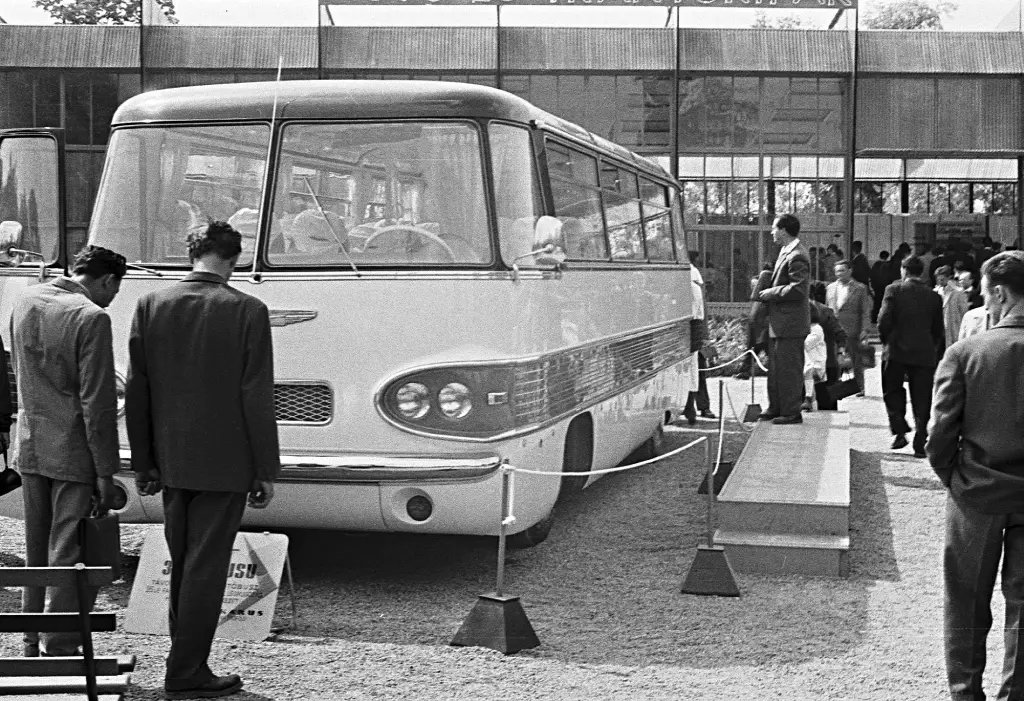
Demonstration examples travelled from one exhibition to another and were always well received: they appeared at the Budapest fairs of 1959 and 1960 and at the Leipzig Fair in 1960. Nine were built in all, each of better quality and yet cheaper to produce than the one before, but the type never reached a price at which customers would buy it in numbers in the 1960s. Supplying the main units, above all the unique JáFI engine, was difficult as well, and so this forward-looking design was never series-produced.
The vehicle carried a series of novelties that counted as luxury at the time. It was the first Hungarian vehicle built with air suspension; it also had a roll bar, a safety steering column and power steering. The window layout gave the interior unusually good light for the period, because the passengers could see out in practically every direction through large glass areas. JáFI designed a special V6 engine of 120 hp for the bus, mounted tilted at the rear, though some examples were built with the Csepel works’ well-proven four-cylinder D-414. Finta’s styling was restrained: far less decoration than on earlier buses, which gave the vehicle a certain elegance, while a thick contrasting stripe ran along the side from front to rear, separated by chrome elements and giving the type its distinctive look.
Design and features
- Air suspension: the first Hungarian vehicle to use it.
- JáFI V6 of 120 hp: a unique engine, tilted at the rear; some buses used the Csepel D-414.
- Passive safety and easy driving: roll bar, safety steering column and power steering.
- Large glass area: unusual brightness for a bus of the period.
- Restrained styling: Finta László’s design with a single contrasting side stripe.
Ikarus 303 versions
- JáFI-engined examples: the intended specification with the V6 at the rear.
- Csepel D-414 examples: built with the proven four-cylinder engine.
- Show buses: demonstration examples that toured Budapest and Leipzig.
The 303 was developed from the abandoned Ikarus 33 as a replacement for the Ikarus 311, and it followed the rear-engined Ikarus 55 in layout. More buses are in the Ikarus collection.
Sources
- Ikarus 303, Hungarian Wikipedia: origin, exhibitions, equipment, engines, why it failed