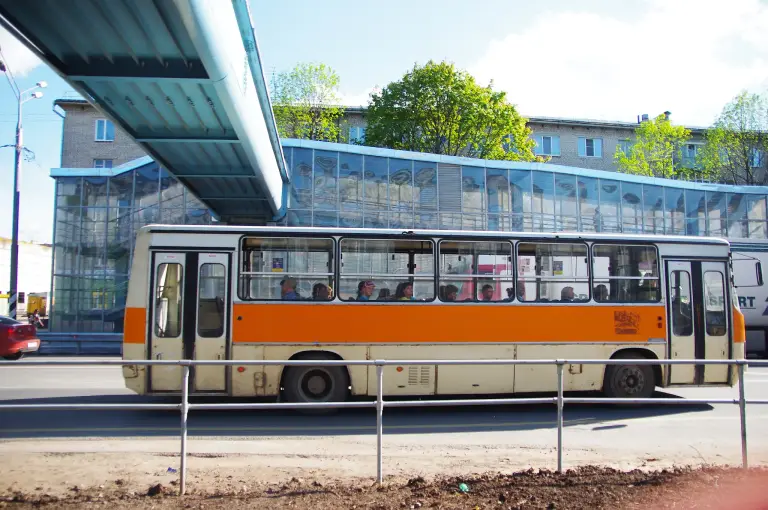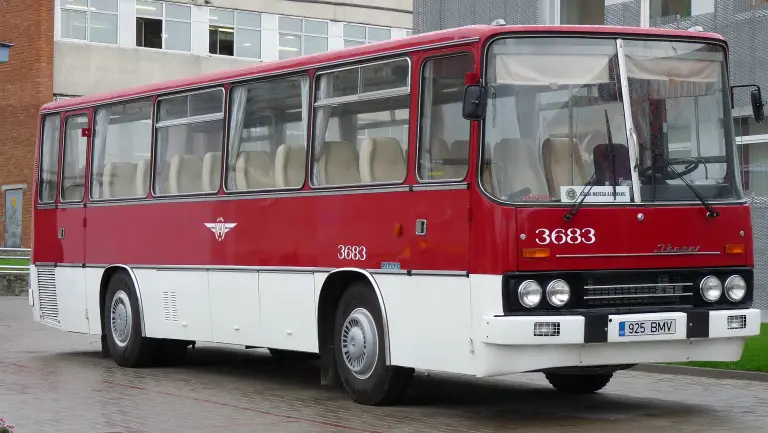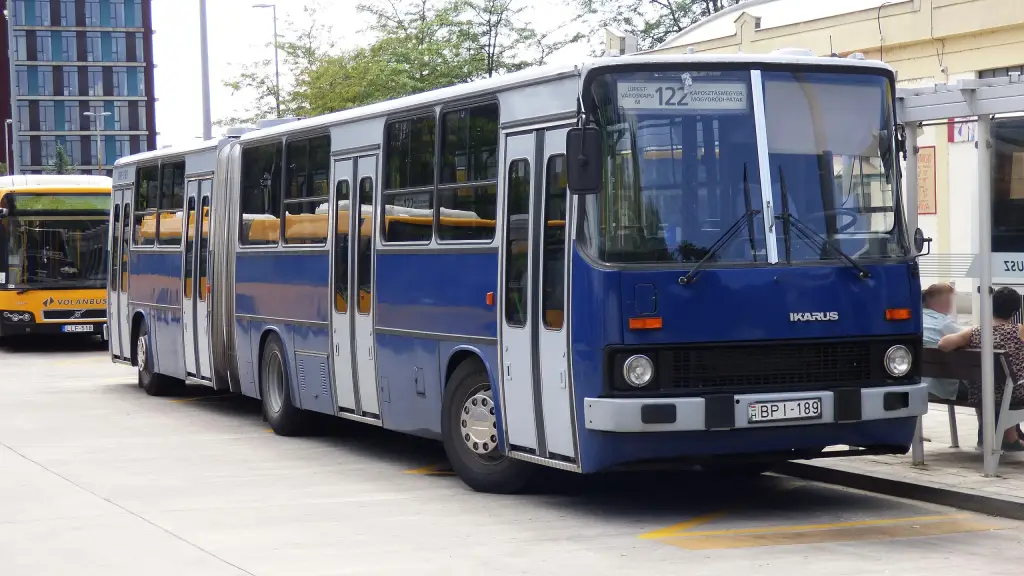
The Ikarus 280 was the articulated version of the Ikarus 260 and the most successful articulated bus in the world of its time. Built from 1973 to 2002, it was the backbone of city transport from Budapest to the furthest cities of the Soviet Union, and three of its axles let it turn in the same circle as the solo 260.
Ikarus 280 at a glance
| Maker | Ikarus, Budapest-Mátyásföld and Székesfehérvár |
|---|---|
| Type | articulated city and suburban bus |
| Production | 1973–2002; tested in Budapest from December 1971 |
| Built | 60,993 |
| Length | 16.5 m |
| Layout | two sections, pivoting joint, engine in the front section |
| Axles | three air-sprung beam axles; middle axle driven |
| Engine | Rába-MAN D2156 inline-six diesel, later Rába D10 |
| Gearbox | automatic or five/six-speed manual |
| Top speed | 65–90 km/h |
| Capacity | at least 26 seats plus up to 134 standing passengers |
| BKV purchases | 1,680 new buses, 1973–1992 |
The two articles differ slightly on the last year of production, 2002 or 2003; the main text follows the 2002 date given by both for the end of the series.
History of the Ikarus 280
Ikarus based the 280 on the 200 platform, which had been laid out in 1966 by chief constructor Bálint György, chief designers Oszetzky Károly, Mádi Jenő and Varga Papp József, and stylist Finta László. The articulated bus ran trials in Budapest from December 1971, was presented in 1972 and entered series production in 1973, the same year in which the Ikarus 180 was withdrawn. In the 1970s and 1980s the type accounted for two-thirds of the world’s articulated bus production. Production continued until 2002 and 60,993 buses left the Mátyásföld and Székesfehérvár plants.
The 280 is made of two rigid sections linked by a pivoting joint. The body is semi-self-supporting with a frame, and the Rába-MAN D2156 inline-six diesel sits in the front section and drives the middle axle, so the bus pulls rather than pushes. All three axles are air-sprung beam axles with telescopic shock absorbers; the middle and rear axles were made by Rába and the front axle by LiAZ. An automatic or a manual gearbox gave a top speed of 65 to 90 km/h, the manual being a five- or six-speed unit with a dry single-disc clutch. The bus has pneumatic brakes, a spring-loaded parking brake and an exhaust brake, and the steering is hydraulically assisted. In service a 280 has at least 26 seats and room for up to 134 standing passengers.
The 280’s greatest advantage was its turning circle, identical to that of the solo 260: the B axle is driven and the wheels of the C axle are force-steered, so the bus fits where other articulated vehicles cannot turn. The design also dropped the curved roof and used the rectangular body of the 200 series, and the twin doors 1,300 mm wide made boarding quick. About half of all 280s went to the Soviet Union, and every Hungarian Volán company had some; the BKV bought 1,680 new buses between 1973 and 1992 and 17 used ones from Miskolc in 2002. Variants included the 281, 282, 283 and 284, the C80 and C83 facelifts, the 280T, 283T and 284T trolleybuses and the double-articulated 293; the C80 of 1999, with 72 built, was the modernised successor. Budapest withdrew its last 280 from scheduled service on 20 November 2022, when the average bus had covered 1.4 million kilometres.
Design and features
- Tight turning circle: the force-steered C axle lets the articulated bus turn like the solo 260.
- Puller layout: the engine in the front section drives the middle axle.
- Three air-sprung axles: a comfortable ride with telescopic shock absorbers all round.
- Room for 160: at least 26 seats plus up to 134 standing passengers.
- Many derivatives: articulated trolleybuses, longer 18-metre versions and the double-articulated 293.
Ikarus 280 versions
- 280 (1973–2002): the standard articulated city bus.
- 281, 282 and 283: longer 18-metre versions and related developments.
- 284: a pusher-configuration version.
- 280T, 283T and 284T: articulated trolleybuses, mostly for Budapest, Debrecen, Szeged, Bulgaria and East Germany.
- 293: the double-articulated bus based on the 280.
- C80: the 1999 Classic version, 72 built, mainly for Hungarian Volán companies.
The 280 was the articulated version of the Ikarus 260, whose tight turning circle it matched, and it replaced the Ikarus 180; its intended successor was the Ikarus 435. More buses are in the Ikarus collection.
Video: Leidenschaft Ikarus – Mit dem 280.02 unterwegs
Video by BUS TV on YouTube.
Sources
- Ikarus 280, English Wikipedia: construction, layout, capacity
- Ikarus 280, Hungarian Wikipedia: history, production totals, derivatives, operators