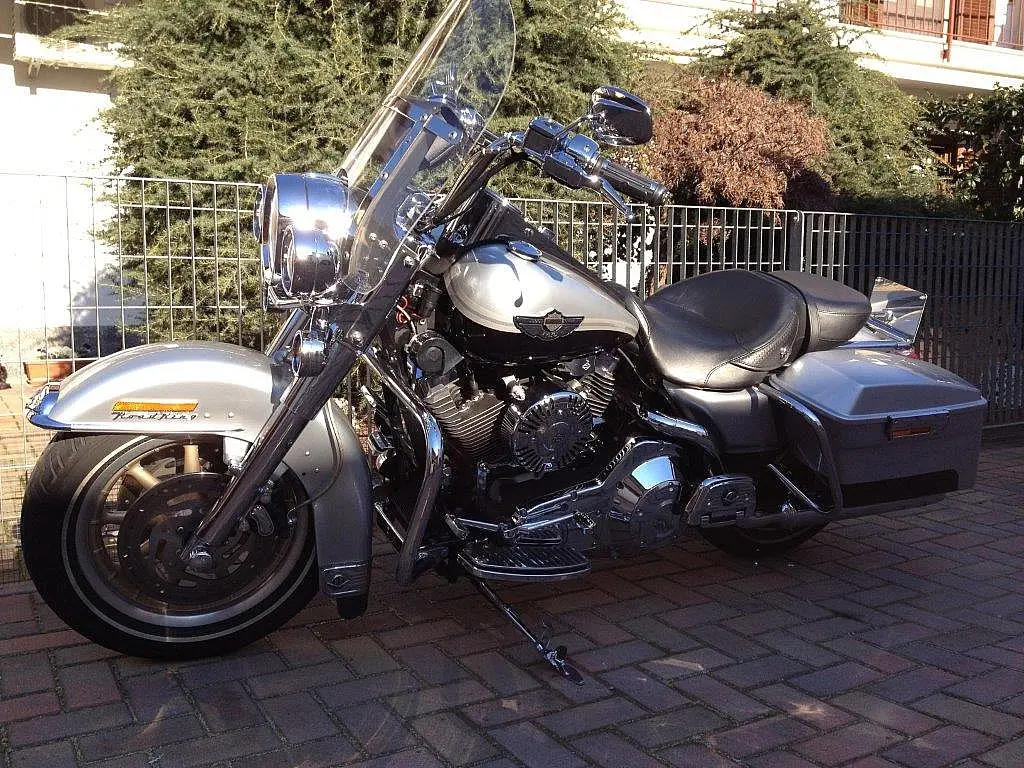
The Harley-Davidson Twin Cam is the V-twin the company built from 1998 to 2017. It kept the familiar 45-degree air-cooled pushrod layout but used two chain-driven camshafts and a much stronger crankcase than the Evolution, and it grew from 88 to 110 cubic inches.
Harley-Davidson Twin Cam at a glance
| Production | 1998–2017 |
|---|---|
| Released | Twin Cam 88 for the 1999 model year, September 1998 |
| Layout | 45-degree air-cooled V-twin, pushrods, two valves per cylinder |
| Camshafts | two, chain driven, to meet noise regulations |
| Twin Cam 88 | 3.75 in bore, 4.00 in stroke, 1,450 cc |
| Twin Cam 95 | 1,550 cc, used by Screamin’ Eagle and CVO models |
| Twin Cam 96 | 1,584 cc, from the 2007 model year |
| Twin Cam 103 | 1,690 cc, from 2012 |
| Twin Cam 110 | 1,801 cc, CVO models |
| Softail versions | 88B and 96B with twin chain-driven balance shafts |
| Parts shared with the Evolution | 18 |
| Replaced by | the Milwaukee-Eight, 2017 |
History of the Harley-Davidson Twin Cam
Development of the Twin Cam began in the early 1990s, when Harley-Davidson set out to cure the weaknesses of the Evolution, especially the crankcase structure, oil circulation and leaks. Where aftermarket firms such as S&S Cycle had answered with stronger crankcases for high-performance Evolutions, Harley-Davidson chose a completely new design while keeping the traditional 45-degree air-cooled pushrod V-twin look. Only 18 parts were shared with the previous engine. The engine uses two chain-driven camshafts, fitted to comply with noise regulations of the Environmental Protection Agency and other markets, and its drivetrain was reinforced with a mounting scheme called the Revised Rear Interface that bolts the gearbox directly to the back of the engine.
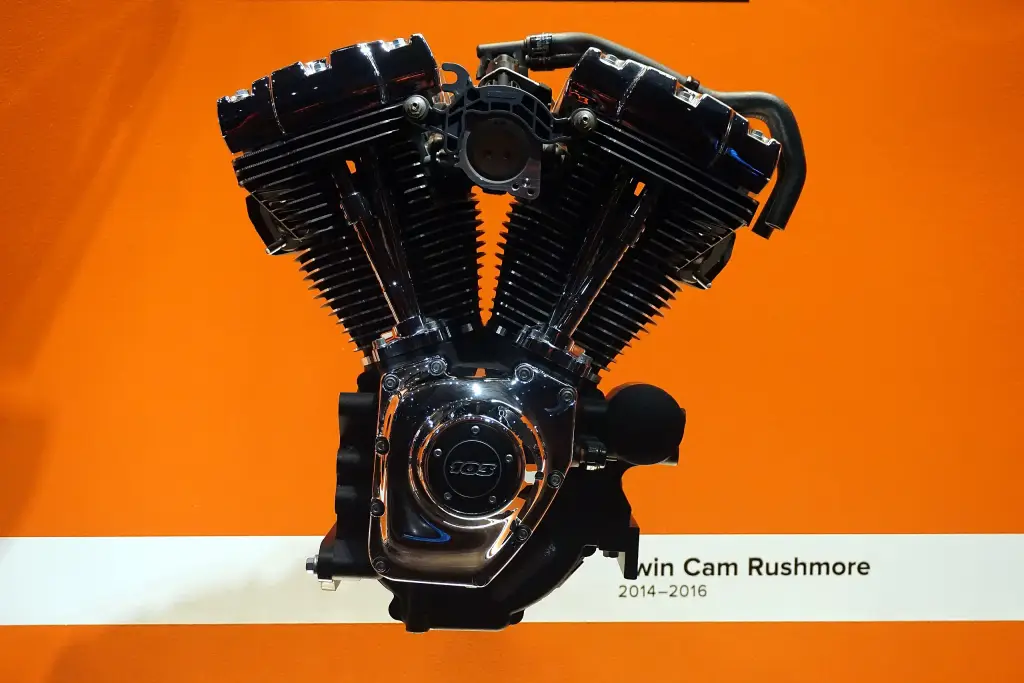
The first prototypes had serious trouble with the oiling system, which delayed the engine from its planned 1997 model year. Oil came out of every gasketed joint and the breather; Harley-Davidson brought in Paul Troxler, an engineer from the Southwest Research Institute, and traced the problem to a design that drained the cam case into the crankcase through a single scavenge pump, with airflow through ports in the crankcase wall preventing proper drainage. The cure was to seal the cam case from the crankcase and use a dual scavenge system built into the engine instead of an outboard pump, and a further restriction of the scavenge inlet diameter solved the remaining problem. The Twin Cam 88 was released for the 1999 model year in September 1998.
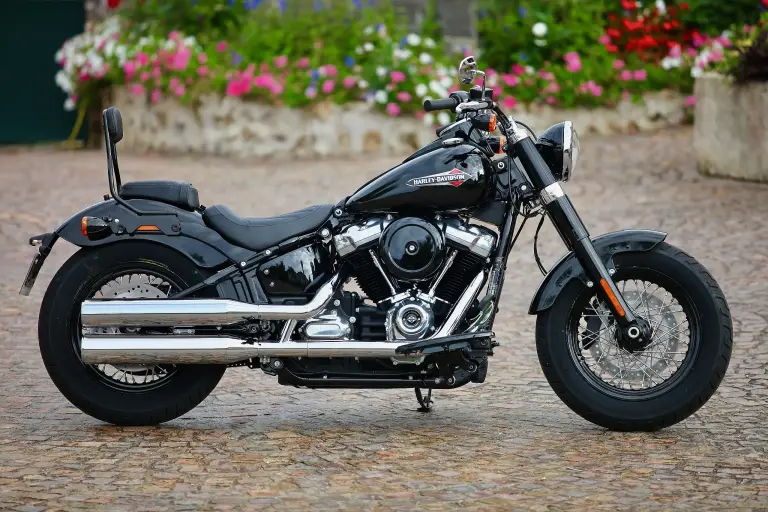
The Twin Cam was not used in the Softail family before 2000, because the Softail’s rigidly mounted engine transferred vibration to the frame and because the seat post between engine and gearbox got in the way of the new transmission case. Harley-Davidson answered with the Twin Cam 88B, the same engine with a modified block incorporating twin chain-driven balance shafts, and the Twin Cam 96B followed for the 2007 model year on all Softails until the 103 replaced it. The 96 arrived for 2007, the 103 cubic inch (1,690 cc) version came in 2012 for the Electra Glide Ultra Limited and later for the Softails, and the 110 cubic inch (1,801 cc) engine was reserved for Screamin’ Eagle and CVO models. The Milwaukee-Eight replaced the Twin Cam in 2017.
Design and features
- Two camshafts: chain-driven and quieter than the single cam of the Evolution.
- Stronger bottom end: a new crankcase and the Revised Rear Interface for the gearbox.
- Balance shafts for Softails: the 88B and 96B versions that allowed rigid mounting.
- Growth in capacity: from 88 to 95, 96, 103 and 110 cubic inches over two decades.
Harley-Davidson Twin Cam versions
- Twin Cam 88 (1999–2006): 1,450 cc, the original engine.
- Twin Cam 88B: the Softail version with twin balance shafts.
- Twin Cam 95: 1,550 cc, for Screamin’ Eagle and CVO models.
- Twin Cam 96 and 96B (from 2007): 1,584 cc, the 96B for Softails.
- Twin Cam 103 (from 2012): 1,690 cc for touring and Softail models.
- Twin Cam 110: 1,801 cc for CVO machines.
The engine the Twin Cam replaced is described in the article on the Evolution, the model families that used it in the articles on the Softail and the Road King, and the engine before that in the article on the Shovelhead. More are in the collection.
Sources
- Harley-Davidson Twin Cam engine, English Wikipedia: development, oiling problems, sizes, Softail versions