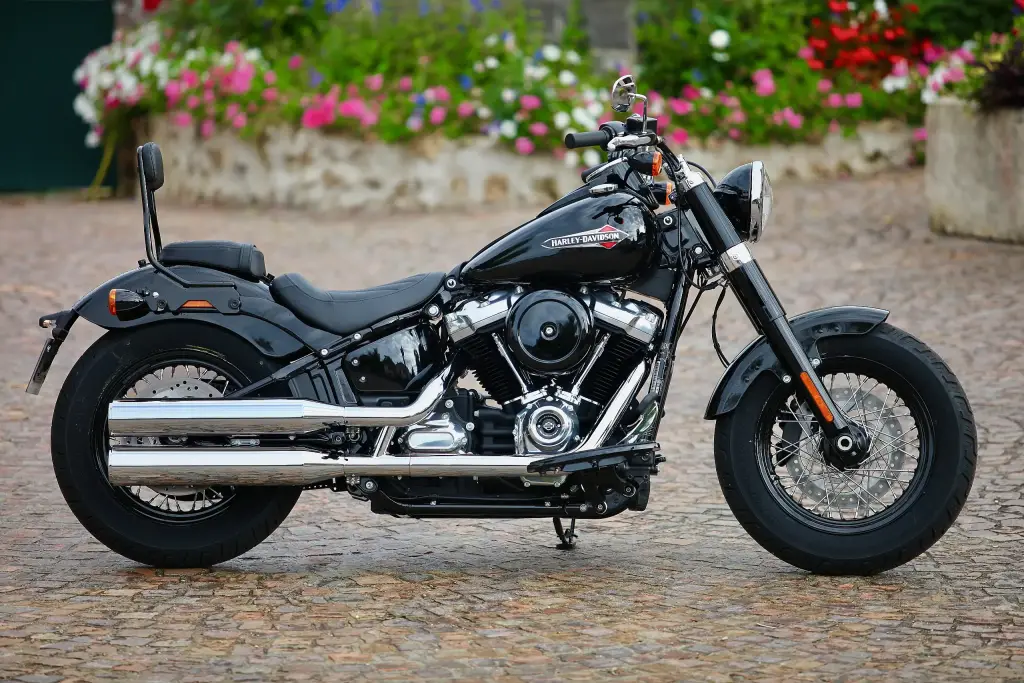
The Softail is the Harley-Davidson chassis that gives a motorcycle the clean line of a rigid frame while hiding its rear suspension. The idea came from the engineer Bill Davis in the 1970s, the company bought the patents in 1982, and the first Softail, the FXST, was presented in 1983 as a 1984 model.
Harley-Davidson Softail at a glance
| First model | FXST Softail, presented June 1983 as a 1984 model |
|---|---|
| Designer | Bill Davis of St. Louis, Missouri |
| Patents bought | January 1982 |
| Frame | triangular swingarm with the shock absorbers hidden under the gearbox |
| Engine at launch | Evolution, the first Harley-Davidson with it |
| First-year sales | about 5,000, the best-selling Harley of the year |
| Two families | FX with a 21-inch front wheel, FL with a 16-inch wheel and retro bodywork |
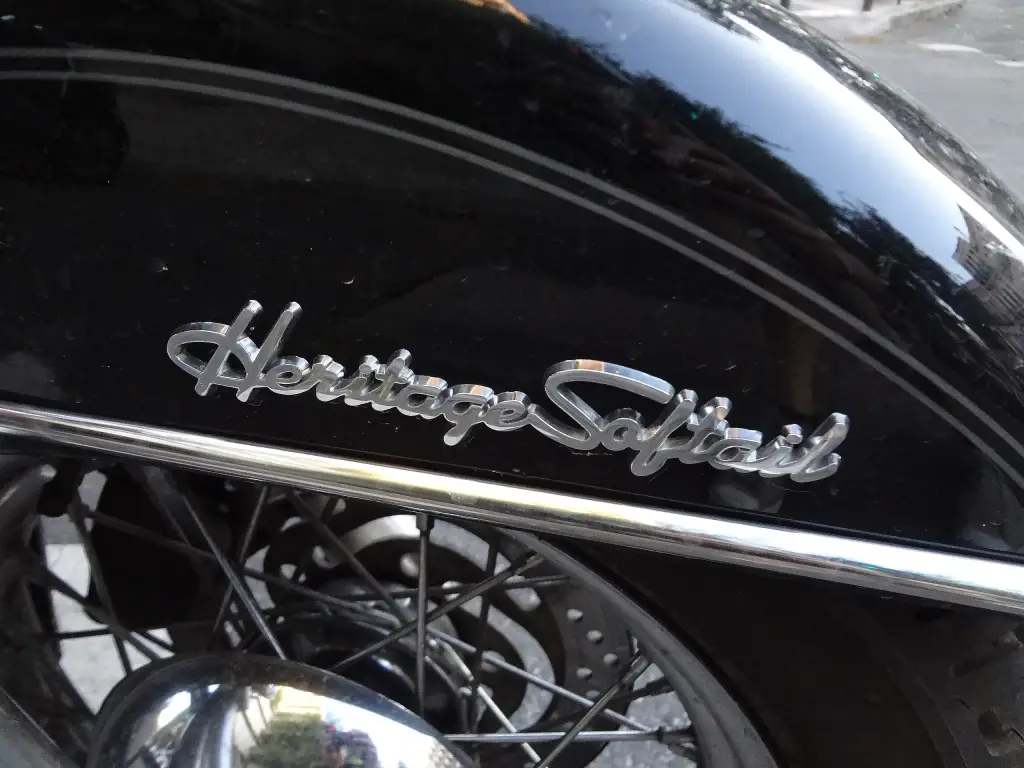
| Heritage | FLST Heritage from 1986, inspired by the 1958 Duo Glide |
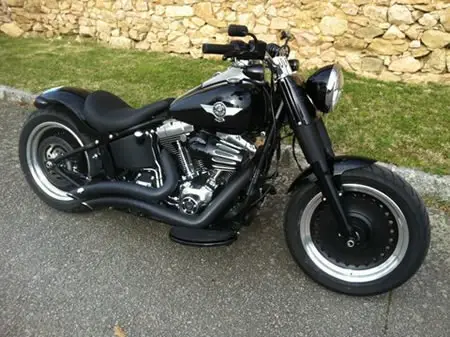
| Fat Boy | FLSTF from 1990 |
| Bad Boy | FXSTSB with a black Springer fork, 1995 |
| Night Train | FXSTB from 1998, all-black Softail Custom |
| New frame | 2018, with a single rear monoshock under the seat |
The article covers the Heritage, Bad Boy and Cross Bones records of the old gallery, which are all Softail versions and now redirect here.
History of the Harley-Davidson Softail
In the 1950s and 1960s many custom motorcycles were built on rigid frames, and the choppers of the period gave the rider a low, rearward position that looked tough even though it was uncomfortable. Harley-Davidson offered only the FLH Electra Glide and the XL Sportster in 1970, and the FX Super Glide of 1971 combined the big twin engine with the narrow Sportster front end, but it still had visible twin shocks. Bill Davis, an engineer from St. Louis and a keen Harley rider, began designing a softail in the mid-1970s: his first version of 1974–75 used a cantilever swingarm pivoting at the bottom with the springs and shock hidden under the seat, and he built a prototype on his 1972 Super Glide.
Davis patented the design and met Willie G. Davidson in August 1976. Davidson was impressed but made no commitment, and six months later said the company was interested but would not use the design at that time. Davis then turned the pivot and springing points around so that the springs and shock sat under the frame and the pivot was at the top of the triangular swingarm, which left room for the traditional horseshoe oil tank under the seat. He tried to make the design himself as the Road Worx Sub-Shock, the partnership failed, and after Harley-Davidson executive Jeffrey Bleustein contacted him the company bought his patents, prototype and tooling in January 1982. In the meantime, from April 1980, Harley-Davidson had its own rear suspension project, passed to Jim Haubert Engineering, whose prototype was ready for review in January 1981.
The design went on sale in June 1983 as the 1984 FXST Softail: essentially an FXWG Wide Glide with the softail swingarm and the shocks hidden under the gearbox, which at the time was still a four-speed with kickstarter and chain. It was also the first Harley-Davidson with the new Evolution engine, and its success was immediate, with about 5,000 sold in the first year. From 1984 to 2017 the Softail kept the same basic layout of frame, tanks, horizontal twin shocks, belt drive and styling, while the rear tyres grew from 130 mm to 240 mm and the gearbox went from five to six speeds. In 1986 the FLST Heritage appeared, a smaller, lighter Electra Glide in the old-school style of the 1958 Duo Glide, and from then on the range split into FX models with a 21-inch front wheel and slim chopper lines and FL models with a heavier front end. The Springer fork returned in 1988 on the FXSTS, the Fat Boy arrived in 1990, the Bad Boy in 1995 and the Night Train in 1998. For 2018 the frame was completely redesigned with a single rear monoshock under the seat, replacing the twin shocks for the first time since the model began.
Design and features
- Hidden suspension: a triangular swingarm and concealed shocks that imitate a rigid frame.
- Straight line: the frame runs clean from the steering head to the rear axle, as on a hardtail.
- Two families: FX Softails with a tall narrow front wheel, FL Softails with a fat 16-inch wheel and retro tinwork.
- Popular for customising: the Softail is the Harley-Davidson family most often rebuilt into show bikes.
Harley-Davidson Softail versions
- FXST Softail (1984): the first model, with the Evolution engine and a four-speed gearbox.
- FLST Heritage (1986): the retro tourer inspired by the Duo Glide.
- FXSTS Softail Springer (1988): the return of the springer front fork.
- FLSTF Fat Boy (1990): the solid-wheel cruiser that became a best seller.
- FXSTSB Bad Boy (1995): a chopper with a black springer fork and a Fat Bob mudguard.
- FXSTB Night Train (1998): an all-black Softail Custom.
The best-known Softail is described in the article on the Fat Boy, the touring line it was derived from in the article on the Electra Glide, and the first factory custom that prepared the way in the article on the Super Glide. More models are in the Harley-Davidson collection.
Video: Harley-Davidson Softail Slim 2013 test
Video by 1000PS on YouTube.
Sources
- Softail, English Wikipedia: design history, hardtail background, FXST introduction
- Harley-Davidson Softail, Italian Wikipedia: launch, model range, versions
- Harley-Davidson Softail, French Wikipedia: FX and FL families, 2018 frame