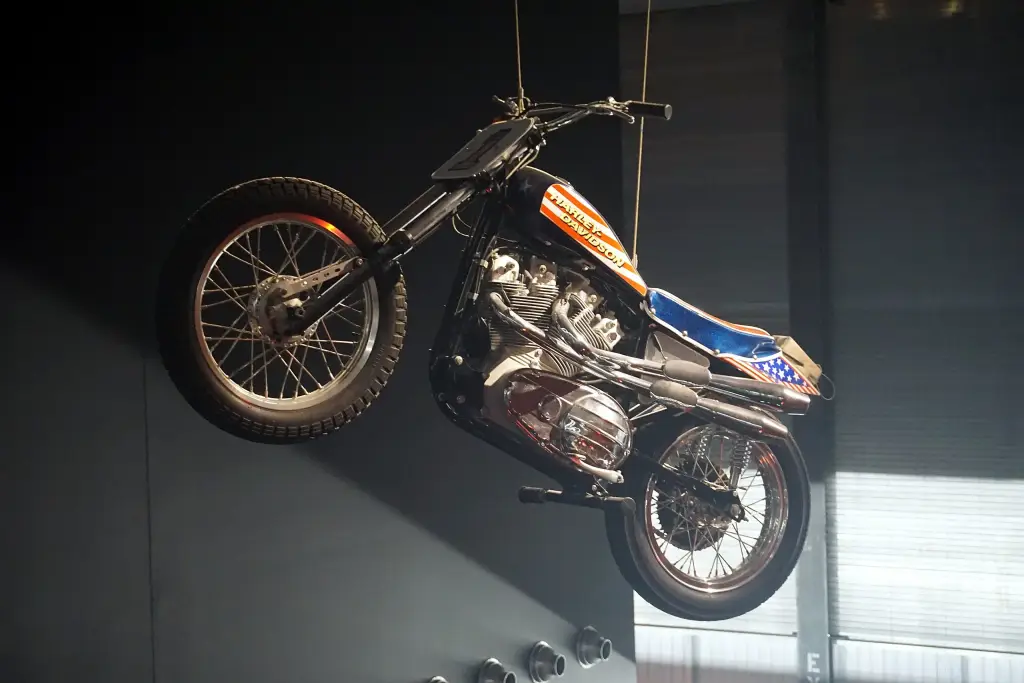
The Harley-Davidson XR-750 is the racing motorcycle the company has built since 1970, mainly for dirt track racing and also for road racing in the XRTT version. It won more races than any other machine in the history of American Motorcyclist Association racing and was Evel Knievel’s favourite motorcycle.
Harley-Davidson XR-750 at a glance
| Racing since | 1970 |
|---|---|
| Purpose | AMA dirt track racing, plus road racing as the XRTT |
| Reason for the design | the 1969 AMA rule that set one 750 cc limit for dirt track |
| First version | 1970–71 with iron heads, prone to overheating |
| Second version | 1972 with aluminium head and cylinders |
| Displacement | 750 cc |
| Homologation | 200 examples at 3,200 dollars each |
| Engine cases | vertically split, with four camshafts and a three-row primary chain |
| Frame | carried over from the KRTT, with a Ceriani fork and Girling shocks |
| Famous rider | Evel Knievel, from December 1970 to January 1977 |
| Championships | 29 of 37 AMA Grand National titles from 1972 to 2008 |
| Power | about 79 hp in 1972, an estimated 100 hp by 2008 |
The article covers the XR and Track records of the old gallery, which refer to the XR racing models and now redirect here.
History of the Harley-Davidson XR-750
The XR-750 was designed in response to a 1969 change in AMA Grand National Championship rules. The Class C rules of 1933, revised in 1954, limited side-valve engines to 750 cc but overhead-valve engines to 500 cc, and that advantage kept the old flathead technology on the track; at least 200 homologated examples of a model had to be built and offered to the public. The flathead Harley-Davidson KR had dominated, but by the late 1960s British makers had little market for 500 cc overhead-valve machines and there was pressure for a single limit. In 1969 the AMA set one maximum displacement of 750 cc for dirt track regardless of valve type, keeping the 500/750 split for road racing for the time being, and the KR was a decade out of date.
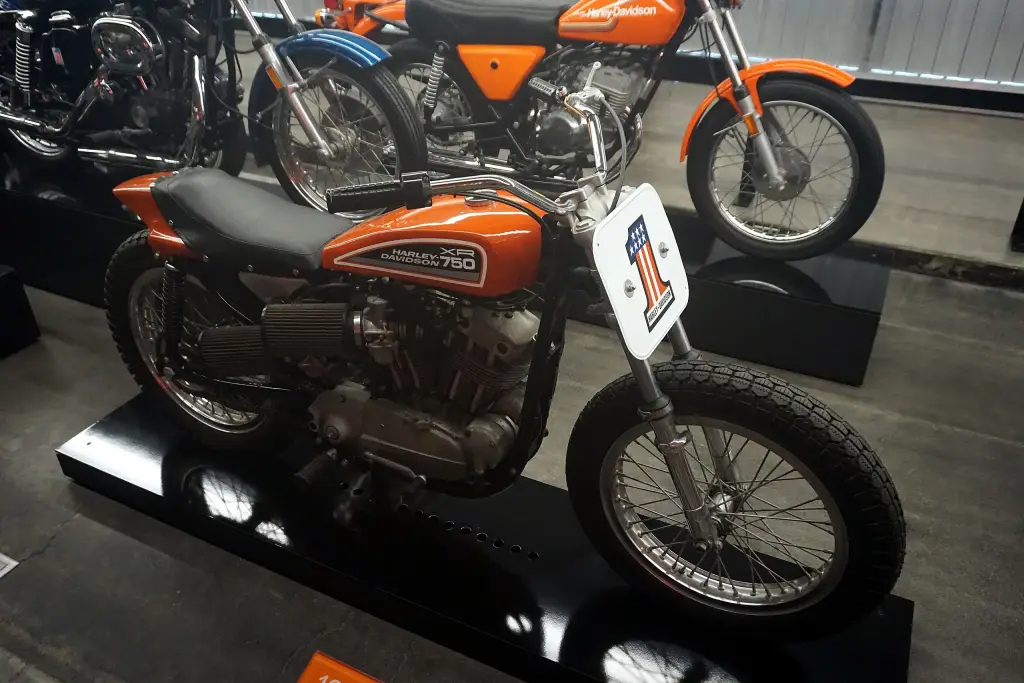
With little time and money in 1969, racing manager Dick O’Brien and his team modified the existing Sportster-based 900 cc XLR magneto race engine rather than starting again: the same iron heads and cylinders with a much shorter stroke and shorter connecting rods brought it to the 750 cc limit. These iron-head XR-750s of 1970 and 1971 were nicknamed waffle irons because they overheated, and they lacked power. The engine was redesigned for 1972 with an all-aluminium head and cylinder package, a bigger bore and a shorter stroke. The frame and running gear came from the KRTT racer with a Ceriani front fork and two Girling rear shocks, the fuel tank, mudguards and seat unit were glassfibre, and 200 examples were made for homologation at 3,200 dollars.
The engine cases split vertically and formed four cavities: a centre front crankcase, a centre rear gearbox, a right-hand gearcase for the timing train with its four camshafts and a left-hand cavity for the three-row primary chain. Four camshafts had also been used on the KR racers, inherited from the side-valve WL and the 1929 Model D: a single camshaft is cheaper and quieter, but four give more freedom in cam timing and a straighter pushrod path. The XRTT road racer used an aluminium oil tank, a 23-litre glassfibre tank and a fairing with extra heat shielding for the rider’s left leg, two 36 mm Mikuni carburettors, tuned dual reverse-cone exhausts and a Smiths tachometer. Unlike the dirt tracker it had brakes, a rear disc and, at the front, a Fontana four-leading-shoe drum, the last competition motorcycle with drum brakes. Official power was never published; estimates run from the high seventies for the early 1972 engines to about 100 hp by 2008. Riders on XR-750s won 29 of the 37 AMA Grand National Championships from 1972 to 2008, and the model is associated with Mark Brelsford, Cal Rayborn and Jay Springsteen.
Design and features
- Racing only: a factory dirt track machine, not a road motorcycle.
- Aluminium top end from 1972: the fix for the overheating iron-head engines.
- Four camshafts: a layout inherited from the KR, the WL and the 1929 Model D.
- XRTT road racer: fairing, road brakes and the last drum-braked competition bike.
Harley-Davidson XR-750 versions
- Iron-head XR-750 (1970–1971): the first version, nicknamed the waffle iron.
- Aluminium XR-750 (from 1972): the redesigned engine with a bigger bore and shorter stroke.
- XRTT: the road racing version with a fairing, a rear disc and a Fontana drum front brake.
- Homologation bikes: 200 examples offered to private riders at 3,200 dollars.
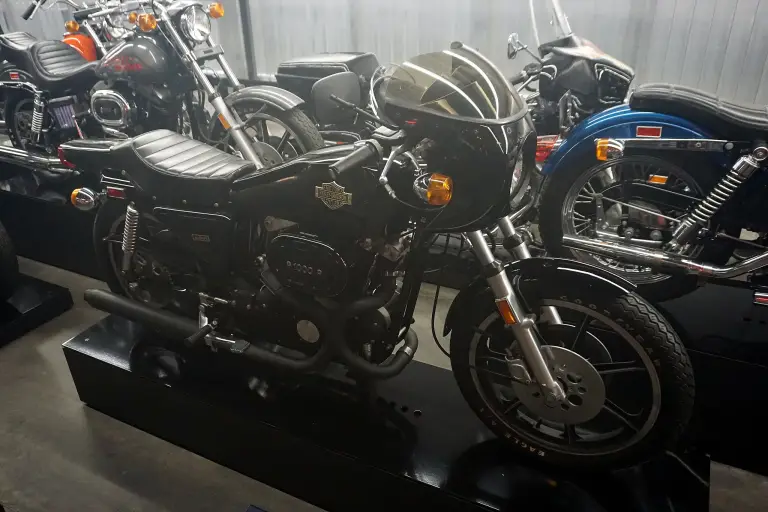
The road-going Sportster family the XR-750 grew out of is described in the article on the Sportster, the café racer that borrowed its tank in the article on the XLCR, and the road-going racing V-twin that followed in the article on the V-Rod. More are in the collection.
Sources
- Harley-Davidson XR-750, English Wikipedia: rules, development, XRTT, racing record
- Harley-Davidson Sportster, English Wikipedia: XR-750 versions in the Sportster line