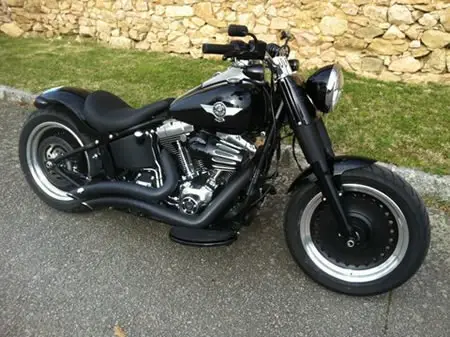
The Harley-Davidson Fat Boy is a V-twin Softail cruiser with solid-cast disc wheels. Willie G. Davidson and Louie Netz designed it, a prototype was built for Daytona Bike Week in 1988 and 1989, and the model has been in production since 1990.
Harley-Davidson Fat Boy at a glance
| Production | since 1990 |
|---|---|
| Designers | Willie G. Davidson and Louie Netz |
| Model codes | FLSTF from 1990 to 2017, FLFB and FLFBS from 2018 |
| Frame | Softail, with hidden rear suspension |
| Wheels | solid-cast disc wheels |
| Engine 2000 | Twin Cam 88, 1,450 cc |
| Engine 2007 | 1,584 cc, six-speed gearbox |
| Engine 2012 | Twin Cam 103, 1,690 cc |
| Engine 2018 | Milwaukee-Eight 107 (1,746 cc) and 114 (1,868 cc) |
| Engine 2025 | Milwaukee-Eight 117 |
| Low seat version | Fat Boy Lo FLSTFB of 2010 |
| Anniversaries | 15th in 2005, 30th in 2020, 35th Grey Ghost in 2025 |
History of the Harley-Davidson Fat Boy
In the mid-1970s the mechanical engineer Bill Davis designed and built a predecessor of the Softail and patented it in 1976. He sold the patents, the prototype and the tooling to Harley-Davidson in January 1982, and the Fat Boy became one of many models built on the Softail frame. Harley-Davidson built a prototype in Milwaukee for the Daytona Bike Week rally in 1988 and 1989, and production began in 1990. The name has nothing to do with the wartime atomic bombs, a story the company has debunked: it simply describes how wide the motorcycle looks when seen head-on. After 1994 the exhaust was made seamless, and in 1996 the master cylinder and switch gear were revised.
A new 1,450 cc Twin Cam engine arrived for the 2000 model year with a bespoke variant and frame changes, bullet-style indicators, an alarm and an immobiliser followed in 2002, and 2005 brought a 15th Anniversary version with a Screamin’ Eagle engine, special paint and custom wheels. Displacement rose to 1,584 cc in 2007 with a six-speed gearbox, the 2010 Fat Boy Lo had the lowest seat height ever offered by Harley-Davidson, and in 2012 the 1,690 cc Twin Cam 103 came in with the rest of the Softail range.
The 2018 Fat Boys have a redesigned Softail frame with Showa front and rear suspension and the new twin-counterbalanced Milwaukee-Eight engines in 107 and 114 cubic inch form, a modified swingarm with a rear monoshock under the seat, an LED headlight and 18-inch Lakester rims with 160 mm front and 240 mm rear tyres. For 2020 only the 114 was offered, together with a 30th Anniversary edition, and for 2025 the model received the Milwaukee-Eight 117, a reworked rear suspension and new wheels, while a limited serialised run of 1,990 Grey Ghost bikes marked 35 years. The Fat Boy is one of Harley-Davidson’s best-selling models and became part of American popular culture after appearing in Terminator 2: Judgment Day; one of the bikes used in the film is in the Harley-Davidson Museum.
Design and features
- Solid disc wheels: the cast wheels that define the model’s look.
- Softail frame: a rigid-looking chassis with the rear suspension hidden beneath it.
- Wide stance: the model’s name comes from how broad it looks from the front.
- Steady modernisation: Twin Cam, then Milwaukee-Eight engines, new frames and Showa suspension.
Harley-Davidson Fat Boy versions
- FLSTF (1990–2017): the original Softail Fat Boy.
- 15th Anniversary (2005): Screamin’ Eagle engine, special paint and custom wheels.
- Fat Boy Lo FLSTFB (2010): the lowest seat height Harley-Davidson had offered.
- FLFB and FLFBS (2018): the new frame with the 107 and 114 engines.
- Grey Ghost (2025): 1,990 serialised bikes for the 35th anniversary.
The frame the Fat Boy is built on is described in the article on the Softail, the large-frame touring line in the article on the FL, and the engine in the article on the Twin Cam. More models are in the Harley-Davidson collection.
Video: Harley-Davidson Fat Boy Special
Video by Lucasse99 on YouTube.
Sources
- Harley-Davidson Fat Boy, English Wikipedia: design, history, engines, versions
- Harley-Davidson Fat Boy, French Wikipedia: development, versions, popular culture