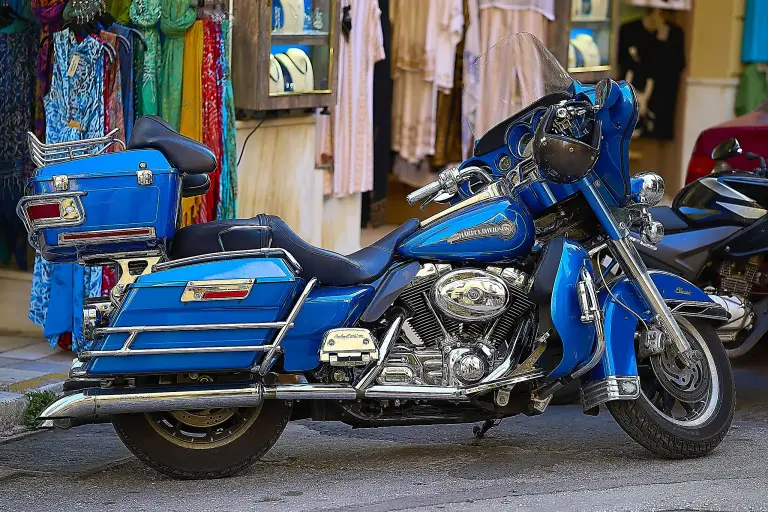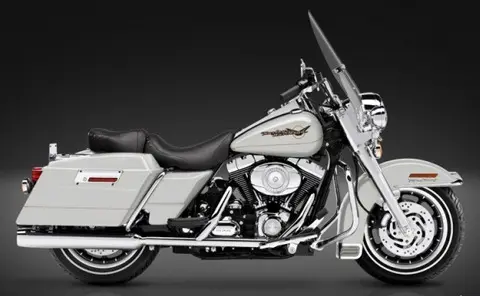
The Road King is the Harley-Davidson touring model that does without the bat-wing fairing. Introduced in 1994 as the FLHR, it has a big chrome nacelle around the headlamp and a quickly detachable windscreen, and it is the heir of the FL Hydra-Glide of 1949.
Harley-Davidson Road King at a glance
| Production | since 1994 |
|---|---|
| First model | FLHR Road King, Evolution 1,340 cc, carburettor |
| Electronic injection | FLHRI from 1996 |
| Classic version | FLHRC from 1998, with vinyl saddlebags, wire wheels and whitewall tyres |
| Twin Cam 88 | from 1999, 1,450 cc |
| Custom version | FLHRSI from 2004 to 2007 |
| Twin Cam 96 | from 2007, 1,580 cc, six speeds, air-adjustable rear suspension |
| 2008 update | Brembo ABS option, six-gallon tank, electronic throttle |
| 2009 update | new frame, 17-inch front and 180-section rear wheel |
| Twin Cam 103 | optional from 2011 |
| Milwaukee-Eight 107 | from 2017, with a 49 mm Showa fork |
| All-black version | Road King Special from 2017 |
The English Wikipedia has no separate Road King article; this page is based on the Italian article on the model and the English article on the FL.
History of the Harley-Davidson Road King
The FLHR Road King was introduced in 1994 with the carburettor Evolution engine of 1,340 cc. Two years later the range gained an electronic-injection version, the FLHRI, still with the same engine. In 1998 a third choice appeared, the FLHRC, where the C stands for Classic: semi-rigid vinyl-covered saddlebags, wire-spoked rims and whitewall tyres. The Evolution was replaced by the Twin Cam 88 of 1,450 cc in 1999.
The FLHRSI Road King Custom of 2004 brought a lowered rear suspension, a beach-bar handlebar turned towards the rider, a new nacelle with a chrome eyebrow, simpler vinyl saddlebags, bullet indicators on the bars and no passing lamps. For 2007 the engine became the injected Twin Cam 96 with a six-speed gearbox and air-adjustable rear suspension, and the carburettor disappeared from the range for good. In 2008 the Custom version was dropped, Brembo brakes with ABS became an option, the tank grew from five to six gallons, the throttle became electronic and an isolated drive system was fitted to reduce vibration.
The frame was completely redesigned for 2009, with 2-into-1-into-2 exhausts, a 180-section rear tyre and a 17-inch front wheel, and the new chassis raised the payload by 31 kg. The Twin Cam 103 of 1,690 cc became an option in 2011, the Project RUSHMORE update with Brembo Reflex ABS arrived in 2014, and for 2017 the Milwaukee-Eight 107 replaced the Twin Cam, together with a 49 mm Showa SDBV fork and new wheels. That year also brought the Road King Special, finished entirely in black, without the auxiliary lamps and with a mini-ape handlebar.
Design and features
- Chrome nacelle: the large headlamp shell that gives the Road King its retro face.
- Removable windscreen: quick-release fittings instead of a fixed fairing.
- Tank-mounted console: instruments set into the fuel tank, unlike other touring models.
- Touring comfort: the size and equipment of the whole Harley-Davidson touring family.
Harley-Davidson Road King versions
- FLHR (1994): the original carburettor Road King with the Evolution 1340.
- FLHRI (1996): the first injected version.
- FLHRC Classic (1998): vinyl saddlebags, wire wheels and whitewall tyres.
- FLHRSI Custom (2004–2007): lowered rear end, beach bar, no passing lamps.
- Road King Special (2017): all-black finish with a mini-ape handlebar.
- Milwaukee-Eight models (2017 onwards): the current 107-cubic-inch generation.
The Electra Glide, the fairing version of the same touring line, is described in the article on the Electra Glide; the FL family behind both is in the article on the Harley-Davidson FL, and the engine in the article on the Twin Cam. More models are in the collection.
Video: Harley-Davidson Road King Classic
Video by hitmhard on YouTube.
Sources
- Harley-Davidson Road King, Italian Wikipedia: model history year by year
- Harley-Davidson FL, English Wikipedia: place in the FL line