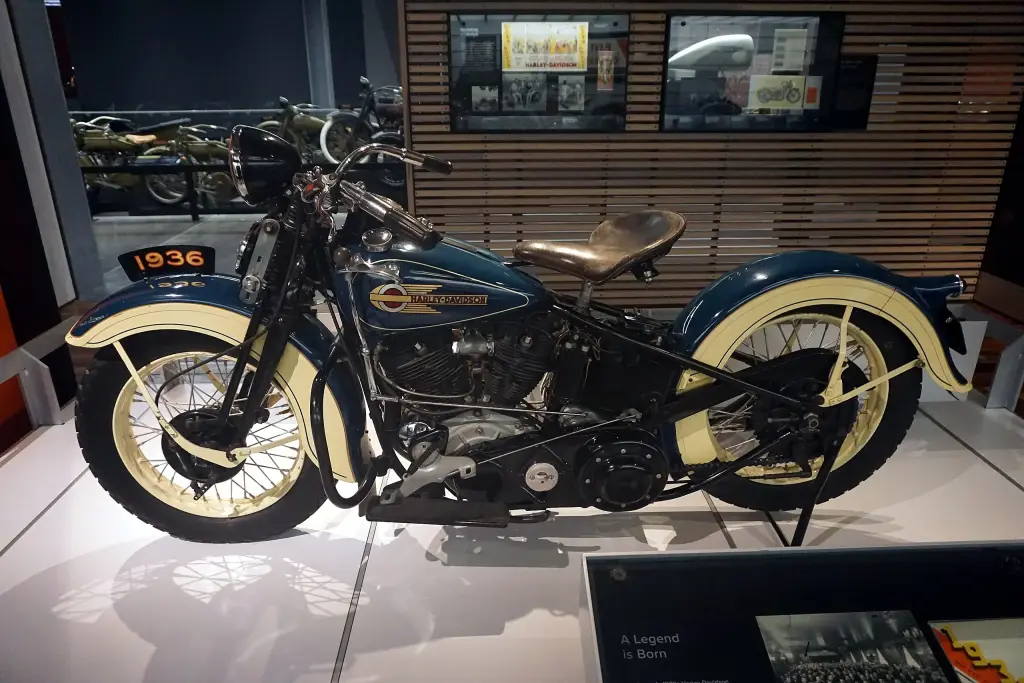
The Knucklehead is the name enthusiasts gave, decades later, to the first Harley-Davidson motorcycle engine with overhead valves. Introduced in 1936, it turned the company’s V-twin from a side-valve design into an overhead-valve one and set the pattern that Harley-Davidson engines still follow.
Harley-Davidson Knucklehead at a glance
| Introduced | 1936 |
|---|---|
| Name | a retronym, from the shape of the rocker boxes |
| First version | Model E, 61 cu in (1,000 cc) |
| Versions at launch | E, ES for sidecar use, EL for high-octane fuel |
| Power of the EL | 40 hp |
| Bigger versions | F and FL, 74 cu in (1,200 cc), 48 hp, from 1941 |
| Layout | 45-degree V-twin, two overhead valves per cylinder, pushrods |
| Lubrication | dry sump with a horseshoe oil tank above the gearbox |
| Speed record | 136.183 mph by Joe Petrali at Daytona Beach in 1937 |
| Replaced by | Panhead engine, from 1948 |
| Built | about 41,000 in total; over 11,000 in 1947 alone |
The EL of the old gallery was the high-compression Knucklehead model, so that record now redirects here.
History of the Harley-Davidson Knucklehead
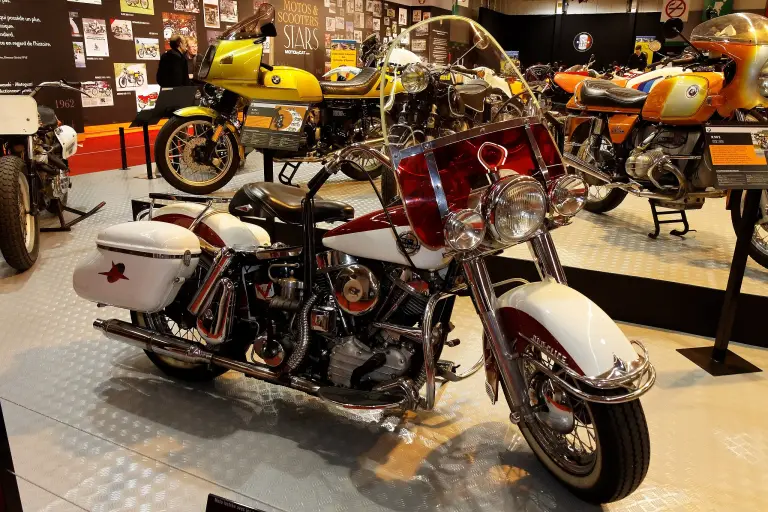
The new type was introduced in 1936 with 61 cubic inches (1,000 cc) as the Model E, the ES with sidecar fittings and the EL for higher-octane leaded petrol with an impressive 40 hp. Until then Harley-Davidson had offered flathead engines in two sizes since 1929, the VL being the top of the range with its total-loss oiling and side valves; the overhead-valve design hung the valves over the piston for a compact combustion chamber. Although they were actuated by long pushrods, the overhead valves allowed higher engine speeds, and the taller engine required a new frame and a dry-sump lubrication system with a horseshoe-shaped oil tank above the gearbox and under the seat, hiding the battery.
The potential of the design was shown in 1937 on the sand at Daytona Beach, where Joe Petrali set a world motorcycle speed record of 136.183 mph on an experimental streamlined 61-cubic-inch overhead-valve Model E. In the first years Harley-Davidson sold about 2,000 of the new high-performance models a year, because police, mail service, military and other government agencies still preferred the established designs. The company answered that demand with the hybrid U, UL and ULH models, which used the new frame and dry-sump lubrication but kept the simpler side-valve top end, since the overhead-valve cylinder heads had early trouble with lubrication and overheating.
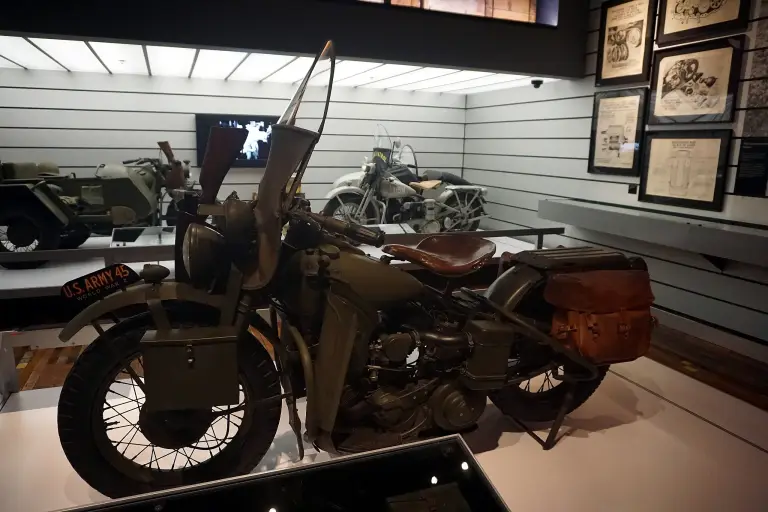
In 1941 the overhead-valve range was expanded by the 74-cubic-inch F and FL, but the war then required large numbers of simple flathead machines, the 45-cubic-inch WLA for the US Army being the most numerous, followed by the WLC variants for Canada. After the war shortages still limited production while imported European models with telescopic forks and rear suspension challenged the remaining American makers. The side-valve Model U outlived the Knucklehead and was still offered in 1948; the Knucklehead had its best year in its last, 1947, when more than 11,000 of a total of about 41,000 were made. For 1948 the E, EL, F and FL were changed to the Panhead engine.
Design and features
- Overhead valves: the first Harley-Davidson V-twin with valves above the piston, in 1936.
- Dry sump: a horseshoe oil tank above the gearbox replaced the wet sump of the flatheads.
- Rocker-box shape: the covers that reminded owners of a fist gave the engine its later nickname.
- Model E and EL: 61 cubic inches, 40 hp in high-compression form.
Harley-Davidson Knucklehead versions
- E (1936): the standard 61-cubic-inch overhead-valve model.
- ES: the version prepared for sidecar use.
- EL (1936–1952): higher compression for high-octane leaded petrol, 40 hp.
- F and FL (from 1941): 74 cubic inches and 48 hp, the start of the FL designation.
- U, UL and ULH: the hybrid models with the new frame but side-valve top ends.
The engine that followed the Knucklehead is described in the article on the Panhead, the model that carried the FL designation in the article on the FL, and the side-valve engines that came before in the article on the flathead. More machines are in the Harley-Davidson collection.
Video: 1946 Harley-Davidson Knucklehead cold start
Video by MrClassicMotorcycle on YouTube.
Sources
- Harley-Davidson Knucklehead engine, English Wikipedia: history, models, production, record