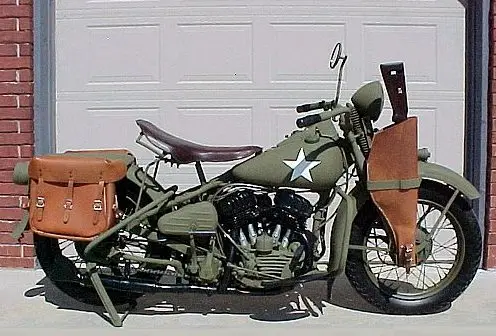
The flathead was the first type of engine Harley-Davidson built. The founders made small side-valve singles by hand and fitted them to bicycles in the wooden barn in Milwaukee, and the same layout later served the W Big Twin of 45 cubic inches, listed in the factory engine line as the flathead of the range.
Harley-Davidson flathead at a glance
| Engine type | side-valve (flathead) V-twin, air-cooled |
|---|---|
| First Harley engines | small single-cylinder flatheads, 1903 |
| Design basis | the French De Dion-Bouton engine |
| First V-twin | 1909 |
| Flathead Big Twin | W, 45 cu in (737 cc) |
| Later Big Twin sizes | Knucklehead and Panhead 60 and 74 cu in; Shovelhead 74 and 80 cu in |
| Even later sizes | Evolution 82 cu in; Twin Cam 88 to 103 cu in; Milwaukee-Eight 107 to 117 cu in |
| First workshop | a wooden barn 10 by 10 feet in Milwaukee, from 1901 |
| Engines built today | Pilgrim Road Powertrain Operations, Menomonee Falls, Wisconsin |
The flathead is described in a section of the English Wikipedia engine timeline; this page uses that section together with the article on the FL for the end of the U and UL twins.
History of the Harley-Davidson flathead
Harley-Davidson engines have been made since 1903, when the founders began building small flathead motorcycle engines individually by hand and fitting them to bicycles in the 10-by-10-foot wooden barn that served as the workshop of the time. That first engine was a single cylinder based on the French De Dion-Bouton internal combustion engine, and the company was soon committed to its own proprietary designs.
By 1909 the first Harley-Davidson V-twin had been designed and built, setting the template that the company has followed ever since. In the factory list of Big Twin engines the flathead is the entry: the W of 45 cubic inches, or 737 cc, sits before the Knucklehead and Panhead of 60 and 74 cubic inches, the Shovelhead of 74 and 80, the 82-cubic-inch Evolution, the Twin Cam and the Milwaukee-Eight.
The side-valve layout kept its place in the range long after overhead valves arrived. The larger 74-cubic-inch flathead twins, the U and UL, were built on the same frame as the overhead-valve EL and FL and were only dropped in 1948, when the overhead-valve models became Harley-Davidson’s large-frame machines. Production has since moved from the original Milwaukee workshop to the Pilgrim Road Powertrain Operations plant in Menomonee Falls, Wisconsin.
Design and features
- Side valves: the valves sit beside the piston rather than above it, the layout with which the company started in 1903.
- From singles to a V-twin: the hand-built singles of 1903 led to the first V-twin in 1909.
- The W Big Twin: the flathead of the factory engine line, 45 cubic inches or 737 cc.
- Long service: flathead Big Twins were still being built in 1948, twelve years after the first overhead-valve Harley.
Harley-Davidson flathead versions
- Early flathead singles (1903 onwards): hand-built engines based on the De Dion-Bouton design.
- W (45 cu in / 737 cc): the flathead Big Twin named in the factory engine list.
- U and UL (74 cu in): the last flathead Big Twins, built on the EL and FL frame and dropped in 1948.
- Military derivatives: the WL and WLA side-valve twins of the Second World War years.
The wartime side-valve model has its own page: the WLA. The overhead-valve engine that replaced the flathead Big Twins is described in the article on the Knucklehead, and the touring line that grew out of it in the article on the FL. More machines are in the Harley-Davidson collection.
Video: 1948 Harley-Davidson WL Flathead
Video by pigeonfarmboy on YouTube.
Sources
- Harley-Davidson engine timeline, English Wikipedia: first engines, V-twin, Big Twin sizes
- Harley-Davidson FL, English Wikipedia: end of the U and UL flathead twins