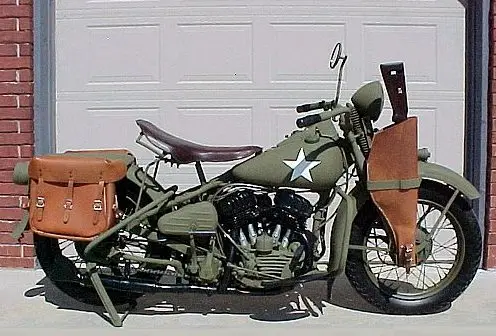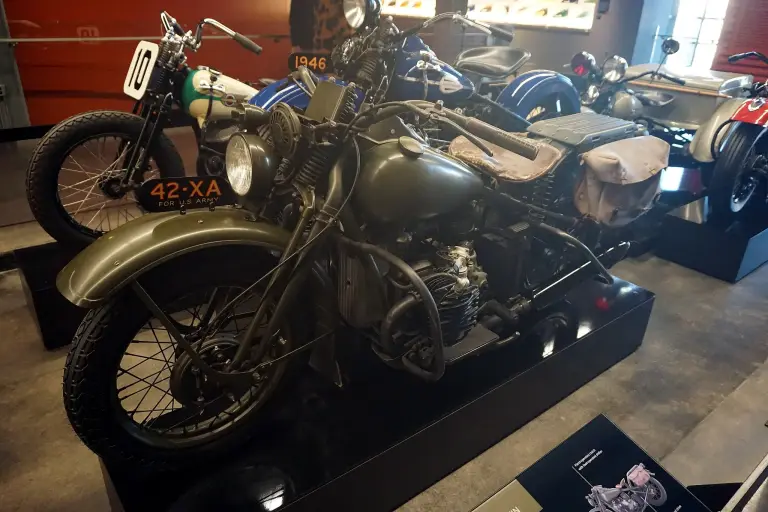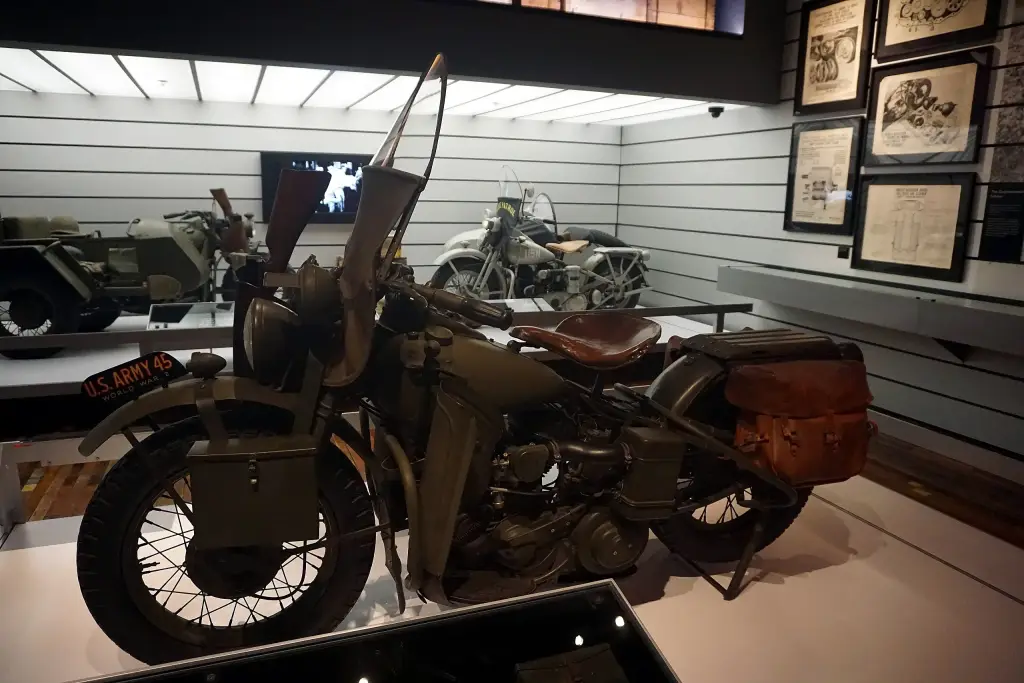
The Harley-Davidson WLA is the military motorcycle built to US Army specification during and around the Second World War. It was based on the civilian WL flathead, and the model code reads W for the 45-cubic-inch family, L for high compression and A for Army; in Europe it was nicknamed the Liberator.
Harley-Davidson WLA at a glance
| Production | from 1940, resumed 1949–1952 for the Korean War |
|---|---|
| Based on | civilian WL |
| Engine | 45 cu in (740–750 cc) side-valve V-twin |
| Compression | about 5:1, to run on low-grade fuel |
| Electrical system | 6 volts |
| Gearbox | three speeds, foot or hand shift depending on series |
| Tyres | Firestone Sportsman 4.00-18 |
| Canadian version | WLC, with foot shift and hand clutch and Canadian blackout lighting |
| Numbers | about 56,000 WLA in the war, about 70,000 WLA and WLC together |
| Soviet Union | about 30,000 delivered under Lend-Lease |
| Serial numbers | all post-Pearl Harbor machines marked as 1942, the 42WLA |
| Small variants | WLH of 1950 for the Dutch military police, WLJ of 1951 |
The article covers the WL and WLC records of the old gallery, which are the civilian and Canadian versions of the same 45-cubic-inch machine and now redirect here.
History of the Harley-Davidson WLA
Harley-Davidson began building the WLA in small numbers in 1940 as part of a general military expansion, and production rose sharply once the United States entered the war, with about 56,000 built during it, plus spare parts equivalent to many more. The company also built a close variant for the Canadian Army, the WLC, which differed chiefly in using some heavier big-twin components and Canadian blackout lighting, and supplied smaller numbers to Britain, South Africa and other allies as well as the US Navy and Marine Corps. Unusually, every WLA built after Pearl Harbor was given a serial number showing 1942 production whatever its actual year, so wartime machines are known as 42WLAs; about 20,000 WLCs were built in 1942 and 1943, marked 42WLC or 43WLC.
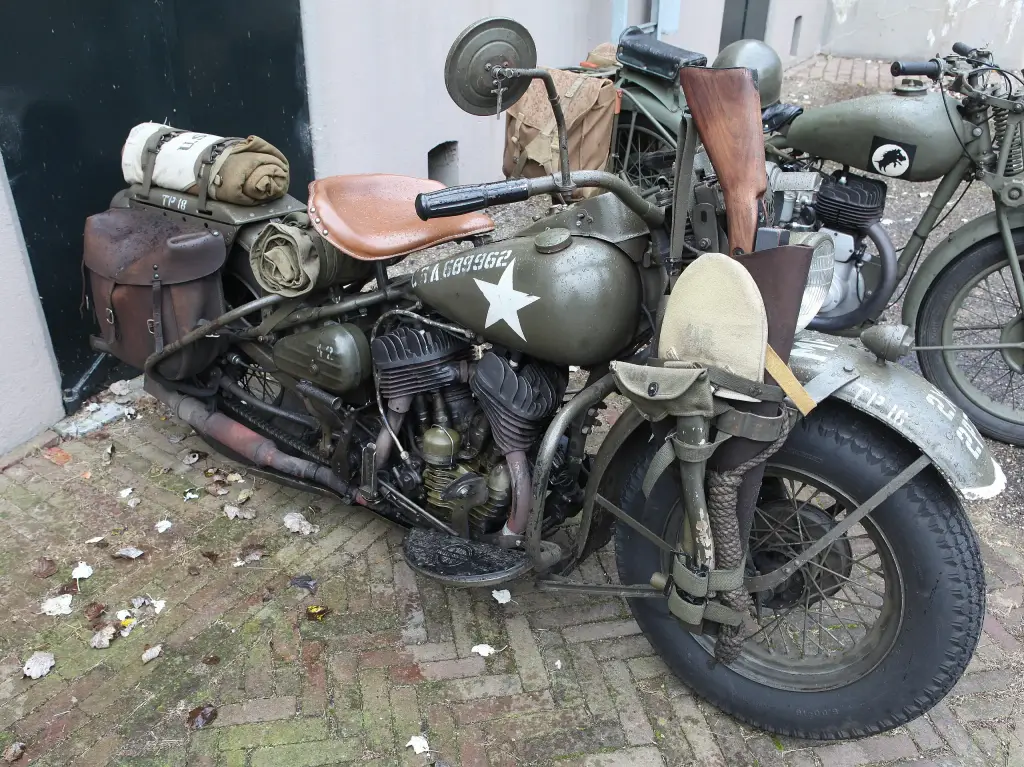
Many WLAs went to allies under Lend-Lease, the largest recipient being the Soviet Union, which received about 30,000. Production stopped after the war and was revived in small numbers for the Korean War between 1949 and 1952. Two further variants were built in those years: the 1950 WLH for the Dutch military police, a cross between the 1950 WL and the 1943 WLC of which 100 were ordered, and the 1951 WLJ for Indonesia, of which fewer than 100 were probably made. After the war most WLAs in Western hands were sold as surplus and civilianised, and the cheap machines helped start the chopper movement and biker culture; many original WLAs survived in the Soviet Union, where there was no chopper culture and little access to parts, and Russia and other former Soviet countries are now a major source of them.
Compared with the civilian WL, the military machine had olive drab or black paint with chrome and nickel parts blued, parkerised or painted white, a second set of blackout head and tail lights, mudguard sides cut away to stop mud clogging, an oil-bath air cleaner from tractor practice, crankcase breather changes to reduce water intake when fording, and fittings for a heavy-duty luggage rack, ammunition box, leather Thompson submachine gun scabbard, skid plate and leg protectors. The 45-cubic-inch engine had a compression ratio of about 5:1 to run on poor fuel, the electrical system was 6 volts and the three-speed gearbox was shifted by foot or hand depending on the series, with a cable-operated front drum brake and a rod-operated rear one.
Design and features
- Military specification: blackout lights, cut-down mudguards, oil-bath air cleaner and fording changes.
- Low compression: about 5:1 so that it would run on whatever fuel was available.
- Accessories: racks, ammunition boxes, a Thompson scabbard, skid plate and leg protectors.
- Post-war legacy: cheap surplus WLAs became the raw material of the first choppers.
Harley-Davidson WLA versions
- WLA (from 1940): the US Army version, most of them marked as 1942 models.
- WLC: the Canadian version with foot shift, hand clutch and blackout lighting.
- WLH (1950): 100 machines for the Dutch military police.
- WLJ (1951): fewer than 100 built for Indonesia.
- Korean War batches (1949–1952): a small revival of WLA production.
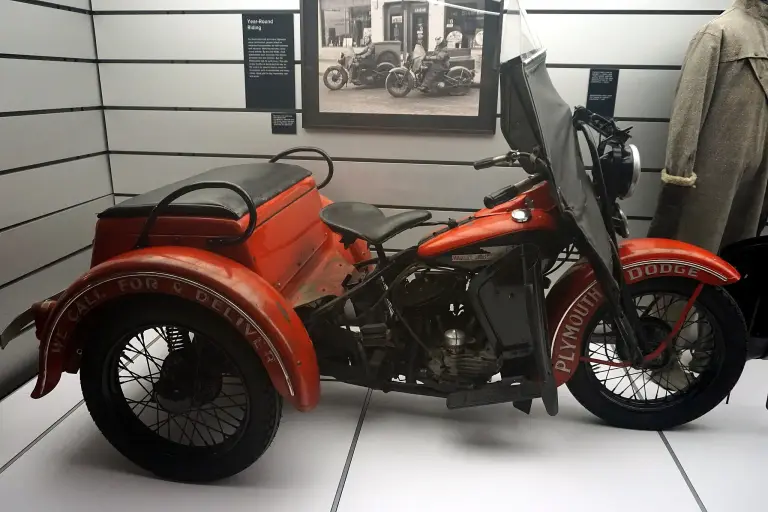
The civilian flathead engine the WLA used is described in the article on the Harley-Davidson flathead, the other wartime design in the article on the XA, and the three-wheeled utility machine of the same era in the article on the Servi-Car. More are in the collection.
Video: 1943 Harley-Davidson WLC
Video by RiE-Store on YouTube.
Sources
- Harley-Davidson WLA, English Wikipedia: designation, production, military changes, post-war use
- Harley-Davidson WLA, German Wikipedia: engine details, equipment, WLC differences, numbers