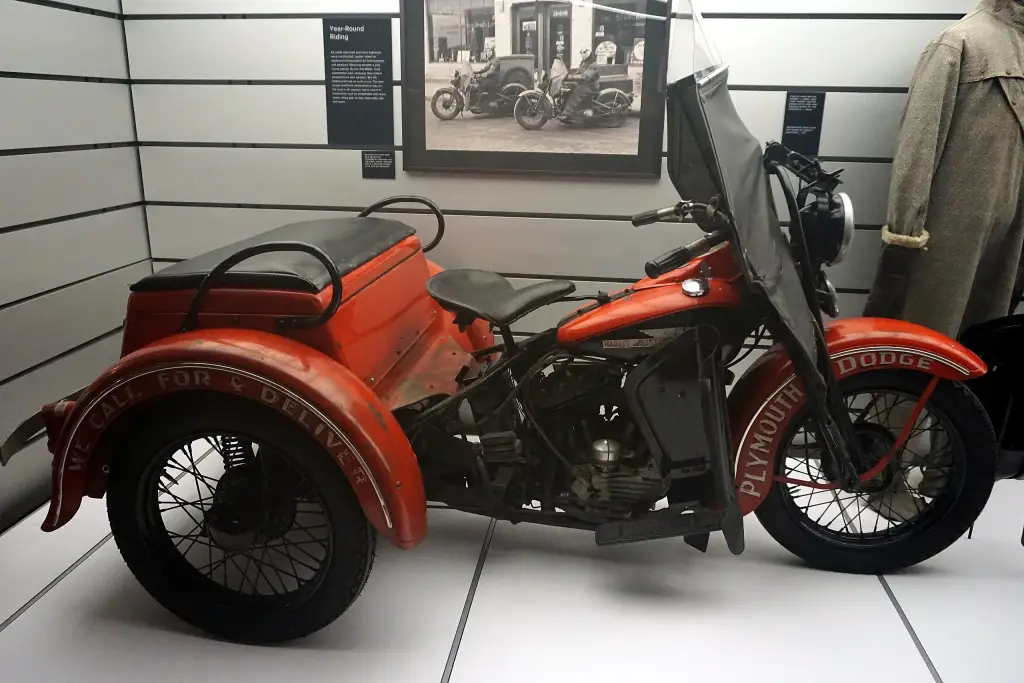
The Servi-Car is the three-wheeled utility motorcycle Harley-Davidson built from 1932 to 1973. It was aimed at garages that needed to deliver and collect customers’ cars, became a favourite of police forces, and stayed in production for 42 years, the longest run of any Harley-Davidson model.
Harley-Davidson Servi-Car at a glance
| Production | 1932–1973 |
|---|---|
| Longevity | 42 years, the longest production run of any Harley-Davidson |
| Purpose | car delivery and collection for garages, utility work, police patrol |
| Engine | 45 cu in flathead, the R engine until 1936, the W engine from 1937 |
| Electric starter | from 1964, the first on a civilian Harley-Davidson |
| Gearbox | three speeds and reverse from 1933 |
| Rear axle | rigid, with a differential, 42-inch (1,100 mm) track |
| Front forks | springer leading-link until 1957, Hydra-Glide forks from 1958 |
| Brakes | drums on all three wheels from 1937, hydraulic rear brake from 1951, discs on the last models |
| Body | steel box, standardised in 1942, fibreglass from 1966 |
| Tow bar | fitted as standard until 1963 |
| Output | about 1,000 a year; 1,159 in 1941 at 510 dollars each |
History of the Harley-Davidson Servi-Car
The Servi-Car was designed during the Great Depression, when Harley-Davidson was desperate to widen its product range. It was aimed at the automotive service trade, for help at roadside breakdowns and for delivering cars to customers, and for that reason it could be ordered with a tow bar at the front and a large 60 Ah battery. The tow bar was used to tow the Servi-Car behind a car, not the other way round: a driver took a customer’s car to its destination, unhitched the Servi-Car and rode it back to the garage, so one person could do the job. Beyond car delivery it was popular with small businesses and mobile vendors, and it proved particularly popular with police departments, some of which used Servi-Cars into the 1990s.
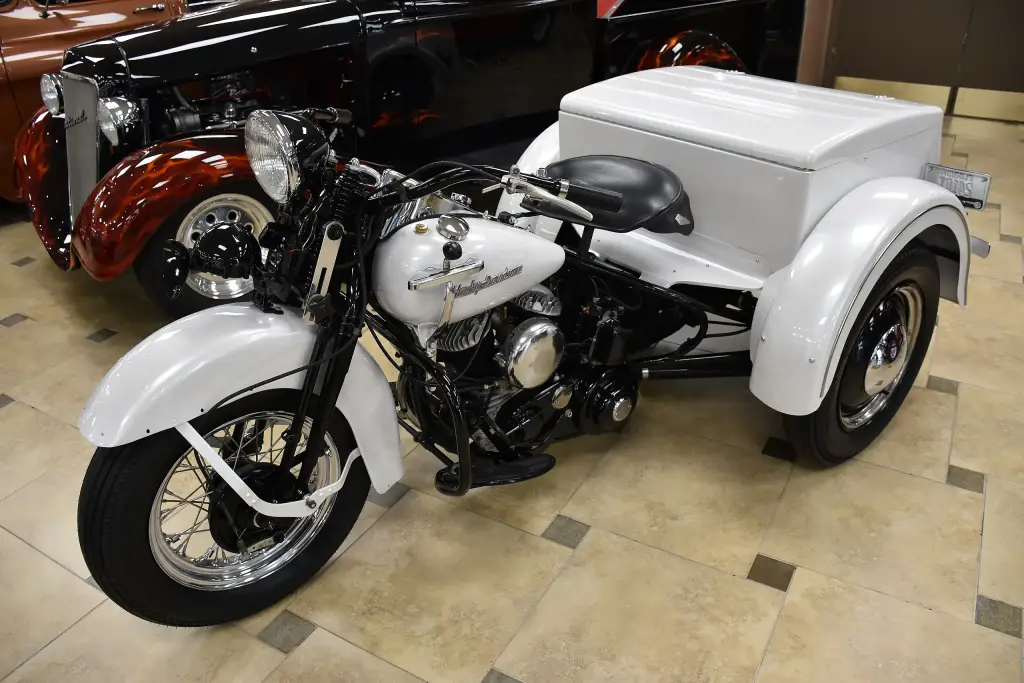
The first year’s range, in 1932, consisted of the G with a small box and a tow bar, the GA with a small box and no tow bar, the GD with a large box and no tow bar and the GE with a large box and an air tank; the GDT with a large box and tow bar followed in 1933. In 1942 the small and large boxes were replaced by a standard intermediate box made for Harley-Davidson by the Chas. Abresch Co. of Milwaukee, and that steel box lasted until 1966, when a fibreglass one took its place.
The Servi-Car used versions of Harley-Davidson’s 45-cubic-inch flathead. From 1932 to 1936 it had the engine of the solo R model, changed in 1937 to the W engine, which mainly differed in having a recirculating oil system instead of the constant-loss system of the R; the W flathead continued to the end of production in 1973, long after the W solo series had been replaced by the K series in 1952. An electric starter became available in 1964, making the Servi-Car the first civilian Harley-Davidson with one, a year before the Electra Glide. The chassis was built for the roads of the Depression, with a rigid rear axle and a differential and no rear suspension at all; a prototype with rear suspension was tested and found unstable. The front forks were springer leading-link units until 1957, and from 1958 the neck was altered to take Hydra-Glide forks. Braking improved step by step, from a drum at the front and one inside the rear axle housing to a drum on each wheel in 1937, a hydraulic rear brake in 1951 and disc brakes on all three wheels of the last machines.
Design and features
- Utility first: designed to carry a box and tow a car, not to be a motorcycle for pleasure.
- Longest run: 42 years in production, from 1932 to 1973.
- Electric starter in 1964: the first on any civilian Harley-Davidson.
- Police favourite: three-wheeled patrol machines stayed in service into the 1990s.
Harley-Davidson Servi-Car versions
- G and GA (1932): small box, with and without a tow bar.
- GD and GE (1932): large box, the GE with an air tank.
- GDT (1933): large box with a tow bar.
- Standard box models (1942–1965): the intermediate steel box by Chas. Abresch.
- Late models (1966–1973): fibreglass box, electric starter and finally disc brakes.
The flathead engine the Servi-Car used is described in the article on the Harley-Davidson flathead, the military version of the same engine family in the article on the WLA, and the first Harley with an electric starter in the touring line in the article on the Electra Glide. More machines are in the collection.
Video: Harley-Davidson Servicar 1966 test drive
Video by Old Motorcycles – Robert on YouTube.
Sources
- Harley-Davidson Servi-Car, English Wikipedia: concept, models, engine, chassis, brakes
- Harley-Davidson Servi-Car, German Wikipedia: production run, tow bar, output, colours