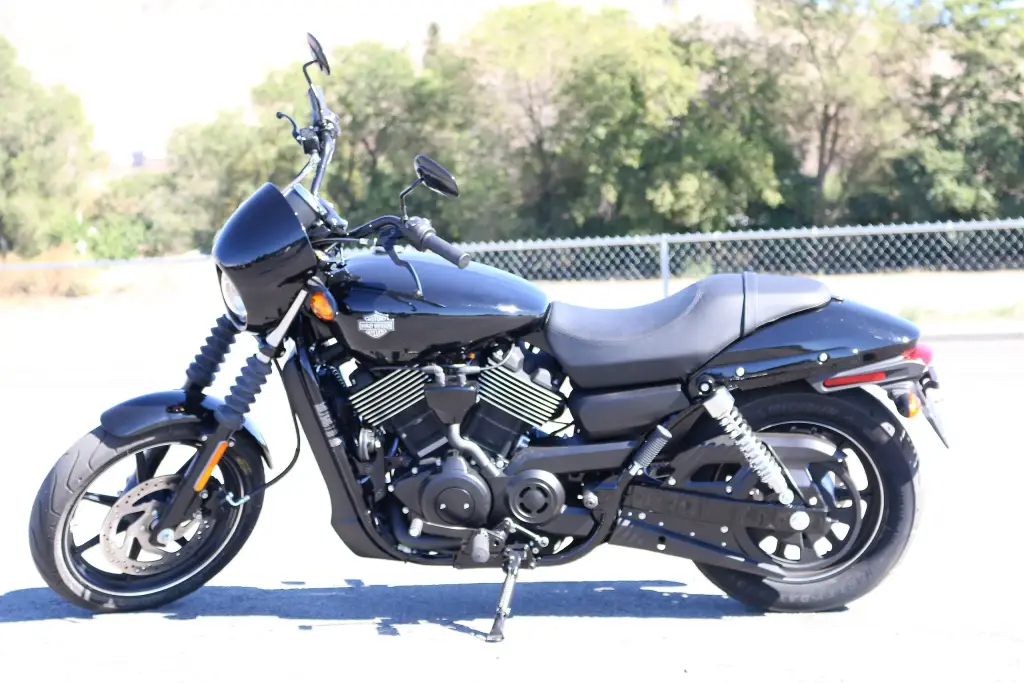
The Harley-Davidson Street series was announced at the 2013 EICMA show in Milan for 2014, the company’s first all-new models in 13 years and its first lightweight motorcycle since the 1974 Sprint. The Street 750 is powered by a water-cooled 60-degree Revolution X V-twin.
Harley-Davidson Street at a glance
| Announced | EICMA, Milan, 2013, for the 2014 model year |
|---|---|
| Street 750 engine | 749 cc water-cooled 60-degree V-twin, Revolution X |
| Street 500 engine | 494 cc, smaller bore, otherwise identical |
| Power in Europe | 43 kW (58 hp) at 8,000 rpm; 35 kW version for A2 licences |
| Bore and stroke | 85.5 x 66 mm |
| Chassis | double-cradle steel frame, 1,520 mm wheelbase |
| Suspension travel | 140 mm front, 90 mm rear |
| Tyres | 100/80 R 17 front, 140/75 R 15 rear |
| ABS | standard from 2017 |
| Weight and top speed | 229 kg, 170 km/h |
| Tank | 13 litres |
| Built in | Kansas City for the USA and Canada, Bawal in India for the rest of the world |
History of the Harley-Davidson Street
The Street series was announced at the 2013 EICMA show in Milan for introduction in 2014. It was Harley-Davidson’s first all-new model in 13 years and its first lightweight motorcycle since the 1974 Sprint. The 750 uses a 749 cc version of the 60-degree single-overhead-cam water-cooled Revolution engine called the Revolution X, while the Street 500 has a 494 cc engine with a smaller bore but is otherwise identical. Production for the United States and Canada is at Harley’s Kansas City facility, and production for the rest of the world, including the engines, is at the Harley-Davidson India subsidiary in Bawal with locally sourced components.
The Street models were positioned as Harley-Davidson’s entry-level machines, with the lowest price in the American range by over 1,200 dollars. In Germany the Street 750 was offered from 2014 to 2020, with a water-cooled 749 cc V-twin at a 60-degree cylinder angle, 43 kW (58 hp) at 8,000 rpm and a restricted 35 kW version for the A2 licence class. The chassis is a conventional double-cradle frame with a swingarm giving 90 mm of travel, a telescopic fork with 140 mm, belt final drive, a 1,520 mm wheelbase and a 13-litre tank; ABS has been standard since 2017. The model was withdrawn from the range as emissions rules tightened, and the Street 500 replaced the Buell Blast in Harley-Davidson’s rider training programme. For 2017 the company also released the Street Rod based on the 750, with a higher-output Revolution X engine, 43 mm inverted forks, piggyback rear shocks, drag-style bars and 17-inch wheels, aimed at machines such as the Yamaha FZ-07.
Design and features
- Revolution X engine: water-cooled, 60-degree V-twin, a first for a Harley street model.
- Entry price: the cheapest machine in Harley-Davidson’s American range by over 1,200 dollars.
- Indian production: built in Bawal for markets outside North America.
- Rider training: the Street 500 took over from the Buell Blast in the riding programme.
Harley-Davidson Street versions
- Street 750 (2014): the 749 cc version for most markets.
- Street 500 (2014): the 494 cc version, mainly for the USA, Canada and training schools.
- Street Rod (2017): a sportier derivative with inverted forks, piggyback shocks and 17-inch wheels.
The big touring Harley-Davidson of the same period is described in the article on the Road King, the engine family in the article on the Evolution, and another small Harley from the Italian years in the article on the M-50. More machines are in the collection.
Video: 2014 Harley-Davidson Street 750 first ride
Video by Motorcycle USA on YouTube.
Sources
- Harley-Davidson Street, English Wikipedia: launch, engines, production sites, Street Rod
- Harley-Davidson Street 750, German Wikipedia: European specification, chassis, dimensions